<?xml version="1.0" encoding="utf-8"?>
<feed xmlns="http://www.w3.org/2005/Atom">
    <title>Torchlight</title>
    <link rel="alternate" type="text/html" href="https://www.sallan.org/Torchlight/" />
    <link rel="self" type="application/atom+xml" href="https://www.sallan.org/Torchlight/atom.xml" />
   <id>tag:www.sallan.org,2020:/Torchlight//18</id>
    <link rel="service.post" type="application/atom+xml" href="http://www.sallan.org/movabletype/mt-atom.cgi/weblog/blog_id=18" title="Torchlight" />
    <updated>2020-07-02T21:45:58Z</updated>
    <subtitle>Torchlight articles are written by NA the Executive Director of the Sallan Foundation</subtitle>
    <generator uri="http://www.sixapart.com/movabletype/">Movable Type 3.2</generator>
 
<entry>
    <title>What&apos;s The Rush?</title>
    <link rel="alternate" type="text/html" href="https://www.sallan.org/Torchlight/2020/06/whats_the_rush.php" />
    <link rel="service.edit" type="application/atom+xml" href="http://www.sallan.org/movabletype/mt-atom.cgi/weblog/blog_id=18/entry_id=22010" title="What's The Rush?" />
    <id>tag:www.sallan.org,2020:/Torchlight//18.22010</id>
    
    <published>2020-06-08T11:57:56Z</published>
    <updated>2020-07-02T21:45:58Z</updated>
    
    <summary><![CDATA[It's spreading fast &mdash; the idea that rush hour on NYC mass transit has got to go for NYC to start up again and get back its mojo. Sounds right to me. But the end of rush hour means quickly moving the city in a direction never before conjured up even in utopian fever dreams.]]></summary>
    <author>
        <name>Nancy Anderson, Ph.D.</name>
        
    </author>
    
    <content type="html" xml:lang="en" xml:base="https://www.sallan.org/Torchlight/">
        <![CDATA[<p>
It's spreading fast &mdash; the idea that rush hour on NYC mass transit has got to go for NYC to start up again and get back its mojo. Sounds right to me. But the end of rush hour means quickly moving the city in a direction never before conjured up even in utopian fever dreams. Here are eight ideas culled from the current  buzz and my own feverish brain for reviving the city. Some could be relatively short term and could end when science finds a cure for COVID 19 and develops a universally accessible vaccine to prevent its future contagion. Other no more rush hour changes should be permanent because they will contribute to the end of auto dependency, clean up NYC's air, cut our carbon emissions and foster a city that doesn't rely on always-expensive and thus always-inequitable car ownership.
</p>
]]>
        <![CDATA[<p>
<figure>
  <img class="img-responsive" src="/images/Torchlight-NYC-Subway-Preparation-for-Phase-One-Reopening.jpg" width="1200" height="800" alt="MTA New York City Transit staff on Sunday, June 7 prepared for the the subway's safe return as New York City begins Phase 1 reopening on Monday, June 8, 2020">
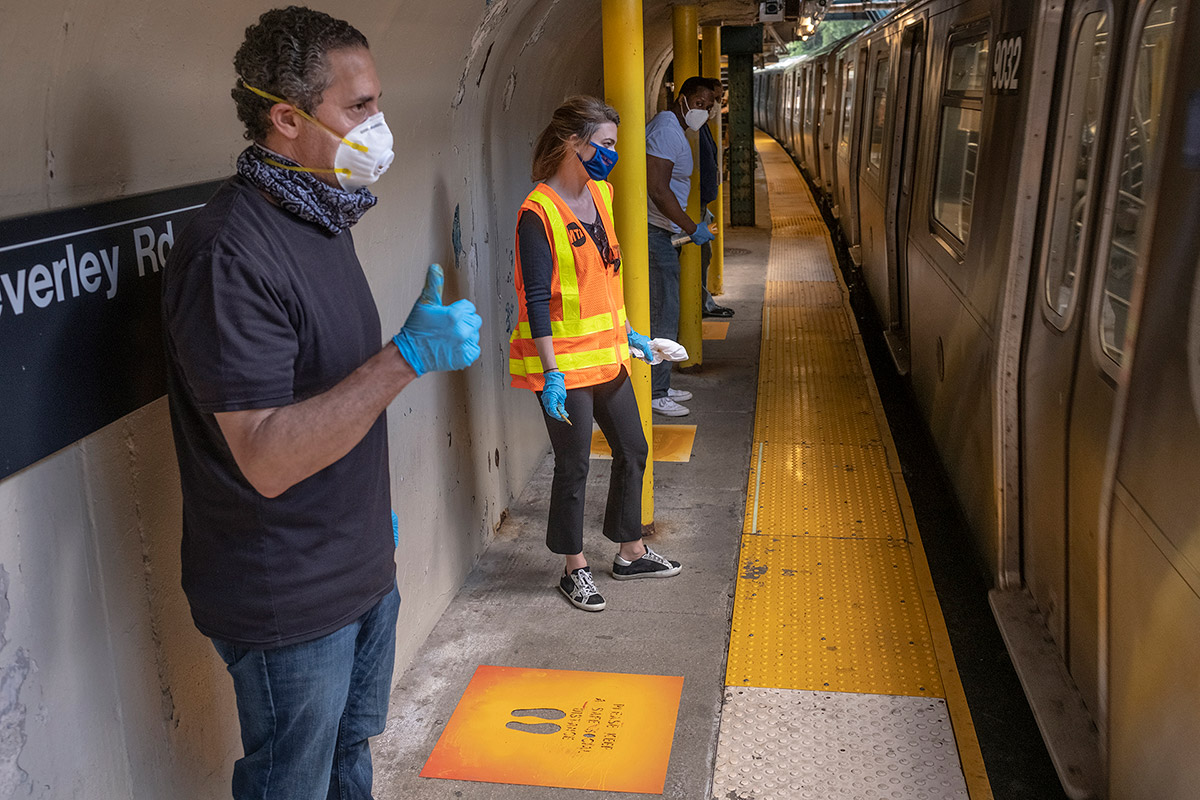
  <figcaption>Photo: MTA New York City Transit staff on Sunday, June 7 prepared for the the subway's safe return as New York City begins Phase 1 reopening on Monday, June 8. Photo Credit: MTA New York City Transit / Patrick Cashin</figcaption>
</figure>
</p>

<ol>
	<li><h4>End free on-street parking</h4>It's time to free up public space to support a permanent NYC no more rush hour. If street parking isn't entirely ended, establish concentrated areas for on street parking and set permit fees at levels comparable to what private garages charge. This will raise much needed revenue that should go to support the options spelled out here for changing the rules of the road. The City can kick off this bold move by surveying residents with small businesses that require the use of small trucks or utility vehicles and consult with them about workable alternatives to free on street parking. Handicapped New Yorkers who rely on cars should also be surveyed.</li>

	<li><h4>Work-Time Flex</h4>City government should work with business and civic groups to get the private sector to foster both flexible work hours and days. At scale, these kinds of changes to the school day and the work day would also entail changes to mass transit operating schedules and overall increased service, especially for local and express bus routes.  Working from home may or may not become a long-term practice but it's certainly an imminent next normal. When it comes to ending rush hour, as Stanford University economist Paul Romer pithily noted, "a crisis is a terrible thing to waste."</li>

	<li><h4>Stagger K-12 public school hours</h4>In tandem with flexing the work day, the Department of Education ought to spread out the daily transit time for  many of its more than one million students.  As well, it would alter the transit patterns of teachers and other education workers and it would help parents of younger students get out of their own rush hour rut. Private secular and religious schools ought to be encouraged to do the same.</li>

    <li><h4>Change the rules of the road</h4>Cars should no longer rule. Instead, make City streets a true public asset by greatly expanding the bike lane network and widening sidewalks.  Wider sidewalks will benefit pedestrians and local businesses alike.  Make safe access to City streets and enhanced personal  mobility affordable to all.  As noted in <a href="https://www.nytimes.com/2020/06/01/nyregion/coronavirus-commute-nyc-subway-cars.html" target="_blank">The New York Times</a>, "For now, the city's limited bike-lane network does not have the capacity to absorb a flood of people cycling to work, and that could push them onto more dangerous streets." <sup id='fnref1-2020-06-08'><a href="#fn1-2020-06-08">1</a></sup></li>
	
	<li><h4>End outer borough transit deserts</h4>More express and rapid transit bus service with routes that help end rush hours are a must;  better bus service would be a less costly and much faster to execute action than expanding subway service.  Not that more subway service should be overlooked.  With a modern signal system, putting more trains into service or running the existing fleet with less time between trains should be part of the mix for mass transit.</li>

	<li><h4>Get serious about enforcement</h4>Ending auto dominance demands public trust in personal safety. Effective dedicated bus lane enforcement so that transit times can be kept to a rider-friendly minimum is a related must. New Yorkers don't like to wait.  Another must is good lighting on bike lanes and pedestrian pathways to foster safe use during short days of winter and work schedules that help to meet  no more rush hour policy goals.</li>

	<li><h4>Ensure transit mobility for all</h4>Seniors, parents with small children, as well as the physically challenged, must have easy access to reliable and frequent public transit where bikes + walking are not feasible choices.</li>

	<li><h4>Revenue. Revenue</h4>Expect NYC's pandemic-delayed congestion pricing scheme to go into effect and start raising revenue to support mass transit. As Charles Komanoff, a proud parent of congestion pricing <a href="https://nyc.streetsblog.org/2020/04/03/komanoff-coronavirus-will-go-away-congestion-pricing-must-not/" target="_blank">wrote recently</a>, "The bedrock conditions that justified congestion pricing in the first place aren't going away". <sup id='fnref2-2020-06-08'><a href="#fn2-2020-06-08">2</a></sup> As a starting point to end free on-street parking, I propose a $350 a month/per vehicle permit program, considerably below what many garages currently charge. That money could allow the City to direct monthly parking permit revenue to other important pedestrian, bike and related street mobility. Should the federal government step up to support urban mass transit and much needed alternatives? Sure. A federal green infrastructure transportation bill will likely be introduced by Congressional Democrats this month. "<a href="https://www.eenews.net/stories/1063295413" target="_blank">The plan, dubbed 'Moving Forward,'</a> would specifically provide $434 billion for highway and transit programs, $55 billion for rail, $34.3 billion for clean energy, and $25.4 billion for drinking water." <sup id='fnref3-2020-06-08'><a href="#fn3-2020-06-08">3</a></sup>  Now guess how likely passage of such a bill is in 2020.</li>
</ol>

<p>
Is all this proposed upheaval really worth the effort? Consider this, "In May, nearly half of New Yorkers said they would avoid public transportation when the city comes back to life, according to a survey conducted by Elucd, a data research company, and Industrious, a workplace operator." <sup id='fnref4-2020-06-08'><a href="#fn4-2020-06-08">4</a></sup> If these attitudes hold true through 2020 or beyond, this city will have another unprecedented life or death problem on its hands. But, unlike COVID-19, <a href="https://www.nytimes.com/2020/06/01/nyregion/coronavirus-commute-nyc-subway-cars.html" target="_blank">there is a cure for that painful dilemma at hand, or better yet, at foot</a>.
</p>

<hr style="height: .1em; color: #fff; background-color: transparent; border-top: 1px dashed #900; border-bottom: 1px dashed #900; width: 100%;">
<a class="torchlinx" href="mailto:nanders@sallan.org?Subject=Torchlight%20Comment">Click To Add A Comment</a> | What's the Rush?

<hr style="color: silver;">
<h4>Comments</h4>

<p>July 2, 2020<br>Terri Matthews, Director, <a href="https://www1.nyc.gov/site/ddc/about/town-gown.page" target="_blank" class="torchlinx">Town+Gown</a> NYC, a city-wide research program in the Built Environment</p>


<p>Moving street parking to underground garages represents the tip of the "subsurface solution iceberg" to reduce street congestion. Traffic tunnels that separate moving traffic from local traffic is another.  These subsurface solutions, which Paris makes extensive use of, optimize effective road area, reducing congestion, travel time, pollution and noise. Subsurface solutions can also solve for combined and single sewer issues and district-level energy efficiency. Town+Gown has been focusing on subsurface issues, holding its Under the Ground: Planning, Management and Utilization event early this year.</p>

<p>Increasing mobility system efficiency in connecting people and jobs increases urban efficiency. Since subsurface and surface public right of way (PROW) is an inelastic public good with no market pricing mechanism, high PROW demand simply translates into congestion, which is a public real estate problem.  Land economic principles support public-private finance options. Quantifying PROW demand with neighborhood-based total road area/person indicator connects PROW demand to adjacent private land demand, providing a basis for quantifying benefits from reducing congestion. Assuming subsurface density reflects surface density provides order of magnitude scale to inform planning.</p>

<p>Subsurface solutions substitute capital for surface PROW in a subsurface direction. Tunnel boring machine technology allows tunneling in more places with minimal surface disturbance.  While transferring surface use underground is expensive and subsidized public and private commuting costs complicate determining whether marginal cost are less than marginal mobility increases, many subsurface projects would be economically justifiable by evaluating full costs and benefits (increased mobility/access, increases in adjacent land values and decreases in surface pollution and noise) over the project's lifecycle.</p>

<p>When the limit of taxing to reduce congestion with existing assets approaches, planning for new subsurface assets to reduce congestion, with benefits tied closely to fees, is a logical next step. The City's Third Water Tunnel is a model for a long-term planning and implementation framework because subsurface solutions are necessary for the City's sustainable future growth; will require an integrated systems planning approach; and, will require project-based revenue financing.  Mechanisms exist—local development corporations, IRC 82-26 and franchises—to finance initial construction and life-cycle costs, permitting private capital infusion and true transportation cost pricing. Value capture to provide additional revenue to the City would require state legislation.</p>

<hr style="color: silver;">
<h4>Comments</h4>

<p>June 13, 2020<br>David Bergman, RA  LEED AP  CPHD</p>

<p>Thank you, Nancy, for a great, encompassing list of steps we can take as we emerge from the pandemic to create a transportation system that’s better than the one we started with. I have to point out, though, that many of the suggestions reflect a Manhattan-centric view. When you leave the parts of the city that are not convenient to subways and that often require cars to do even basic errands, you find that ideas such as ending free street parking meet strong resistance. And that resistance is not without merit. Bicycling, too, is often not a viable option. Expansion of bus routes might help a bit. But the point is that what works in the densely populated areas of the city may not be applicable elsewhere.</p>

<hr>
<p class="nvComment">Footnotes</p>
<div class="footnotes">
<ol>
<li id="fn1-2020-06-08">Goldbaum, Christina. “Can 8 Million Daily Riders Be Lured Back to N.Y. Mass Transit?” The New York Times, The New York Times, 1 June 2020, www.nytimes.com/2020/06/01/nyregion/coronavirus-commute-nyc-subway-cars.html  <a href="#fnref1-2020-06-08" class='footnoteBackLink' title="Jump back to footnote 1 in the text.">&#8617;</a></li>

<li id="fn2-2020-06-08">Komanoff, Charles, et al. “KOMANOFF: Coronavirus Will Go Away, Congestion Pricing Must Not.” Streetsblog New York City, 3 Apr. 2020, nyc.streetsblog.org/2020/04/03/komanoff-coronavirus-will-go-away-congestion-pricing-must-not/ <a href="#fnref2-2020-06-08" class='footnoteBackLink' title="Jump back to footnote 2 in the text.">&#8617;</a></li>

<li id="fn3-2020-06-08">Joselow, Maxine, and Geof Koss. “AGENDA: House Democrats to Unveil Green Infrastructure Bill This Week.” AGENDA: House Democrats to Unveil Green Infrastructure Bill This Week &mdash; Tuesday, June 2, 2020, E&amp;E Daily, 2 June 2020, www.eenews.net/stories/1063295413 <a href="#fnref3-2020-06-08" class='footnoteBackLink' title="Jump back to footnote 3 in the text.">&#8617;</a></li>

<li id="fn4-2020-06-08">Goldbaum, Christina. “Can 8 Million Daily Riders Be Lured Back to N.Y. Mass Transit?” The New York Times, The New York Times, 1 June 2020, www.nytimes.com/2020/06/01/nyregion/coronavirus-commute-nyc-subway-cars.html <a href="#fnref4-2020-06-08" class='footnoteBackLink' title="Jump back to footnote 4 in the text.">&#8617;</a>

</ol>
</div>]]>
    </content>
</entry>
<entry>
    <title>Demand Accountability</title>
    <link rel="alternate" type="text/html" href="https://www.sallan.org/Torchlight/2019/12/demand_accountability.php" />
    <link rel="service.edit" type="application/atom+xml" href="http://www.sallan.org/movabletype/mt-atom.cgi/weblog/blog_id=18/entry_id=21663" title="Demand Accountability" />
    <id>tag:www.sallan.org,2019:/Torchlight//18.21663</id>
    
    <published>2019-12-10T20:51:13Z</published>
    <updated>2020-06-08T12:00:14Z</updated>
    
    <summary><![CDATA[As we hurtle into 2020, let's acknowledge the urgent need for deep, durable and just climate action. Let's agree it requires us &mdash; as voters, opinion shapers and policy makers, as owners, investors and workers, whatever our collar-color, and as families, neighbors and bequeathers of Planet Earth to future generations &mdash; to demand accountability in confronting our climate crisis.]]></summary>
    <author>
        <name>Nancy Anderson, Ph.D.</name>
        
    </author>
    
    <content type="html" xml:lang="en" xml:base="https://www.sallan.org/Torchlight/">
        <![CDATA[<p>Let's end 2019 with an existential downer. <a href="https://www.nytimes.com/2019/12/04/climate/climate-change-acceleration.html" title="Climate Change Is Accelerating, Bringing World 'Dangerously Close' to Irreversible Change" target="_blank">Climate Change Is Accelerating, Bringing World 'Dangerously Close' to Irreversible Change</a> <sup id='fnref1-2019-12-10'><a href="#fn1-2019-12-10">1</a></sup> was an alarming, but no longer shocking, New York Times front page headline on December 4. Don't blame the headline writer for the alarm, the column's content was just as bad. I've been immersed in climate change developments since Sallan opened its doors 15 years ago and have paid attention to climate change since hearing a James Hansen talk in the 1990's. Until recently, both climate science and media coverage, spotty though such coverage could be, told us the impacts of climate change would start rolling in mid-century, with 2100 as the time when the oppressive weight of these impacts were predicted to be felt. But all that's changed. Petteri Taalas, Secretary General of the UN World Meteorological Organization has bad tidings. Things are already getting worse. The climate crisis is upon us. Now.</p>
]]>
        <![CDATA[<p>Fossil fuel companies and electric utilities have long used their political clout to deny, delay or dilute public action on climate change when it was a late 20th century problem but not yet a clear and present danger. In the second decade of the 21st century, the focus of attention is expanding to the culpability of investment and insurance sectors without whose support, the fossil fuel energy economy would not dominate and endure. Since I wrote about the need to better understand the role of the financial sector in my last column, <a href="/Torchlight/2019/10/were_in_the_money.php" title="Link to Anderson's Torchlight We're In the Money">We're In The Money?</a>, I've been on the lookout for related material so <a href="https://www.euromoney.com/article/b1j97rjr74vd00/sustainable-finances-biggest-problems-by-the-people-who-know-best" title="Link to Sustainable Finance's Biggest Problems by the People Who Know Best article" target="_blank">Sustainable Finance's Biggest Problems by the People Who Know Best</a> <sup id='fnref2-2019-12-10'><a href="#fn2-2019-12-10">2</a></sup> grabbed my attention. Politely put, this feature story pointed a finger at the industry's greenwashing practices. Less politely, it made for a kiss-and-tell piece filled with quotes like for investment banks, "These (sustainability) commitments are just nonsense." You get the idea. The takeaway from "Biggest Problems" is there's simply no leverage to demand accountability.</p>

<p>
<figure>
  <img class="img-responsive" src="/images/Torchlight-Demand-Accountability-FDR-New-Deal.jpg" width="940" height="706" alt="Photo: Bronze Bust of President Roosevelt">
  <figcaption>Photo: Bronze Bust of President Roosevelt, FDR Four Freedoms State Park &copy;amazon pixels</figcaption>
</figure>
</p>

<p>Where are the sharpest tools to be forged for demanding accountability? On the street with Sunrise Movement demonstrators? High profile Presidential campaigns where vowing commitment to a Green New Deal, in some shape or form, can get media attention and climate-centered televised candidate debates? A refocused US labor movement? Sustainable finance and regulators with guts and where metrics matter? Federal elections? State elections? Local Elections? All of the above? None of the above?</p>

<p>I leave to others the work of doing deep dives into what Ocasio-Cortez, Markey, or for that matter Presidential candidates Biden, Sanders or Warren are stating, implying or inferring when they embrace a Green New Deal and if that's the best or only path to achieving climate security for all. For a politically progressive accounting, <a href="https://prospect.org/greennewdeal" title="Link to GND Issue of the American Prospect" target="_blank">The American Prospect devotes its December 2019 issue to the Green New Deal</a>. <sup id='fnref3-2019-12-10'><a href="#fn3-2019-12-10">3</a></sup> Robert Kuttner introduces this theme with a call to create the political leadership needed to advance the demand for accountability "As we demonstrate in this special report, the needed technologies and strategies exist. The challenge is rallying a national commitment to pursue them. Leadership has to begin in the U.S., because we are both the worst climate offender as well as the one nation capable of spearheading a global reversal." In short, for Kuttner it's the politics, stupid. We will see soon enough if the 2020 elections can bring about a climate regime change in the US.</p>

<p>Elections get won or lost for myriad reasons and the ways political influence is wielded is rarely transparent. When it comes to climate legislation and policy making &mdash; the fossil fuel, utility and auto industries in concert with the elected officials who protect their interests &mdash; the historic record is clear. As well, this carbon-coalition has not always acted alone. While the role of organized labor in the US elections and law-making is much diminished since its salad days in the mid 20th Century, union opposition to environmental and climate legislation is well known + that still carries clout.  Organized labor hasn't shunned capital's carbon-coalition to join the ranks of climate activists. Not quite yet. If this reflects a gap between union leadership and a greener rank and file, it's time for the rank and file to demand accountability. <a href="https://www.the-trouble.com/content/2019/11/28/the-case-for-an-ecosocialist-rank-amp-file-strategy-in-the-building-trades" title="Link to Ryan Pollock's article" target="_blank">Trade union member Ryan Pollock recently wrote</a>  <sup id='fnref4-2019-12-10'><a href="#fn4-2019-12-10">4</a></sup>:</p>

<p style="margin-top: 1em; margin-bottom: 1em; margin-left: 30px; margin-right: 20px;">The building trades have often been one of the more reactionary elements of organized labor in the United States. Even as a tradesman myself &mdash; an inside wireman with the International Brotherhood of Electrical Workers (IBEW) &mdash; I had my own doubts about how much support for the Green New Deal (GND) could be garnered from the building trades.</p>

<p style="margin-top: 1em; margin-bottom: 1em; margin-left: 30px; margin-right: 20px;">My recent experience at the 60th Annual Texas AFL-CIO Constitutional Convention shattered that understanding.</p>

<p>By now, you've noticed a theme in my 2019 wrap-up. As we hurtle into 2020, let's acknowledge the urgent need for deep, durable and just climate action. Let's agree it requires us &mdash; as voters, opinion shapers and policy makers, as owners, investors and workers, whatever our collar-color, and as families, neighbors and bequeathers of Planet Earth to future generations &mdash; to demand accountability in confronting our climate crisis.</p>

<hr>
<p class="nvComment">Footnotes</p>
<div class="footnotes">
<ol>
<li id="fn1-2019-12-10">Fountain, Henry. "Climate Change Is Accelerating: 'Things Are Getting Worse'." The New York Times, The New York Times, 4 Dec. 2019, https://www.nytimes.com/2019/12/04/climate/climate-change-acceleration.html. <a href="#fnref1-2019-12-10" class='footnoteBackLink' title="Jump back to footnote 1 in the text.">&#8617;</a></li>

<li id="fn2-2019-12-10">Avery, Helen. "Sustainable Finance's Biggest Problems, by the People Who Know Best." Euromoney, Soledad Contreras, 3 Dec. 2019, https://www.euromoney.com/article/b1j97rjr74vd00/sustainable-finances-biggest-problems-by-the-people-who-know-best. <a href="#fnref2-2019-12-10" class='footnoteBackLink' title="Jump back to footnote 2 in the text.">&#8617;</a></li>

<li id="fn3-2019-12-10">"Green New Deal Issue." The American Prospect, The American Prospect, Inc., Dec. 2019, https://prospect.org/greennewdeal</a>. <a href="#fnref3-2019-12-10" class='footnoteBackLink' title="Jump back to footnote 3 in the text.">&#8617;</a></li>

<li id="fn4-2019-12-10">&#8220;Pollock, Ryan. "The Case for an Ecosocialist Rank &amp; File Strategy in the Building Trades." THE TROUBLE., 28 Nov. 2019, https://www.the-trouble.com/content/2019/11/28/the-case-for-an-ecosocialist-rank-amp-file-strategy-in-the-building-trades &#8221; <a href="#fnref4-2019-12-10" class='footnoteBackLink' title="Jump back to footnote 4 in the text.">&#8617;</a></li>
</ol>]]>
    </content>
</entry>
<entry>
    <title>We&apos;re In The Money?</title>
    <link rel="alternate" type="text/html" href="https://www.sallan.org/Torchlight/2019/10/were_in_the_money.php" />
    <link rel="service.edit" type="application/atom+xml" href="http://www.sallan.org/movabletype/mt-atom.cgi/weblog/blog_id=18/entry_id=21493" title="We're In The Money?" />
    <id>tag:www.sallan.org,2019:/Torchlight//18.21493</id>
    
    <published>2019-10-10T16:52:13Z</published>
    <updated>2020-06-08T12:00:14Z</updated>
    
    <summary><![CDATA[As with most things in life, climate-conscious investors ought to place a premium on assurances that they will get what they're paying for. But, for such investors, comprehensive and trusted information sources are not systematically available. While such resources are not the only things lacking in the struggle for a climate-sane planet &mdash; the need for ambitious, comprehensive and enforceable public policies comes immediately to mind &mdash; making climate-smart financial decisions have not yet emerged as the new normal. What's missing?]]></summary>
    <author>
        <name>Nancy Anderson, Ph.D.</name>
        
    </author>
    
    <content type="html" xml:lang="en" xml:base="https://www.sallan.org/Torchlight/">
        <![CDATA[<p>As with most things in life, climate-conscious investors ought to place a premium on assurances that they will get what they're paying for. But, for such investors, comprehensive and trusted information sources are not systematically available. While such resources are not the only things lacking in the struggle for a climate-sane planet &mdash; the need for ambitious, comprehensive and enforceable public policies comes immediately to mind &mdash; making climate-smart financial decisions have not yet emerged as the new normal.</p>]]>
        <![CDATA[<p>What's missing? According to Earth Institute sustainability scholar Steve Cohen, today, "The measurement of organizational and local sustainability is conducted and verified by a host of nonprofit organizations&hellip; The problem with all of these is structural: Nearly all of these organizations generate revenues by certifying the "sustainability" of other organizations. It's fine that sustainability measurement is a business, so is accounting, but <a href="https://blogs.ei.columbia.edu/2019/10/07/defining-measuring-sustainability/" title="Defining and Measuring Sustainability by Steve Cohen" target="_blank">what's missing is the independent audit</a>" <sup id='fnref1-2019-10-10'><a href="#fn1-2019-10-10">1</a></sup></p>

<p>
<figure>
  <img class="img-responsive" src="/images/Torchlight-Screengrab-Gold-Diggers-We-Are-In-The-Money.png" width="823" height="568" alt="Screengrab Gold Diggers We're In The Money">
  <figcaption>Screengrab: Gold Diggers of 1933 "We're in the Money"</figcaption>
</figure>
</p>

<p>What about other independent and accessible risk-assessment data relevant to the universe of climate-impacted stock market investing? The U.S. Securities And Exchange Commission (SEC) now requires some climate risk reporting for publicly traded companies when they file mandatory 10-K disclosure documents. <sup id='fnref2-2019-10-10'><a href="#fn2-2019-10-10">2</a></sup> But that's just a narrow band of information for individual or institutional stock investors. What about bonds? What about banks? What about insurance companies, where "Today, over 100 globally significant financial institutions have divested from thermal coal, including 40% of the top 40 global banks and 20 globally significant insurers." <sup id='fnref3-2019-10-10'><a href="#fn3-2019-10-10">3</a></sup> And, what about the black box of hedge fund investing?</p>

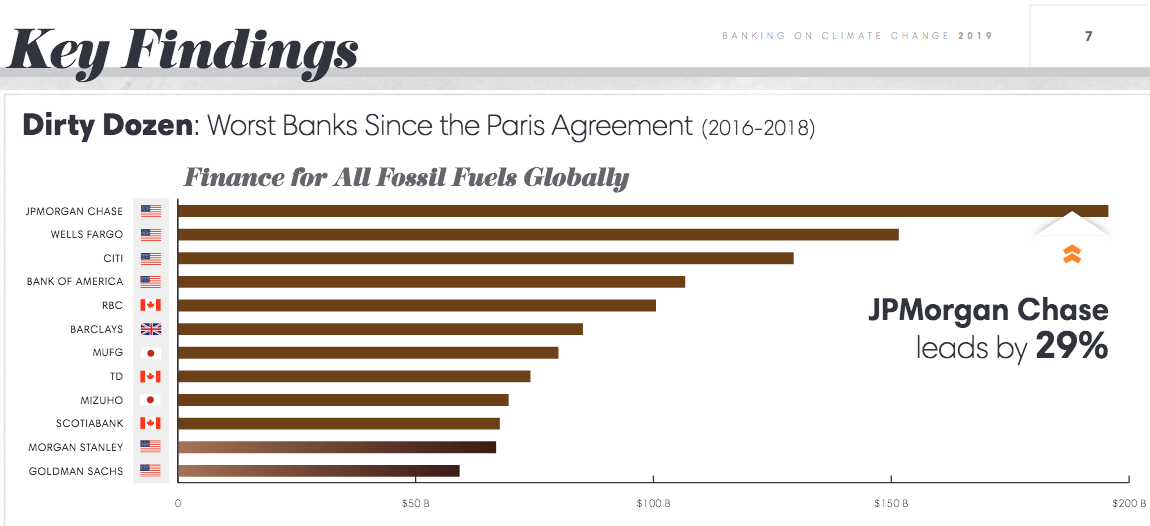
<p>Today, sophisticated studies of climate investment and impact profiles of these sectors of the finance universe are starting to appear. For example, <a href="https://www.banktrack.org/download/banking_on_climate_change_2019_fossil_fuel_finance_report_card/banking_on_climate_change_2019.pdf" title="Link to Banking On Climate Change: Fossil Fuel Report Card 2019" target="_blank">Banking on Climate Change: Fossil Fuel Report Card 2019</a>, which "for the first time&hellip; adds up lending and underwriting from 33 global banks <sup id='fnref4-2019-10-10'><a href="#fn4-2019-10-10">4</a></sup> to the fossil fuel industry as a whole" and finds that "fossil fuel financing is dominated by the big U.S. banks, with JP Morgan Chase as the world's top funder of fossil fuels by a wide margin." Similarly, the financial think tank Carbon Tracker makes use of "leading industry  data bases to map both risk and opportunity for investors on the path to a low-carbon future." In 2019, Carbon Tracker posted a new investor tool <sup id='fnref5-2019-10-10'><a href="#fn5-2019-10-10">5</a></sup>, <a href="https://companyprofiles.carbontracker.org/" title="Carbon Tracker Initiative" target="_blank">Climate Action100+</a>, that aims to help its members "engage with power utilities to ensure they align their generation activities with the temperature goal in the Paris Agreement and manage the risks associated with a transition to a low carbon economy."</p>

<p>Just this month, the venerable World Resources Institute came out with a <a href="https://www.wri.org/finance/banks-sustainable-finance-commitments/" title="Link to Green Targets Tool" target="_blank">Green Targets Tool</a>. This tool <sup id='fnref6-2019-10-10'><a href="#fn6-2019-10-10">6</a></sup> drills down into the sustainability practices of the world's largest 50 private sector banks. WRI analysis found that "only 23 of them had a sustainable finance target. And such targets or commitments don't in themselves demonstrate an institution's concrete implementation and execution of sustainability in its concrete allocation of capital."</p>

<p>
<figure>
  <img class="img-responsive" src="/images/Torchlight-Dirty-Dozen.png" width="1150" height="526" alt="Dirty Dozen">
  <figcaption>Source Graphic: Banking On Climate Change, Dirty Dozen: Worst Banks Since the Paris Agreement (2016&ndash;2018)</figcaption>
</figure>
</p>

<p>My shout outs to leading-edge finance climate and sustainability resources and reports  are neither a comprehensive nor representative survey of climate finance disclosure today.  But you get the idea. There is sophisticated analytic work being done and there's more mainstream media reporting than there was even 5 years ago, in top tier places like the <a href="https://www.ft.com/content/d0c4af5f-0004-3d0f-8238-e28be38a8327" title="FT article Investors struggle to make US companies change tack on climate change" target="_blank">Financial Times</a> <sup id='fnref7-2019-10-10'><a href="#fn7-2019-10-10">7</a></sup> and <a href="https://www.nytimes.com/2019/10/07/business/energy-environment/climate-energy-experts-debate.html" title="NYT article Climate and Energy Experts Debate How to Respond to a Warming World" target="_blank">The New York Times</a> <sup id='fnref8-2019-10-10'><a href="#fn8-2019-10-10">8</a></sup> where coverage focuses on how far we are from a tipping point on decarbonizing investments and corporate conduct. This is important work. But where can those in need of reliable information, analysis and indexes or benchmarks go to routinely access news about the financial world as it impacts the persistence of old ways, or the emergence of new financial practices that can light the way toward decarbonization?</p>

<p>What we need now is a Carbon Finance News and Notes platform. Just think! a monthly report from an independent, credentialed and credible organization that aggregates information from myriad relevant finance sector, think-tank, scholarly, legal and breaking news sources. CFNN's challenge would be to find nimble ways to become a widely-read, go-to source for this universe of information and analysis. Its impact should be defined by how well it enables the expansion and application of climate financial literacy for investors and their advisors, climate policy makers and activists as well as government agencies who set the rules for mandatory carbon disclosure and financial risks.</p>

<p>The CFNN might take the form of a regularly updated database or it could incorporate narrative. The Sabin Center for Climate Law at Columbia Law School provides <a href="http://climatecasechart.com" title="Link to Climate Change Litigation Databases" target="_blank">two searchable online databases of climate change litigation</a>, one for U.S. climate change litigation and one for non-U.S. cases. <sup id='fnref9-2019-10-10'><a href="#fn9-2019-10-10">9</a></sup> It exemplifies one possible approach to a CFNN, but it's not the only feasible model. What's crucial is that the CFNN be created, maintained and regularly updated by a highly credible and independent source able to attract a wide readership. It should not be hidden behind a paywall. Instead, it should develop a social media presence to advance the mission of getting out the message.</p>

<p>What would make a useful and well used CFNN? I invite Sallan's readers to weigh in on the CFNN proposal, whose intended purpose is to provide private and public finance-focused useful knowledge for greener cities &mdash; and for unloading the climate gun pressed against our global temples right now. <a href="mailto:nanders@sallan.org?subject=Sallan Reader Weighs In">Email your ideas and reactions.</a> Sallan will post them.</p>

<hr>
<h4>Bibliography</h4>
<div class="footnotes">
<ol>
<li id="fn1-2019-10-10">Cohen, Steve. “Defining and Measuring Sustainability.” State of the Planet, Earth Institute Columbia University, 7 October 2019, blogs.ei.columbia.edu/2019/10/07/defining-measuring-sustainability/. <a href="#fnref1-2019-10-10" class='footnoteBackLink' title="Jump back to footnote 1 in the text.">&#8617;</a></li>

<li id="fn2-2019-10-10">The SEC Sustainability Disclosure Search tool scours the text of SEC annual filings (10-Ks, 20-Fs and 40-Fs) and automatically identifies relevant disclosures specifically addressing climate change risks, carbon asset risks or other issues. Link to <a href="https://www.ceres.org/resources/tools/sec-sustainability-disclosure-search-tool" title="SEC Sustainability Disclosure Search tool" class="torchlinx">The SEC Sustainability Disclosure Search tool</a> <a href="#fnref2-2019-10-10" class='footnoteBackLink' title="Jump back to footnote 2 in the text.">&#8617;</a></li>

<li id="fn3-2019-10-10">Source: Buckly, Tim. IEEFA, 27 February 2019, Over 100 Global Financial Institutions Are Exiting Coal, With More to Come. Link to <a href="https://www.ieefa.org/wp-content/uploads/2019/02/IEEFA-Report_100-and-counting_Coal-Exit_Feb-2019.pdf" title="Link to IEEFA Report" class="torchlinx">Institute for Energy Economics and Financial Analysis Report</a>. <a href="#fnref3-2019-10-10" class='footnoteBackLink' title="Jump back to footnote 3 in the text.">&#8617;</a></li>

<li id="fn4-2019-10-10">&#8220;<a class="torchlinx" href="https://www.banktrack.org/download/banking_on_climate_change_2019_fossil_fuel_finance_report_card/banking_on_climate_change_2019.pdf" target="_blank">Big Banks Stoke the Flames of the Climate Crisis</a>, Source: Banking On Climate Change Fossil Fuel Finance Report Card 2019, BankTrack, March 20, 2019, https://www.banktrack.org &#8221; <a href="#fnref4-2019-10-10" class='footnoteBackLink' title="Jump back to footnote 4 in the text.">&#8617;</a></li>

<li id="fn5-2019-10-10">&#8220;Carbon Tracker to Measure World's Power Plant Emissions from Space with Support from Google.org.&#8221; Carbon Tracker Initiative, 8 May 2019, https://www.carbontracker.org/carbon-tracker-to-measure-worlds-power-plant-emissions-from-space-with-support-from-google-org/.
<strong><a href="https://www.carbontracker.org/carbon-tracker-to-measure-worlds-power-plant-emissions-from-space-with-support-from-google-org/" title="Link to Carbon Tracker Press Release" class="torchlinx">Link to Carbon Tracker</a></strong>  <a href="#fnref5-2019-10-10" class='footnoteBackLink' title="Jump back to footnote 5 in the text.">&#8617;</a></li>

<li id="fn6-2019-10-10">&#8220;GREEN TARGETS: A Tool To Compare Private Sector Banks Sustainable Finance Commitments. <a class="torchlinx" href="https://www.wri.org/finance/banks-sustainable-finance-commitments" target="_blank">World Resources Institute</a>, 3 Oct. 2019 https://www.wri.org/finance/banks-sustainable-finance-commitments/. &#8221; <a href="#fnref6-2019-10-10" class='footnoteBackLink' title="Jump back to footnote 6 in the text.">&#8617;</a></li>

<li id="fn7-2019-10-10">Flood, Chris. &#8220; <em>Investors Struggle to Make US Companies Change Tack on Climate Change</em> &#8221; Financial Times, Financial Times, 6 Oct. 2019, https://www.ft.com/content/d0c4af5f-0004-3d0f-8238-e28be38a8327 <a href="#fnref7-2019-10-10" class='footnoteBackLink' title="Jump back to footnote 7 in the text.">&#8617;</a></li>

<li id="fn8-2019-10-10">The New York Times. &#8220;Climate and Energy Experts Debate How to Respond to a Warming World.&#8221; <em>The New York Times</em>, 7 Oct. 2019, https://www.nytimes.com/2019/10/07/business/energy-environment/climate-energy-experts-debate.html <a href="#fnref8-2019-10-10" class='footnoteBackLink' title="Jump back to footnote 8 in the text.">&#8617;</a></li>

<li id="fn9-2019-10-10">&#8220;See <a class="torchlinx" href="http://climatecasechart.com" target="_blank">Climate Change Litigation Databases</a> &#8221; Sabin Center for Climate Change Law. Climate Change Litigation, climatecasechart.com <a href="#fnref9-2019-10-10" class='footnoteBackLink' title="Jump back to footnote 9 in the text.">&#8617;</a></li>

</ol>
</div>]]>
    </content>
</entry>
<entry>
    <title>DEE-fense!</title>
    <link rel="alternate" type="text/html" href="https://www.sallan.org/Torchlight/2019/06/defense.php" />
    <link rel="service.edit" type="application/atom+xml" href="http://www.sallan.org/movabletype/mt-atom.cgi/weblog/blog_id=18/entry_id=21182" title="DEE-fense!" />
    <id>tag:www.sallan.org,2019:/Torchlight//18.21182</id>
    
    <published>2019-06-01T17:13:58Z</published>
    <updated>2020-06-08T12:00:14Z</updated>
    
    <summary><![CDATA[There's a new climate action kid on the block &mdash; the Renewable Energy Legal Defense Initiative. Born in 2019, its proud parents are the Sabin Center for Climate Change Law at Columbia University and the law firm Arnold &amp; Porter. What are their hopes for this new project and why is it called a "Defense Initiative"?]]></summary>
    <author>
        <name>Nancy Anderson, Ph.D.</name>
        
    </author>
    
    <content type="html" xml:lang="en" xml:base="https://www.sallan.org/Torchlight/">
        <![CDATA[<p>There's a new climate action kid on the block &mdash; the Renewable Energy Legal Defense Initiative. Born in 2019, its proud parents are the Sabin Center for Climate Change Law at Columbia University and the law firm Arnold &amp; Porter. What are their hopes for this new project and why is it called a "Defense Initiative"?</p>
]]>
        <![CDATA[<p>Michael Gerrard, Director of <a href="http://columbiaclimatelaw.com" title="the Sabin Center -- Last visited June 2, 2019 -- http://columbiaclimatelaw.com" target="_blank" class="torchlinx">the Sabin Center</a> and Laura Cottingham, an attorney with <a href="https://www.arnoldporter.com/en/people/c/cottingham-laura-l" title="Laura Cottingham -- Last visited June 2, 2019 -- https://www.arnoldporter.com/en/people/c/cottingham-laura-l" target="_blank" class="torchlinx">Arnold &amp; Porter</a> met with me to introduce their new kid. The project will offer pro bono (free) legal defense to individuals or local organizations that would welcome solar or wind power projects into their communities, but face opposition. Opposition can take several forms &mdash; for instance, local government can impose project moratoriums that could fatally delay projects or pass zoning rules crafted to preclude renewable energy proposals from consideration. Facing down such opposition can mean undertaking legal action or even going to court.</p>

<p><img class="img-responsive" src="/images/Torchlight-DEFENSE.jpg" width="640" height="360" title="Justitia the Roman goddess of Justice" alt="&copy; Can Stock Photo Inc. / FyreStock"></p>

<p>The Defense Initiative's first client is <a href="https://www.hudsonvalley360.com/article/farmers-take-stand-against-town" title="Link to Friends of Flint Mine Solar article -- Last visited June 2, 2019 -- https://www.hudsonvalley360.com/article/farmers-take-stand-against-town" target="_blank" class="torchlinx">the Friends of Flint Mine Solar</a>, a group of 25 farmers and other landowners in Coxsakie, New York  who want to lease or sell their property to a utility-scale solar power developer for the purpose of installing photovoltaic panels, but are prohibited from such leasing by local ordinances. "This was a group that had already been formed," prior to the Defense Initiative learning of it, Cottingham explained. In other circumstances, the Defense Initiative might support municipalities that are pro-renewable energy, but are being legally challenged by renewable energy opponents.</p>

<p>To date, Gerrard and Cottingham describe the Renewable Energy Legal Defense Initiative is the only legal resource of its kind, one that supports renewable energy projects, rather than opposes non-renewable energy projects. Gerrard remarked, "I don't believe there is another organization that's been set up with this purpose." Expanding on what makes the Defense Initiative singular, he underlined the principle that the Defense Initiative will not represent renewable energy project developers, nor will it accept money from them.  Nor will it engage in opposition to fossil fuel energy projects, that's an arena that's already covered. The Defense Initiative is founded on the idea that renewable energy proposals need "disinterested" defenders who don't necessarily have a financial stake in the outcome. It is also the case that local land owners or project advocates do not often attract direct litigation support from "Big Green" national environmental organization, which means that experienced legal resources are scarce for most below-the-radar renewable energy supporters, where willingness to engage can mean life or death for a project, and this is where the new kid fits on the climate action block.</p>

<p>What kind of resources does this initiative bring to the renewable energy projects? In addition to Cottingham's own pro bono work, she meets with law firms and law school clinics to line up more professional and academic commitment. The Sabin Center will also provide Fellows who will rotate into work on the Defense Initiative. It's too early to say just how many lawyers, law professsors and students the Defense Initiative could use, but given the likely geographic diversity of renewable energy projects in need of legal champions, Cottingham knows that over time it will need attorneys in jurisdictions where projects are under attack, whether a case is based on local, state or federal law.</p>

<p>Cottingham also recognizes the need to engage in targeted and effective outreach about defending renewable energy projects and she both attends conferences and meets with government officials who know what's happening "on the ground" to provide them with information about the Defense Initiative. She's already started to contact national organizations as well as regional groups in the southeast.</p>

<p>We ended our conversation from a vantage point a few years in the future and what Gerrard and Cottingham would hope to have achieved. For Cottingham, notching a handful of legal victories that allowed renewable energy projects to move forward would be a benchmark of success. For Gerrard, success would be sending a message that renewable energy projects have strong support and local governments should think hard about opposing such projects because they will have the legal resources to push back and prevail. "Gerrard's urgent message is, "A massive increase in renewable energy generation is central to addressing the climate problem" and an important path to decarbonizing our economy and protecting the climate will be paved with local victories. He is certain that defending renewable energy developments will help provide incremental power for electric vehicles and replacing of fossil fuels for heating with carbon free sources until such time as there is a national consensus on the urgency of climate action.</p>

<p>Here's Cottingham's message to readers of this Sallan column, "We have the resources and are available to help and we are looking for projects where we can be of assistance." Interested in learning more about the Renewable Energy Legal Defense Initiative? E-mail her at <a href="mailto:laura.cottingham@arnoldporter.com" title="E-mail Laura Cottingham" class="torchlinx">laura.cottingham@arnoldporter.com</a></p>]]>
    </content>
</entry>
<entry>
    <title>Climate Action Meets The Piecemeal Problem</title>
    <link rel="alternate" type="text/html" href="https://www.sallan.org/Torchlight/2019/02/climate_action_meets_the_piecemeal_problem.php" />
    <link rel="service.edit" type="application/atom+xml" href="http://www.sallan.org/movabletype/mt-atom.cgi/weblog/blog_id=18/entry_id=20830" title="Climate Action Meets The Piecemeal Problem" />
    <id>tag:www.sallan.org,2019:/Torchlight//18.20830</id>
    
    <published>2019-02-04T05:37:45Z</published>
    <updated>2020-06-08T12:00:14Z</updated>
    
    <summary><![CDATA[Meeting NYC's legal mandate to cut its carbon footprint 80% by 2050 is a tall &mdash; and essential &mdash; order. To cite Benjamin Franklin, "Never confuse motion with action."]]></summary>
    <author>
        <name>Nancy Anderson, Ph.D.</name>
        
    </author>
    
    <content type="html" xml:lang="en" xml:base="https://www.sallan.org/Torchlight/">
        <![CDATA[<p>Meeting NYC's legal mandate to cut its carbon footprint 80% by 2050 is a tall &mdash; and essential &mdash; order. While 2050 gets closer every day, the full suite of detailed policies, laws, regulations and market transformations needed to meet the 80x50 remain substantially incomplete. It's been a decade since the release of <a href="https://www.sallan.org/Torchlight/2007/05/in_dreams_begin_accountability.php" title="Link to In Dreams Begin Accountability Torchlight" target="_blank" class="torchlinx">Mayor Bloomberg's Greener Greater Building Plan</a> and the phased-in ban on burning heavy fuel oil for heating buildings has likely been the most effective carbon cutting tool to date, but that still leaves much to do that will entail complex political and technical effort.</p>

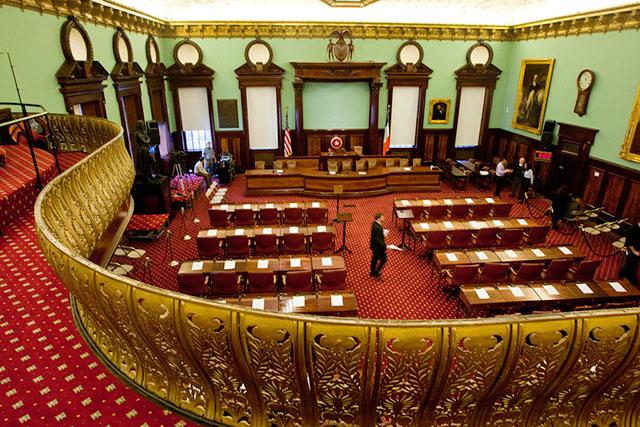
<p>I've written before about City Council bills that would require existing buildings to renovate and retrofit buildings to achieve levels of energy efficiency that 80x50 demands. As of this writing, another version of the bill, now designated <a href="https://legistar.council.nyc.gov/MeetingDetail.aspx?ID=651750&amp;GUID=071220EB-6220-4387-B352-FA9A633D53C0&amp;Search=" title="Link to The New York City Council Committee on Environmental Protection" target="_blank" class="torchlinx">Intro 1253</a>, had lengthy hearings in December 2018 before the Committee on Environmental Protection, but how the many challenging technical, financial and residential tenant protection issues will be resolved is unknown. What is known is that retrofit decisions and deadlines, as well as the basic metrics for measuring building energy and carbon outputs have no off-the-shelf answers. They have to be discovered or invented and their specifics hammered out &mdash; or not. All that can be said with confidence is that the City will not meet its 80x50 goals unless the energy appetite of its built environment changes in big ways and this means both more efficient uses of fuel and electricity along with a shift to fuel and electricity sources that are zero, net-zero or ultra-low carbon.</p>
]]>
        <![CDATA[<p>
<figure>
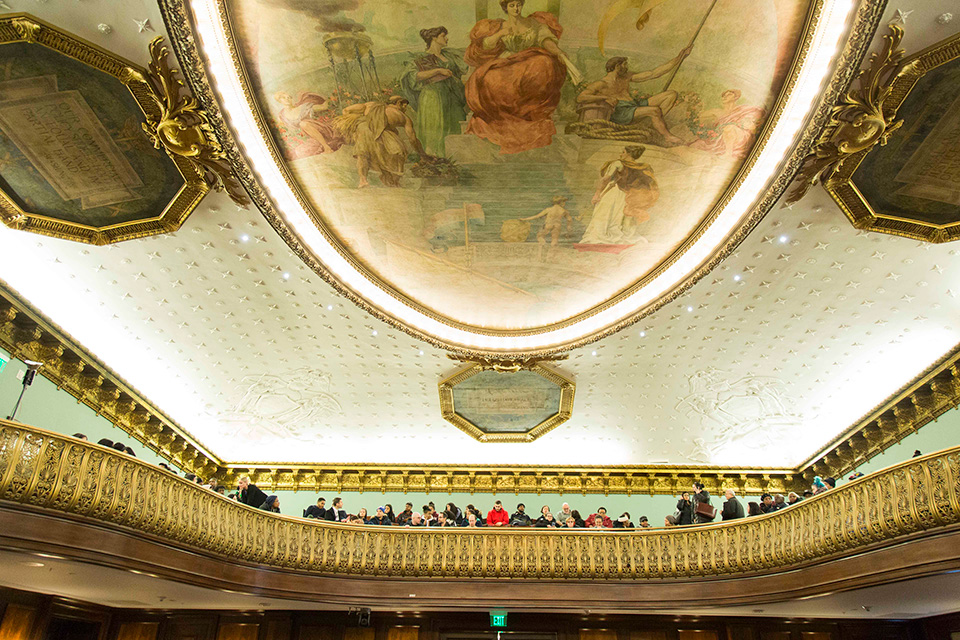
  <img class="img-responsive" src="/images/Torchlight-Climate-Action-Meets-The-Piecemeal-Problem.jpg" width="960" height="640" alt="New York City Council Chamber">
  <figcaption>Photo by Emil Cohen of the New York City Council chamber ceiling murals, depicting civic virtues</figcaption>
</figure>
</p>

<p>Just a month after the Intro 1253 hearing, the Committee on Environmental Protection held hearings on an array of bills that focused on the potential of using the City's rooftops for installing solar panels and planting "green roofs". The bills would create specific musts rather than a menu of mays. (As an aside, "green roof" legislation aims for benefits that are not specifically tied to energy use, such as limiting the impact on the City's stressed waste water management infrastructure or growing edibles, so a comparison with energy retrofit bills is not exact.) Still, the City's venerable, voluntary and low-cost "cool roof" program has been quite a success, while it's "green roof" program which helps defray installation costs, has completed a mere 25 projects since its inception in 2011.  At the January 2019 hearings, the importance of PV and "green roof" obligations were discussed in detail, but not in coordination with other actions that are likely to become requirements if a building energy retrofit bill becomes law.</p>

<p>By the time I left the hearing, I was worried. Zeal and the desire to "do something now" could be getting ahead of the grinding work of passing legislation that tackles the comprehensive need to upgrade the energy efficiency and decarbonize the fuel supply of our entire building stock.</p>

<p>This hearing raised a vivid and discomforting question for me:  is drafting many laws, each with a specific focus and set of requirements, the path to climate action success?  Here's the thing: however well-intentioned and well-drafted any one bill might be, the probability seems low that a bevy of bills will fortuitously add up to a coherent 80x50 policy to provide building owners, tenants and financial lenders with a coherent platform from which to launch rational, green choices that will add to the public good.</p>

<p>A common and cynical metaphor applied to the legislative process is "sausage making", but that's not the grind troubling me here. Rather, it's the piecemeal problem, where in the 80x50 context, "the road to hell is paved with good intention". Despite the green blueprints issued by the de Blasio Administration &mdash; <a href="https://www.sallan.org/Torchlight/2014/09/the_de_blasio_benchmarking_blessing.php" title="Link to The De Blasio Benchmarking Blessing Torchlight" target="_blank" class="torchlinx">One City Built to Last</a> and <a href="https://www.sallan.org/Torchlight/2017/07/80x50_promises_promises.php" title="Link to 80x50 — Promises, Promises Torchlight" target="_blank" class="torchlinx">New York City's Roadmap to 80x50</a> &mdash; after five years in office there's something of a dearth of initiatives with outcomes. One highlight has been the installation of 11 megawatts of rooftop PV on municipal buildings, with another 30 megawatts in the works. In contrast, another Administration climate program, the voluntary Building Energy Challenge, has just 100 participating buildings (per Administration testimony back in December), so the need for legally requiring building energy upgrades, particularly for existing buildings, is indisputable.</p>

<p>Already in 2019, with a term-limits, New York City's election cycle, is starting to gear up for Mayoral and City Council races in 2021. It is not difficult to imagine that this election cycle could induce a scattershot of well-meaning climate and energy bills in the City Council until the elections. It's no secret that Corey Johnson, the Council's current Speaker is interested in running for Mayor and that New Yorkers will be on the lookout for candidates who have bragging rights about their own version of a Green New Deal. The immediate risk posed by this hard-wired election cycle is not sausage-making so much as a piecemeal path that leads to a mish-mash of mandates (with all their associated compliance costs measured in both time and money) instead of leading to New York's 80x50 goal. This would mean failing to do what's needed for fending off a worst-case climate disruption future. To cite Benjamin Franklin, "Never confuse motion with action."</p>

<p>Here's my wish list: one comprehensive bill for cutting the carbon footprint of existing buildings while making life better for owners and occupants alike. It's also a way to boost green businesses and local employment. Legislative language should establish energy performance outcomes but should not be prescriptive in terms of the specific actions every building owner and manager must take. Will that be easy? No, but it will be something which really matters and that ought to focus the minds and wills of legislative drafters and all those who have skin in this game.</p>]]>
    </content>
</entry>
<entry>
    <title>Rock Around The Sun</title>
    <link rel="alternate" type="text/html" href="https://www.sallan.org/Torchlight/2018/11/rock_around_the_sun.php" />
    <link rel="service.edit" type="application/atom+xml" href="http://www.sallan.org/movabletype/mt-atom.cgi/weblog/blog_id=18/entry_id=20614" title="Rock Around The Sun" />
    <id>tag:www.sallan.org,2018:/Torchlight//18.20614</id>
    
    <published>2018-11-26T05:03:51Z</published>
    <updated>2020-06-08T12:00:14Z</updated>
    
    <summary>Here&apos;s hoping that 2019 will be the beginning of the Anti-Entropy Era when we&apos;ll muster the political heat and the means to keep global temperature rises below 1.5&amp;#8451;. If we can, then we can breathe a sigh of relief as we rock on around the sun.</summary>
    <author>
        <name>Nancy Anderson, Ph.D.</name>
        
    </author>
    
    <content type="html" xml:lang="en" xml:base="https://www.sallan.org/Torchlight/">
        <![CDATA[<p>It's that time of year for looking back and peering ahead. But what would a theoretical physicist who specializes in quantum mechanics say about this predilection to see what's happening in terms of the passage of time, the before and after, the yesterday and tomorrow? The physicist might say "Bah, humbug!" More professionally, a citation could be made to entropy &mdash; commonly defined as "heat death" or an irreversible flow of heat from warmer objects to colder ones &mdash; as the only aspect of physics where before and after &mdash; or time as we non-physicists think of it &mdash; makes any sense.</p>]]>
        <![CDATA[<p><style>.embed-container { position: relative; padding-bottom: 56.25%; height: 0; overflow: hidden; max-width: 100%; } .embed-container iframe, .embed-container object, .embed-container embed { position: absolute; top: 0; left: 0; width: 100%; height: 100%; }</style><div class='embed-container'><iframe src="https://www.youtube.com/embed/vgsoI4ZUkUA" frameborder="0" allowfullscreen></iframe></div></p>

<p>I owe this startling downgrade of time to Carlo Rovelli's book <a href="https://www.kirkusreviews.com/book-reviews/carlo-rovelli/the-order-of-time/" title="Link to Kirkus Reviews">The Order of Time</a>. Still, it's impossible to live in an era, on a planet facing a different kind of "heat death" by way of human-induced climate disruptions and not care deeply about a future we are careening toward and are beginning to already collide with head-on. Put bluntly, time is not on our side. A 2018 <a href="/pdf-docs/IPCC_2018_SpecialReport.pdf" title="Link to IPCC 2018 Special Report">Special Report</a> by the International Panel on Climate Change finds that we're nearly locked in to global mean temperatures rising 1.5<span>&#8451;</span>, which entails real disruptions to life on Earth, but the risk of the global mean temperature rising 2<span>&#8451;</span> will mean disruption, damage and destruction that is much more profound. In the dry, quiet language of the Special Report, the clock ticks loudly.</p>

<blockquote>
  <p>In model pathways with no or limited overshoot of 1.5<span>&#8451;</span>, global net anthropogenic CO2 emissions decline by about 45% from 2010 levels by 2030 (40&ndash;60% interquartile range), reaching net zero around 2050 (2045&ndash;2055 interquartile range). For limiting global warming to below 2<span>&#8451;</span> CO2 emissions are projected to decline by about 25% by 2030 in most pathways (10&ndash;30% interquartile range) and reach net zero around 2070 (2065&ndash;2080 interquartile range).</p>
</blockquote>

<p>It insists the world must ratchet down its human-source CO2 emissions 25% by 2030 and get down to "net zero" by around 2070 to avoid profound disruption and lays out four "model pathways" for getting where we need to get to go. To keep global temperature increases no higher than 1.5<span>&#8451;</span></p>

<blockquote>
  <p>Would require rapid and far-reaching transitions in energy, land, urban and infrastructure (including transport and buildings), and industrial systems. <strong>These system transitions are unprecedented in terms of scale, but not necessarily in terms of speed</strong> and imply a wide portfolio of mitigation options and a significant upscaling on investment in those options. (emphasis added)</p>
</blockquote>

<p>Tick, tick, tick&hellip;</p>

<p>As a practical matter, does this mean we're doomed or will we survive climate change? According to a recent <a href="https://www.nytimes.com/2018/11/19/science/climate-change-doom.html" title="Link to NYT">New York Times headline</a> when it comes to survival the answer is, "Possibly." As renowned climate scientist Jim Hansen comments, "I find the people who think we are doomed to be very tiring and unhelpful."</p>

<p>
<figure>
  <img class="img-responsive" src="/images/Torchlight-Rock-Around-the-Sun.jpg" width="960" height="640" alt="JPL NASA Photo of the Sun">
  <figcaption>Photo: Solar Dynamics Observatory, NASA, JPL</figcaption>
</figure>
</p>

<p>So, are there any reasons to think something other than doom? Possibly. Before Earth completes its 2018 revolution around the Sun, the New York City Council <a href="https://www.huffingtonpost.com/entry/nyc-climate-bill_us_5bf4214ae4b0d9e7283d6355" title="Link to HuffPo">will hold public hearings on a new bill</a> that would require steep cuts in buildings' climate-warming emissions resulting from the way they are heated, cooled and electrified. Grassroots, affordable housing activist Pete Sikora was jubilant about the bill authored by Council member Costa Constantinides,</p>

<blockquote>
  <p>I gotta hand it to him: It's awesome&hellip; noting that the legislation matches the urgency set out by last month's United Nations report warning that world governments must halve emissions in the next 12 years to avoid catastrophic global warming.</p>
</blockquote>

<p>While legislative hearings don't rubberstamp final legislative outcomes, this isn't the only climate-positive news for the year. Shortly after the 2018 election, when the Democrats retook the House of Representatives by a surprising margin, the Sunrise Movement and Justice Democrats, with the participation of newly-elected Congressmember Alexandria Ocasio-Cortez, held a demonstration in the Capitol that made national headlines. This <a href="https://www.vox.com/energy-and-environment/2018/11/14/18094452/alexandria-ocasio-cortez-nancy-pelosi-protest-climate-change-2020" title="Link to Vox">new generation of climate activists demanded</a> that likely-incoming House Speaker Nancy Pelosi create a Select Committee on the Climate with the goal of creating a Green New Deal.</p>

<p>Ocasio-Cortez says she'll be introducing a draft resolution to set parameters for such a Select Committee. One of the best climate beat reporters in the country, Dave Roberts, tweeted about Democratic climate strategy in a polarized era and the "three basic prongs of a unilateral left strategy," one of which is "defining a long-term, comprehensive federal climate action agenda for when/if Democrats regain the power to implement one." For Roberts, the Sunrise Movement and Justice Democrats are doing just this by laying down an early marker to set the bar high, even as he notes, "I admit, I have trouble envisioning the resolution passing in anything like its current form."</p>

<p>But it's certainly a place to start, something that's been beyond absent in Washington and inching forward way too slowly, even in liberal, climate action-promising cities like New York. Here's hoping that 2019 will be the beginning of the Anti-Entropy Era when we'll muster the political heat and the means to keep global temperature rises below 1.5<span>&#8451;</span>. If we can, then we can breathe a sigh of relief as we rock on around the sun.</p>]]>
    </content>
</entry>
<entry>
    <title><![CDATA[You Can Lead A Horse To Data&hellip;]]></title>
    <link rel="alternate" type="text/html" href="https://www.sallan.org/Torchlight/2018/08/you_can_lead_a_horse_to_data.php" />
    <link rel="service.edit" type="application/atom+xml" href="http://www.sallan.org/movabletype/mt-atom.cgi/weblog/blog_id=18/entry_id=20294" title="You Can Lead A Horse To Data&amp;hellip;" />
    <id>tag:www.sallan.org,2018:/Torchlight//18.20294</id>
    
    <published>2018-08-14T15:22:53Z</published>
    <updated>2020-06-08T12:00:14Z</updated>
    
    <summary>Turning Data Into Action is a report on a mission. That mission is turning data about building energy use into actions resulting in significant building energy savings.</summary>
    <author>
        <name>Nancy Anderson, Ph.D.</name>
        
    </author>
    
    <content type="html" xml:lang="en" xml:base="https://www.sallan.org/Torchlight/">
        <![CDATA[<p><a href="https://be-exchange.org/report/turning-data-into-action/" title="Turning Data Into Action BE-Ex Report" target="_blank">Turning Data Into Action</a> is a report on a mission. That mission is turning data about building energy use &mdash; submitted to New York City government by owners of large properties to comply with green building laws &mdash; into actions resulting in significant building energy savings. The report, issued by the <a href="https://be-exchange.org" title="Visit BE-Ex" target="_blank">Building Energy Exchange</a> (BE-Ex), focuses on large multifamily buildings. It predicts, "Implementing recommended efficiency retrofits would immediately reduce multifamily energy use in NYC by 11% and have a simple payback of less than 6 years." and its target readership consists of, "Building decision makers, operators, contractors and policy makers."</p>]]>
        <![CDATA[<p>Sounds good &mdash; save energy, with a return on investment of just six years and then enjoy the future savings resulting from lower fuel bills. But the problem, as policy makers and experts have learned, is that just spelling out the benefits of energy efficiency retrofitting has not produced a plethora of adopters in existing buildings.  Here's where <em>Turning Data Into Action</em> seeks to make its mark. How? By, "Organizing energy auditor evaluations of building efficiency upgrade opportunities into complimentary 'packages' of energy conservation measures (ECMs), that are matched to key touchpoints in a building's financial lifecycle."</p>

<p>These touchpoints are: 'anytime anywhere' low cost measures; 'mid-cycle retrofits' that may require some financial planning; 'refinance retrofits', more capital-intensive measures with longer paybacks but also big savings; 'tenant turnover', which are opportunities specific to tenant-controlled spaces and systems; and 'equipment replacement', opportunities that arise when a piece of major equipment reaches the end of its useful life.</p>

<p>The ECMs and touchpoints are assembled into "tearsheets". These are easy-to-digest, two-page retrofit pathways tailored to building age, size and fuel currently used for heat and domestic hot water. In keeping with the report's mission of making data the springboard for action, the intent of these two-pagers is to, "Enable building decision makers to better understand their options at critical milestones &hellip; designed to guide and inspire building owners and managers in their pursuit of energy efficiency retrofits."</p>

<p>Here's an example. One tearsheet, specifies the options and payback period in a pre-1947 residential building, eight stories or higher, that currently uses natural gas or, if needed heating oil for heating and domestic hot water are specified. Typically, at the low end of the touchpoint range, "Anytime/Anywhere" actions would cost $13,720, provide savings of $4,900 and an ROI of 2.8 years. At the high end, at the time of building refinance, long term investments for deep energy retrofits would cost $391,500, provide savings of $29,000 and have an ROI of 13.5 years.</p>

<p>But what if the intended readership of decision makers has other things on its mind? What if an ROI of more than three years for a retrofit is not deemed an attractive business option by an owner? Or a co-op board votes to spend money on modernizing the building lobby, something visible to everyone entering and leaving the premises, instead of doing an energy retrofit that might be invisible to most? What about tenants who worry that retrofit costs that fall into the category of a major capital improvement lead to rent increases or even deregulation, thus putting their apartments into the stratosphere of New York City "market rate" dwellings? There are nearly 1,000,000 rent stabilized apartments here, so that could add up to a lot of anxious tenants who won't be lending their support to building energy retrofits.</p>

<p>This list of hypotheticals is certainly not inclusive, but it is illustrative of obstacles dampening down the uptake on retrofit opportunities in multifamily buildings.  Should a report like <em>Turning Data Into Action</em>, when <a href="https://www.nytimes.com/2018/08/09/climate/summer-heat-global-warming.html" title="Somini Sengupta's NYT Article" target="_blank">concern about climate change risks are on the rise</a>, help building decision makers commit to energy retrofits? Absolutely.  How about the incentive to save on operating expenses when most building operating costs are on a permanent upward curve? Of course, that should and does drive some retrofit action but it's not making energy efficient building the 'new normal' at a speed and scale needed to meet New York's climate action goals.</p>

<p><img class="img-responsive" src="/images/Torchlight-You-Can-Lead-A-Horse-To-Data.jpg" width="960" height="640" alt="Torchlight-You-Can-Lead-A-Horse-To-Data"></p>

<p>Let's acknowledge that we have a problem here. We can lead the horse (building owner) to water (benchmarking and energy audit data, going back six years and 'tearsheets' to make retrofit decisions easy) but what if we can't make that horse drink (retrofit) enough to cut the NYC's carbon footprint 80% by 2050? Given the modest scale of energy retrofitting to date, more encouragement is called for and some of it needs to be done differently to get it done bigger and better.</p>

<p>Here's my suggestion for deploying <em>Turning Data Into Action</em> to meet its valid and valorous aims: marketing. New York City is replete with experts who market real estate. Let's put some of those best creative minds to work on promoting energy efficiency and retrofitting.</p>

<p>Marketing? What happened to mandates? One indelible lesson of from the history of environmental protection is that the force of law and enforcement are necessary to shift otherwise recalcitrant habits. Another lesson, however, is that enacting and executing laws require stakeholders and advocates who are able to overcome opposition. That doesn't always happen, or it may take several rounds of legislative action or produce watered down standards. Here's where marketing comes in.</p>

<p>Marketing energy retrofits needs more than one target audience and more than one message. The first audience consists of those "building decision makers, operators, contractors and policy makers" who are the primary audience for <em>Turning Data Into Action</em>. Here, data presented by experts and peers acknowledged in the real estate, construction and lending industries is the best path to persuasion and action. Get them on board and the chances for retrofit legislation soar. But aspirational marketing to tenants, prospective tenants and a larger public is also essential. Like promoting a new beverage product, people have to want to live in a building that's energy efficient, healthier and cooler than the rest. And let's admit it will take more than data to get all that retrofit action. That's our challenge. Drink up!</p>

<p>One more thing, don't forget to vote.</p>]]>
    </content>
</entry>
<entry>
    <title>There Ought To Be A Law, Right?</title>
    <link rel="alternate" type="text/html" href="https://www.sallan.org/Torchlight/2018/05/there_ought_to_be_a_law_right.php" />
    <link rel="service.edit" type="application/atom+xml" href="http://www.sallan.org/movabletype/mt-atom.cgi/weblog/blog_id=18/entry_id=20001" title="There Ought To Be A Law, Right?" />
    <id>tag:www.sallan.org,2018:/Torchlight//18.20001</id>
    
    <published>2018-05-23T05:00:34Z</published>
    <updated>2020-06-08T12:00:14Z</updated>
    
    <summary>What kind of coalition is needed to pass a building energy retrofit bill able to do what is needed?</summary>
    <author>
        <name>Nancy Anderson, Ph.D.</name>
        
    </author>
    
    <content type="html" xml:lang="en" xml:base="https://www.sallan.org/Torchlight/">
        <![CDATA[<p>Raising the level of energy performance in buildings old and new has been on New York City's climate action agenda for nearly a decade. While a crop of new Energy Star-rated, LEED-certified and Passive House-compliant buildings are up and occupied and voluntary energy performance upgrades or "retrofits", like the Empire State Building, have been undertaken and celebrated, signals that these "greener" buildings are part of a surge sufficient to make a big dent in the City's energy use and carbon footprint are hard to detect. Is this a problem baked into local property markets, policy design or political will?</p>]]>
        <![CDATA[<p>Let's consider what has been accomplished on the way to understanding the nature of this problem. First, the 15% drop in NYC's greenhouse gas emissions since 2005 is attributed largely to the switch to natural gas at electric generating plants and the successful ban on the use of #6 heating oil in buildings around the City. Good, but this drop is not a victory for building design or operations. Second, informed by energy benchmarking in municipal buildings, by spending $480 million to date, "The City has focused its own investment in municipal-owned buildings on high value energy efficiency projects by allocating competitive funding and implementing deep retrofits in key facilities." It has <a href="/pdf-docs/OneNYC_Progress_2018-2-Page-62.pdf" title="Page 62 of Progress Report OneNYC 2018">improved the Energy Star score for its 'eligible' buildings 21%</a> since 2010.</p>

<p>Great, but what about all the buildings not owned by the City? Third, there has been a startling reversal in a decades-old trend of steady increases in electricity use citywide, this reversal isn't just a good news blip. The problem is, all this good news just is not enough to reach the goal of cutting our total greenhouse gas emissions 80% by 2050 and we have little reason to believe that the 'low hanging fruit', such as swapping out every energy hungry light bulb for LED's or tuning up the boiler in the basements of well-maintained buildings will be enough. New York City's exemplary Building Energy Benchmarking Law, Local Law 84, with its robust data base, backs up the fear that we're not yet doing what needs to be done.</p>

<p>While it would be a mistake to succumb to resignation, saying either the means or the ends are unreasonable or infeasible, as Winston Churchill noted, "Sometimes doing your best is not good enough. Sometimes, you must do what is required." This brings us to the question for this column: does New York City need to pass a law now to compel energy retrofits in existing buildings to make them collectively capable of meeting our 80% carbon cutting commitment? A corollary question, if the answer is "yes" to the first, what kind of coalition-making is necessary to get such legislation enacted?</p>

<p>The Environmental Defense Fund's Rory Christian, New York Director, Clean Energy and Marc Rauch, Senior Specialist, New York Clean Energy Real Estate, shared some of their sharpest ideas with me about why the Big Apple needs a building energy retrofit law, one that would require existing buildings to meet stipulated energy utilization standards by way of owners undertaking the energy efficiency upgrades most appropriate to their situations. In 2017, Intro 1745, covering buildings of 25,000 gross square feet or larger, was introduced into the City Council by Costa Constantinides, Chair of the Environmental Protection Committee and supported by Mayor de Blasio. An amended version of this bill is expected to be introduced for Council consideration this year. Absent a redrafted bill, my conversation with Messrs. Christian and Rauch was not a line by line legislative critique. Rather, it was an open-ended and forward-facing consideration, based on their experience with climate/energy policy goals and the real estate industry.</p>

<div class="row">
	<div class="col-md-6">
  		<img class="img-responsive" src="/images/Torchlight-EDF-Rory-Christian.jpg" alt="Rory Christian"><span style="color: #010f5d; font-weight: 600;">Rory Christian</span>
	</div>
	<div class="col-md-6">
  		<img class="img-responsive" src="/images/Torchlight-EDF-Marc-Rauch.jpg" alt="Marc Rauch"><span style="color: #010f5d; font-weight: 600;">Marc Rauch</span>
	</div>
</div>

<p>For them, the dynamics and drivers of the real estate market both create some incentives for and throw up many barriers against bringing existing buildings up to more demanding levels of energy performance. Starting with the base line reality that property owners seek to maximize their revenue and profits, it follows that legislation ought to harness the profit motive, when feasible, for enhancing building energy efficiency. For Mr. Rauch, among the incentives that have worked in voluntary programs like the NYC Carbon Challenge &mdash; established in 2007 for participating property owners to cut their emissions 30% over ten years &mdash; are competitive pressure to be LEED or Energy Star certified. As well, occupant and investor expectations have become a force to be reckoned with. Commercial occupants like new tech companies are highly valued and they want to rent sustainable, green offices. On the finance side, today's many REITS and institutional investors have formal sustainability goals for where they put their money. For others, "bragging rights" about having staffs that are happier to be working in green buildings is a motivator. Finally, peer pressure has been a potent driver in the Carbon Challenge. In fact, it's worked so well, that some building owners and managers having exceeded their 30% carbon cutting goals are now committing to 40&ndash;50% emissions reductions.</p>

<p>When taken together, these incentives go a long way toward explaining why some owners of commercial or residential assets, have become industry leaders and early adopters of building energy performance upgrades. However, these drivers and rewards are either unavailable to the bulk of the City's property owners or are not valued enough as business decisions to make the kinds of changes at a scale that public climate policy calls for.  As if to underline this truth, <a href="http://www.crainsnewyork.com/article/20180514/FEATURES/305149999" title="Link to Crain's article">a recent article in Crain's named names</a>, noting that several recently-constructed highest-of-the-high-end Manhattan condo projects have blithely disregarded energy efficiency and are slurping energy as if there is no tomorrow. "As New York moves to cut greenhouse gases, new projects show scant sensitivity to environmental concerns. But do upscale buyers even care?" With this kind of new construction, it's clear that without widespread energy upgrades of New York City's existing building stock, things look grim for Gotham keeping the climate protection promises it has made to future generations.</p>

<p>Based on their experience, Christian and Rauch are strong advocates for a New York City building energy retrofit law; voluntary commitments alone won't achieve what's necessary.  Absent legislation, "hard market barriers" like the fact that while energy efficiency saves money over time, equipment and operations upgrades cost money now and there's no guarantee how long it will take for that investment to pay off.  Also, "opportunity costs" pull owners and managers away from investing in energy efficiency; purchasing an energy efficient boiler or insulating the building envelope means there may not be the budget to redo the lobby or install new lighting. elevators or refrigerators.</p>

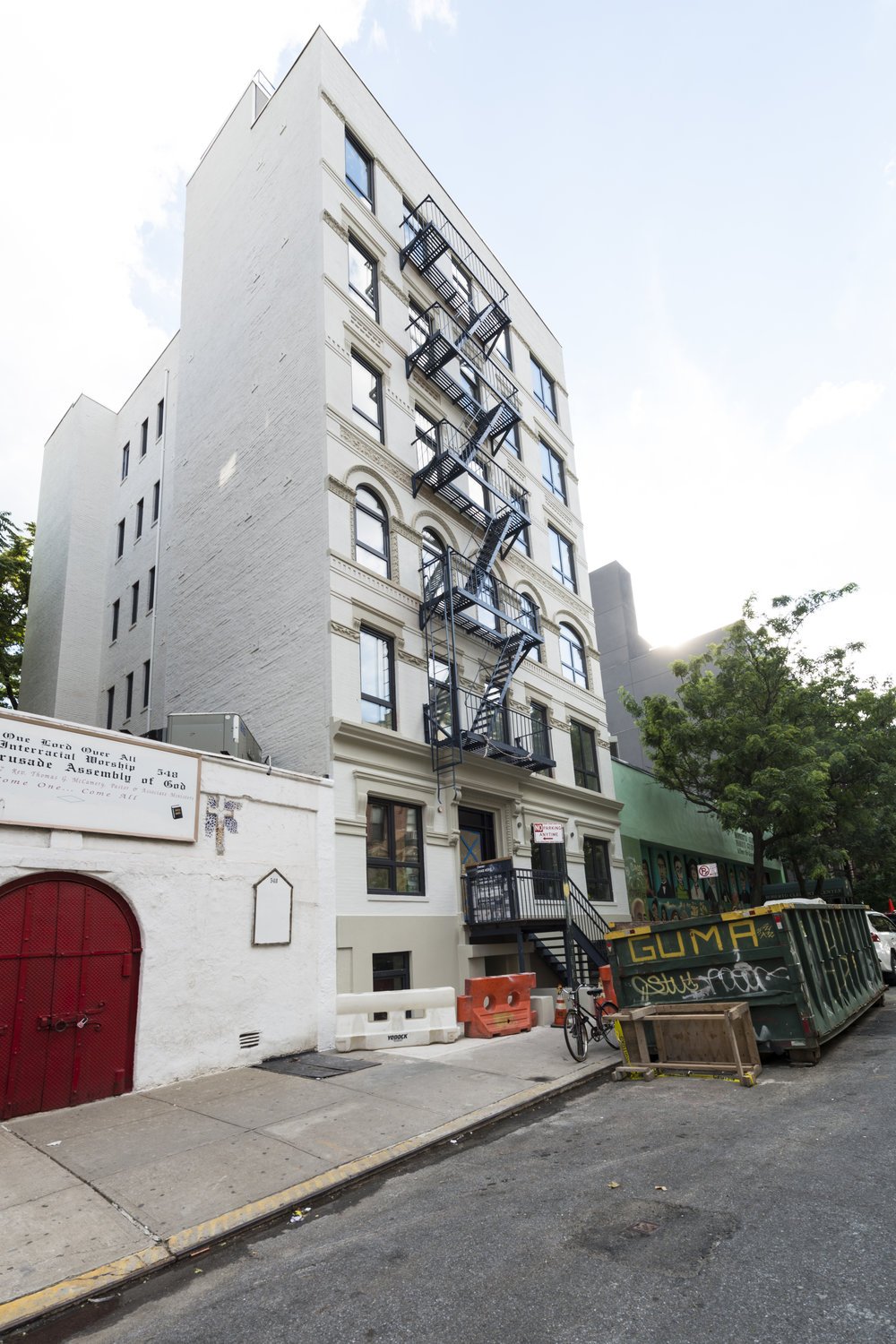
<p><img class="img-responsive" src="/images/Torchlight-544-East-13th-Street.jpg" alt="544 East 13th Street"><span style="color: #010f5d; font-weight: 800;">Caption: 544 East 13th Street</span></p>

<p>In Mr. Christian's estimation, other municipal programs like the Retrofit Accelerator, geared to advancing voluntary building energy upgrades, are only now reaching the cusp of their full potential for helping to comprehend and confront "hard market barriers" to greener buildings. With a retrofit mandate in place, program participation and tangible accomplishment should soar.</p>

<p>Of course, program design also will affect outcomes and the Rocky Mountain Institute has developed a seven-point framework that applies to all rental housing, not just new construction. In <a href="https://rmi.org/news/how-cities-can-ensure-better-rentals-for-everyone/" title="Link to RMI article">How Cities Can Ensure Better Rentals for Everyone</a>, RMI spotlights the need to design programs in consultation with property owners and managers, the importance of establishing reliable streams of financing from both utilities and lenders to spread upfront costs over lifetime of new equipment, as well as the salience of making energy performance data transparent to tenants. Given the fraught nature New York City's multi-family residential real estate sector, the RMI framework might help to make a contribution for addressing some of its complex realities when it comes to improving energy efficiency. It is safe to say that if tenants or the media see energy efficiency upgrades as a threat to affordable rents, energy efficiency mandates are doomed.</p>

<p>Let me end with the hardest question &mdash; what kind of coalition is needed to pass a building energy retrofit bill able to do what is needed? It's clear that environmental organizations like EDF will play a vital role, as will tenant and community groups as well as the real estate industry and the professional design community. But what about the construction industry and labor unions? What about lenders? What about the State of New York, which has legal jurisdiction over residential rent laws and control over significant program funding through entities like the New York State Energy Research and Development Authority and the Green Bank? These are the known unknowns that will help determine if a bold, smart and effective building energy retrofit law gets passed. Then, there's one more known unknown, top-level political leadership, right?</p>]]>
    </content>
</entry>
<entry>
    <title>Show Us The Power</title>
    <link rel="alternate" type="text/html" href="https://www.sallan.org/Torchlight/2018/03/show_us_the_power.php" />
    <link rel="service.edit" type="application/atom+xml" href="http://www.sallan.org/movabletype/mt-atom.cgi/weblog/blog_id=18/entry_id=19708" title="Show Us The Power" />
    <id>tag:www.sallan.org,2018:/Torchlight//18.19708</id>
    
    <published>2018-03-05T20:53:29Z</published>
    <updated>2020-06-08T12:00:14Z</updated>
    
    <summary>The only chance for New York City to meet its pledge to cut its carbon footprint 80% by 2050 is to make sure that its buildings and its transportation are powered without (much) fossil fuel. While we have a long way to go in a time frame that&apos;s short, there is a lot of creative ferment and public discussion...</summary>
    <author>
        <name>Nancy Anderson, Ph.D.</name>
        
    </author>
    
    <content type="html" xml:lang="en" xml:base="https://www.sallan.org/Torchlight/">
        <![CDATA[<p>The only chance for New York City to meet its pledge to cut its carbon footprint 80% by 2050 is to make sure that its buildings and its transportation are powered without (much) fossil fuel. While we have a long way to go in a time frame that's short, there is a lot of creative ferment and public discussion about making new and old buildings alike proudly energy efficient, along with accelerating the introduction of electric vehicles, while throttling back on total car use and reviving the decrepit mass transit system. Calls to electrify everything abound and New York State's REV (Reforming the Energy Vision), gives pride of place to shifting the electric power supply model in the direction of Distributed Energy Resources that will rely on clean power sources like solar, wind, hydro and geothermal.</p>]]>
        <![CDATA[<p>While the Sallan Foundation sponsored the panel <a href="https://www.sallan.org/Offshore-Wind-In-New-York-Event/" title="Read Offshore Wind in NY Wrap-up and take advantage of extensive Resources" class="snaplinx">Offshore Wind in New York: What's Next?</a> during Climate Week 2017, prospects for onshore, rooftop scale on-shore wind power also have been getting attention. In February 2018, the City Council Environmental Protection Committee conducted hearings focused on rooftop scale wind turbines, as it contemplates new local legislation. <a href="http://legistar.council.nyc.gov/LegislationDetail.aspx?ID=3325425&amp;GUID=016A2570-EC65-4B84-82CD-B2F94F2B5AC7&amp;Options=&amp;Search=" title="Visit NYC Council Legislative Research Center" target="_blank" class="snaplinx">Intro 0048-2018</a> would require the City to map local wind resource potential for buildings taller than 100 feet and situated in designated "Zone Green" areas. This mapping initiative could both create informed decision-making on wind power's contribution to growing total renewable energy capacity as well as to saving time and money for building owners considering this energy option.</p>

<p><style>.embed-container { position: relative; padding-bottom: 56.25%; height: 0; overflow: hidden; max-width: 100%; } .embed-container iframe, .embed-container object, .embed-container embed { position: absolute; top: 0; left: 0; width: 100%; height: 100%; }</style><div class='embed-container'><iframe src='https://www.youtube.com/embed/dW2J1cc_biI' frameborder='0' allowfullscreen></iframe></div></p>

<p><a href="http://legistar.council.nyc.gov/LegislationDetail.aspx?ID=3325426&amp;GUID=DABB9428-6DDB-41FF-BCEE-12E0308F0CDB&amp;Options=&amp;Search=" title="Visit NYC Council Legislative Research Center" target="_blank" class="snaplinx">Intro 0050-2018</a> would set noise limits and establish building code specifics to guide property owners in "Zone Green" areas interested in installing rooftop wind power devices, sized at 100kW or less. The Committee had experts testify about emerging and existing technologies, like vertical or bladeless rooftop scale wind turbines and what could be done to remove legal impediments to their installation diffusion, while ensuring public safety and enhancing New York City's supply of clean energy. The Committee is also considering <a href="http://legistar.council.nyc.gov/LegislationDetail.aspx?ID=3344782&amp;GUID=58E3ED36-D6C6-4B12-9816-16996ACA259B&amp;Options=&amp;Search=" title="Visit NYC Council Legislative Research Center" target="_blank" class="snaplinx">Intro 0598-2018</a>. It would require all City-owned buildings to be powered by green energy sources no later than 2050, as well as Resolution 176-2018 in support of developing New York's multi-megawatt offshore wind power potential, in recognition of its role in realizing the State's Clean Energy standard, which requires all utilities in the state to distribute 50% of the electricity from renewable sources, not limited to wind, by 2030.</p>

<p>At the Environmental Protection Committee hearing, the De Blasio Administration offered "general support" for the bills. The NYC Environmental Justice Alliance testified on behalf of wind power, specifically addressing Resolution 176-2018 by observing, "In addition to its promising economic potential, wind power &mdash; particularly through large-scale offshore wind development &mdash; can have extensive environmental and health benefits in vulnerable communities who have been historically exposed to noxious pollutants generated from fossil fuel energy infrastructure &#8230; The City should study, prioritize and streamline the deployment of wind power systems in the coming years &#8230; We recommend that any offshore wind power cost-benefit analyses include economic, social environmental and resiliency benefit inclusive of robust equity metrics." Much the same could be applied to rooftop scale wind power.</p>

<p>Now, let's kick things up a level to New York State. That's where the major, direct levers of energy law and regulation reside, as well as funding for utilities' energy efficiency incentive programs; the City's direct legal powers when it comes to utility and non-utility electricity are circumscribed in comparison. The Cuomo Administration has been making major decisions and <a href="https://www.forbes.com/sites/jaredanderson/2017/01/09/ny-nuclear-plants-capacity-to-be-replaced-with-renewables-and-energy-efficiency-at-minimal-cost/" title="Visit Forbes to read the article" target="_blank" class="snaplinx">making headlines about its efforts to shut down the Indian Point nuclear power plant</a>, something slated to occur in 2021. Its closure will mean an end to 25% of New York City's current electric supply, all 2,000 megawatts of it carbon-free.</p>

<p>At a February 2018 panel hosted by the Guarini Institute at NYU Law School, panelists were confident that replacing the carbon free power now generated by Indian Point would be achievable. NRDC commissioned a report about <a href="https://www.nrdc.org/experts/jackson-morris/roadmap-replacing-nys-indian-point-clean-energy" title="Visit NRDC to read more and to download the report" target="_blank" class="snaplinx">the impact of the plant's shutdown</a>, which modeled six different futures. It supports Indian Point closure and concludes that the shutdown will not hinder the State goal of getting 50% of its electric power supply from renewables by 2030 or raise carbon emissions levels. It also posited that energy efficiency gains will be critical to this endeavor, although the current 1% annual gains in efficiency can and must be ramped up to 3%. Jackson Morris, the NRDC panelist, called this "hard but doable".</p>

<p>The New York Independent System Operator (NYISO), whose job it is to "keep the lights on" was confident, based on its analytic work whch found a steady 8 year trend of declining electricity demand in this state, that the post-Indian Point power grid will be able to ensure continued energy reliability, even as the moderator pushed panelists hard on both reliability and decarbonizing the power supply, calling the nuclear shutdown "nuts" from a climate change perspective.</p>

<p>So, is a clean, low carbon, reliable and cost-effective energy future for New York "hard but doable" or "nuts" without Indian Point? Stay tuned, or better yet, get engaged.</p>
]]>
    </content>
</entry>
<entry>
    <title>The Science Guy And The Rest Of Us</title>
    <link rel="alternate" type="text/html" href="https://www.sallan.org/Torchlight/2017/11/the_science_guy_and_the_rest_of_us.php" />
    <link rel="service.edit" type="application/atom+xml" href="http://www.sallan.org/movabletype/mt-atom.cgi/weblog/blog_id=18/entry_id=19276" title="The Science Guy And The Rest Of Us" />
    <id>tag:www.sallan.org,2017:/Torchlight//18.19276</id>
    
    <published>2017-11-15T05:07:16Z</published>
    <updated>2020-06-08T12:00:14Z</updated>
    
    <summary>I saw &quot;Bill Nye: Science Guy&quot; a film that weaves several narrative strands together in an admiring but deeply disturbing documentary...</summary>
    <author>
        <name>Nancy Anderson, Ph.D.</name>
        
    </author>
    
    <content type="html" xml:lang="en" xml:base="https://www.sallan.org/Torchlight/">
        <![CDATA[<p>This fall I saw "Bill Nye: Science Guy" a film that weaves several narrative strands together in an admiring but deeply disturbing documentary. The first strand follows Bill Nye from his days as the TV goofy science guy in a series aimed at young viewers, which aired from 1993&ndash;1998, to a well-respected educator and fearless spokesperson for climate change science. "Fearless"? Yes. He's appeared on Fox TV to cross swords with climate deniers like weather forecaster Joe Bastardi and engaged in public, in-person debates in less-than-receptive venues. The second strand is biographic.</p>]]>
        <![CDATA[<p>It's the third strand that's tough going. Here, Nye's fear is palpable for the future of science as a indispensible way of understanding the world we live in, and its erosion as something we share and respect as a society. We witness not just a take-no-prisoners attack on climate science, although it is the most dramatic part of the film. The Science Guy's pained dismay over literalist biblical exhibits at the <a href="https://creationmuseum.org" title="Museum of Creation" target="_blank" class="torchlinx">Museum of Creation</a> and his fear for the consequence of such exhibits &mdash; children will become unable to absorb the lessons of evolutionary science, whatever their religious faith &mdash; was one of the film's most alarming moments.</p>

<style>.embed-container { position: relative; padding-bottom: 56.25%; height: 0; overflow: hidden; max-width: 100%; } .embed-container iframe, .embed-container object, .embed-container embed { position: absolute; top: 0; left: 0; width: 100%; height: 100%; }</style><div class='embed-container'><iframe src='https://player.vimeo.com/video/236842249' frameborder='0' webkitAllowFullScreen mozallowfullscreen allowFullScreen></iframe></div>

<p>Now for a segue to the recently released <a href="https://www.nytimes.com/interactive/2017/11/03/climate/document-Climate-Science-Special-Report-2017.html" title="NYT Article" target="_blank" class="torchlinx">4th US Climate Science Special Report</a>. That this report has seen the light of day during the Trump Administration is something of a miracle. But, it's not a miracle that holds glad tidings about salvation from the risks of inaction and federal policy reversals on coal and climate change. The din of polarization and the fervor that's been ginned up to make public views of climate science a litmus test of political and civic identity, means it's unlikely that climate deniers will reconsider their beliefs in the face of the unambiguous science on climate change. The day after the release of the report, a New York Times headline said it all <a href="https://www.nytimes.com/2017/11/04/climate/trump-climate-change-report.html" title="NYT Article" target="_blank" class="torchlinx">A Climate Report That Changes Mind? Don't Bet on It</a></p>

<p>It's become a truism to say "elections matter", and they do, a great deal. But here's the thing, what's happening now, is the cultural erosion of science and scientific method as legitimate and widely respected tools for discovering the truth and foundations for setting public policy. It takes more than election outcomes to reset a cultural trend, and this trend is not just science in the abstract, it also is manifested in personal attacks on scientists. A <a href="/Snapshot/2015/09/climate_scientists_in_the_crosshairs.php" title="Sallan Snapshot Article" target="_blank" class="torchlinx">Snapshot guest column by Lauren Kurtz</a> posted on the Sallan website in September 2015 describes "scientists operating in politically controversial areas, particularly climate science, have been attacked by ideologically motivated groups trying any means possible to discredit, distract, and intimidate. Such tactics have included hate mail, death threats and even an anthrax scare. Less violently but no less noxiously, attacks via the legal system are an increasingly common way for self-styled "skeptics" to go after climate scientists with whom they disagree."</p>

<p>While scientific theory and research findings are far from the only forces that drive policy-making, as well as societal acceptance and compliance, we know we're in trouble when science and scientists are held in contempt or shoved out the door, as is happening now at the Environmental Protection Agency led by Scott Pruitt who expresses more faith in industry representatives than <a href="http://blogs.ei.columbia.edu/2017/11/06/scott-pruitts-attack-on-scientists-serving-on-advisory-boards-is-illegal/" title="Sabin Center for Climate Change Law Post" target="_blank" class="torchlinx">scientists who have received EPA research grants</a>.</p>

<p>If you agree with me, rather than curse this darkness, what candles should we be lighting?  Taking climate action and making progress must be more than acts of personal virtue, like buying carbon credits to compensate for airline travel or using LED bulbs. It must be more than donating to national and grassroots environmental organizations and it must be more than writing well-meaning columns. We must find ways to make sure that our elected officials who speak about the urgency of confronting climate change &mdash; and issue glossy reports &mdash; actually take effective actions with real impact.</p>

<p><img class="img-responsive" src="/images/Torchlight-Wright_of_Derby_The_Orrery.jpg" alt="One of Joseph Wright of Derby candlelight masterpieces"><span style="color: #010f5d; font-weight: 800;">Artist:</span> Joseph Wright of Derby, 1766</p>

<p>Science must keep a special role in guiding climate policies. If our elected representatives don't do these things, make that matter. Light a match. Be part of shifting the political culture. Today, we must find new ways to protect the status and practice of science. Why? Because as Neil deGrasse Tyson said, "The good thing about science is that it's true whether or not you believe in it. </p>

<p>Join civic advocacy groups that place a premium on climate action and are good at building alliances with others. When possible, speak up at work, help grow an informed and effective, greener corporate culture. Also, get involved in grassroots and local politics; even run for office. Cities that are climate leaders serve as beacons of light for advancing myriad resiliency agendas for all. Know, at the same time, that favoring and forging specific carbon-cutting actions will entail conflict and winning is not a sure thing. Climate progress and culture resets entail a heavy lift and there's no way to get around that. But if we share a culture that values protecting our collective future on this small planet we call home, we will be lighting many candles.</p>

<p>Start now, it's urgent.</p>
]]>
    </content>
</entry>
<entry>
    <title><![CDATA[80x50 &mdash; Promises, Promises]]></title>
    <link rel="alternate" type="text/html" href="https://www.sallan.org/Torchlight/2017/07/80x50_promises_promises.php" />
    <link rel="service.edit" type="application/atom+xml" href="http://www.sallan.org/movabletype/mt-atom.cgi/weblog/blog_id=18/entry_id=18793" title="80x50 &amp;mdash; Promises, Promises" />
    <id>tag:www.sallan.org,2017:/Torchlight//18.18793</id>
    
    <published>2017-07-11T19:33:11Z</published>
    <updated>2020-06-08T12:00:14Z</updated>
    
    <summary>Let&apos;s learn from the data on hand and let&apos;s get a wide range of views and input informed by expert information on how to move forward rapidly to make the next round of climate-enhancing NYC building and energy laws as smart, agile and effective as can be.</summary>
    <author>
        <name>Nancy Anderson, Ph.D.</name>
        
    </author>
    
    <content type="html" xml:lang="en" xml:base="https://www.sallan.org/Torchlight/">
        <![CDATA[<div class="picture pixright"><img src="/images/Torchlight-ny-city-council-chamber.jpg" alt="NYC Council Chamber"></div>

<p>At a June 2017 City Council meeting, the Environmental Protection Committee heard testimony from the de Blasio Administration and a host of environmentalists about a menu of new bills related to cutting the greenhouse gas emissions of buildings all around town.  This hearing took place a decade after then-Mayor Bloomberg launched his Greener, Greater Building Plan. As such, consider it a marker for what New York has learned about the task of taking aggressive climate action, as well as what's been done to date and what it will take for meeting its legally set goal of cutting carbon emissions 80% by 2050. I'd like to say that effusive talk has led to demonstrable action, but I'm not sure I can.</p>]]>
        <![CDATA[<p>The programmatic aspirations found in <a href="http://www.nyc.gov/html/builttolast/assets/downloads/pdf/OneCity.pdf" title="One City Built to Last">One City Built to Last</a>, <a href="http://www1.nyc.gov/html/onenyc/downloads/pdf/publications/OneNYC-2016-Progress-Report.pdf" title="the 2016 Progress Report">the 2016 Progress Report</a> and other de Blasio administration publications, offer up recommended pathways, often spelled out in later Taskforce reports, and a favorite trope of de Blasio Administration reports "program highlights", are not the same thing as actions that advance us along the still long and steep climb ahead to meet 80x50 goals. The Trump Administration stance on climate disruption and mitigation only means the road ahead for American cities won't be getting any federal assistance, but that only makes the need for keeping promises and providing detailed measurements and signposts along the way all the more important.</p>

<p>Doing my homework on programs like the Mayor's <a href="http://www.nyc.gov/html/gbee/html/challenge/nyc-carbon-challenge.shtml" title="NYC Carbon Challenge">NYC Carbon Challenge</a> and the NYC Retrofit Accelerator<a href="https://retrofitaccelerator.cityofnewyork.us" title="NYC Retrofit Accelerator"></a>, seeking information on program participation and how much greenhouse gas emissions are being reduced, along with a look-back at local laws like Energy Benchmarking, Auditing and Retrofitting leave me with warm-hearted impressions. But that's not good enough. What's needed is the firm footing to measure progress to date, whether City government, independent scientists and scholars or the media does the measuring. The only exception is the successful phase out of #6 heating oil, a clear win.</p>

<p>The June City Council hearings sharply focused the need for New York City to make sure its promises are kept. Let's look at three of the bills under discussion: Intro 1629 would update the current Energy Code by requiring new building construction and major renovations to meet efficiency standards 20% greater than those of the current code; Intro 1644 would reward developers of green projects with onsite renewable energy generation (but not other green building strategies), by fast-tracking them in the permit process at the Buildings Department; and, Intro 1632, which would create an energy score disclosure requirement as part of real estate sale transactions, were highlights of the hearings.</p>

<p>While the de Blasio Administration, environmentalists and green building supporters offered detailed testimony, the absence of anyone from the real estate owners', management or financing sectors giving oral testimony should have been one of the most newsworthy features of the day. While one Councilmember made reference to written testimony from the industry that raised concerns about the energy score method stipulated in Intro 1632, that was the only acknowledgement that real estate interests were engaged in impacting the bills under consideration. Go figure.</p>

<p>Intro 1629 is arguably the bill that potentially carries the biggest punch. Any change to the City's building code as it applies to spelling out base line energy performance of all newly constructed structures along with upgrading standards in buildings undergoing certain major and costly structural upgrades isn't optional, it's mandatory. Passive House advocates are big supporters on Intro 1629 because it moves the dial close to the energy performance levels achieved almost alone, by structures built in accordance with Passive House standards, which are a radical rethink of most venerable building and engineering practices. The City of Brussels, Belgium has put Passive House-type standards in place for all its building now, so Intro 1629 is not unprecedented and laws enacted in 2016, put NYC's own municipal buildings on notice that they will have to meet Passive House-type energy performance standards. But does that mean that NYC developers, architects, engineers, building trades and the marketplace be ready to meet Intro 1629's standards by 2025, when they would go into effect?</p>

<iframe src='https://nyc.councilmatic.org/legislation/int-1629-2017/widget/' height='260px' width='100%' scrolling='no' style='border: 1px solid #eee;'></iframe>

<p>Expect yesses and no's and maybe-buts and calls for "carrots" will fill hearing rooms and bill negotiations if this legislation moves forward. Concerns about the fine print of metrics, performance standards and costs have been raised and will be debated. Doing that work is not my purpose here. Instead, I want to look at the record and see if innovative laws like Benchmarking and Auditing/Retro-commissioning, along with voluntary programs like the Carbon Challenge and the Retrofit Accelerator are lighting the way for the next leg of the long-march-to-80x50.</p>

<div class="picture pixleft"><img src="/images/Torchlight-Getting-NYC-to-80x50.jpg" alt="Getting NYC to 80x50 Whitepaper"></div>

<p>This is where we should get concerned. To date, City government has not provided the sustained, systematic year-over-year reporting on what's been achieved to date and what challenges have become better understood. It appears that the law phasing out the burning of #6 heating oil in boilers around the City (except some power plant boilers) has been a great success and that reductions in overall GHG emissions has been attributed to the end of #6 oil as a fuel in the City. Recent warm winters have also helped. But what about the impact of the other laws and programs?</p>

<p><a href="http://www.nylcvef.org/wp-content/uploads/2017/06/Getting-NYC-to-80x50-Buildings.pdf" title="White Paper">Getting NYC to 80x50</a>, a white paper written by Byron Stigge and Adam Hinge for the New York League of Conservation Voters, cautions that, despite the City's climate leadership, there are significant "roadblocks in the roadmap" to 80x50 and getting there will require putting an end to burning fuel oil and natural gas by most buildings in the City. According to the authors, the challenges here are not technical, but rather financial in combination with the decades-old construction practices and real estate norms, often rooted in economic drivers.</p>

<p>As keenly observed in a July 2017 Climatewire story, <a href="https://www.eenews.net/stories/1060056980" title="E&E News">Mayors promise to act on climate. How much can they do?</a></p>

<p class="ml-48">Assessing the success of city climate initiatives is extremely difficult, experts say. US EPA monitors emissions at the state and facility level, leaving a skyscraper-sized hole in municipal monitoring efforts. Cities have moved to address this in recent years by conducting greenhouse gas inventories, but those efforts often vary by community and are sometimes conducted infrequently.</p>


<p>While anecdotal accounts about the accomplishments of individual NYC buildings is something to cheer, as are the City's energy reporting and energy code upgrade statutes, these successes are being not yet being scaled up to something that can achieve 80x50 or that the pace of market adoption of climate-friendly building strategies is on the way to becoming the new normal. In fact, City GHG emissions levels are, at most, inching down, not dropping at a pace to get us to 80x50. Reporting on the latest available data:</p>

<p class="ml-48">Emissions in 2014 dropped 12 percent since 2005, despite economic growth, an extremely cold winter, and increased population. As outlined in <a href="https://www1.nyc.gov/assets/sustainability/downloads/pdf/publications/NYC_GHG_Inventory_2014.pdf" title="Inventory of New York City Greenhouse Gas Emissions Published April 2016">Inventory of New York City Greenhouse Gas Emissions</a>, reductions to date had been almost entirely the result of switching to natural gas in the electricity grid.</p>

<p>This is a problem.</p>

<p>One step toward a remedy and an 80x50 accelerator would be for the City Council to hold oversight hearings and coordinate them with further hearings on the bills first discussed at the Environmental Protection' Committee's June hearing. In this way, the Administration could give testimony that provides extensive, indepth data on how its 80x50 programs are performing and what can be learned from the multiple and growing databases generated by reporting required by the Benchmarking and Audit laws as they apply to privately owned buildings. As well, agency officials should be asked to testify in depth about what's been accomplished in cutting the carbon footprint of municipally-owned buildings. Reaching beyond City government, such hearings would give all stakeholders and experts the opportunity to weigh in on what they deem necessary "to build not just a roadmap, but the road itself", to use Stigge and Hinge's pithy phrase.</p>

<p>So, let's learn from the data on hand and let's get a wide range of views and input informed by expert information on how to move forward rapidly to make the next round of climate-enhancing NYC building and energy laws as smart, agile and effective as can be. There is everything to gain and very little to lose (other than time) in scheduling a set of oversight hearings, ideally starting in January 2018, just after the winners of NYC's November elections take their offices. Who'll support this call for oversight hearings &mdash; will you?</p>]]>
    </content>
</entry>
<entry>
    <title>More Good Green Jobs For OneNYC</title>
    <link rel="alternate" type="text/html" href="https://www.sallan.org/Torchlight/2017/05/more_good_green_jobs_for_onenyc.php" />
    <link rel="service.edit" type="application/atom+xml" href="http://www.sallan.org/movabletype/mt-atom.cgi/weblog/blog_id=18/entry_id=18580" title="More Good Green Jobs For OneNYC" />
    <id>tag:www.sallan.org,2017:/Torchlight//18.18580</id>
    
    <published>2017-05-09T05:17:21Z</published>
    <updated>2020-06-08T12:00:14Z</updated>
    
    <summary>With a tip of the hat to Jane Austen, let me tweak her famous observation &quot;It is a truth universally acknowledged, that a single man in possession of a good fortune, must be in want of ...</summary>
    <author>
        <name>Nancy Anderson, Ph.D.</name>
        
    </author>
    
    <content type="html" xml:lang="en" xml:base="https://www.sallan.org/Torchlight/">
        <![CDATA[<p>With a tip of the hat to Jane Austen, let me tweak her famous observation "It is a truth universally acknowledged, that a single man in possession of a good fortune, must be in want of a wife." Today, "It is a truth universally acknowledged that a liberal big city Mayor must be in want of good jobs for all." I can't vouch that Austen was comedy-free, but I do believe that Mayor de Blasio is earnest in his commitment to good jobs for all as part of his OneNYC mission.</p>]]>
        <![CDATA[<p>In the Mayor's <a class="torchlinx" href="https://sallan.org/pdf-docs/OneNYC_2017_Progress_Report.pdf" title="Take a look at the OneNYC Progress Report">2017 OneNYC Progress Report</a>, large print trumpets his credo laid out in the first <a class="torchlinx" href="https://www.sallan.org/pdf-docs/OneNYC_2015.pdf" title="Link to OneNYC 2015">OneNYC Report of 2015</a>: "I believe fundamentally you can't have environmental sustainability without economic sustainability. Nor can you have economic sustainability without environmental sustainability." This is a good thing to believe, so let's see how this credo is getting expressed in concrete policy and actions.</p>

<div class="picture pixleft"><img src="/images/Torchlight-Earth-Day-2017-3k-Jobs.jpg" alt="3,000 Green Jobs"><br><b>Photo: Ed Reed</b> Mayor de Blasio announces GJC</div>

<p>In May 2017, I interviewed Daniel Zarrilli, Senior Director, Climate Policy and Programs and New York City's Chief Resilience Officer, to get up to speed about the Green Jobs Corps (GJC), a recently announced initiative for advancing the Mayor's agenda of harnessing together environmental and economic urban sustainability, which builds on experience gained after the City funded an initial 100 Sandy-impacted residents through pre-apprenticeship programming. Here are some facts provided by the City: exceeding its original goal, 209 people have been trained through the Sandy Recovery Workforce and 173 people have entered union apprenticeship programs to date. Graduates have joined the ranks of DC9 Painters, Electricians Local 3, Laborers Local 731, Laborers Local 79, Metal Lathers Local 46, NYC District Council of Carpenters, Plumbers Local 1, Roofers and Water Proofers Local 8, Sheet Metal Workers Local 28, and Tile Marble and Terrazzo Local 7.</p>

<p>The <a class="torchlinx" href="http://www1.nyc.gov/office-of-the-mayor/news/254-17/earth-day-mayor-building-construction-trades-council-launch-first-nyc-green-jobs-corps-training" title="New York City Hall Press Release" target="_blank">Green Jobs Corps</a> will launch its first pre-apprentice training program this summer with a class of 200 New York residents of various ages. It's worth noting that instead of just being conventionally youth-centric, the GJC embraces the "Helmets to Hardhats" jobs program for military veterans as well as a program for non-traditional career paths for women. Over three years, the Green Jobs Corps aims to familiarize 3,000 women and men with construction work. According to Mr. Zarrilli, the GJC will put graduates on a good jobs "pathway", because successful completion of the Corp's pre-apprentice program, will make graduates eligible for entry into the Building Construction Trade Council of Greater New York apprentice programs, a venerable route to union membership and good-paying jobs.</p>

<div class="picture pixright"><img src="/images/Torchlight-Earth-Day-2017-GJC.jpg" alt="Visit to Local 3 in Long Island City"><br><b>Photo: Ed Reed</b> Mayor Bill de Blasio visits Local 3</div>

<p>But not just any good-paying construction jobs! The GJC, Mr. Zarrilli emphasized, will provide 3,000 New Yorkers with the skills needed to participate in the emerging clean energy economy. <a href="https://sallan.org/pdf-docs/OneCity_2015.pdf" title="Take a look at OneCity Built to Last">OneCity Built to Last</a>, mapped out the City's goal to cut its greenhouse gas emissions 80% by 2050 and its commitment to "lead by example", by way of its own new construction and major renovations &mdash; now required by Local Laws 31/32 of 2016 &mdash; at very high performing building energy standards. In addition to its intent to ramp up renewable energy installations around the City, there is a real opportunity at hand for matching people to skills and skills to good jobs.</p>

<p>Admirably, <em>OneCity Built to Last</em> pledged to "Closely track our progress. We will create a Compstat-like portal at the <a class="torchlinx" href="http://www1.nyc.gov/office-of-the-mayor/news/043-07/mayor-s-office-long-term-planning-sustainability-completes-phase-two-outreach-campaign" title="Visit the Mayor's Office Of Long-term Planning And Sustainability Completes Phase Two Of Outreach Campaign" target="_blank">Office of Long Term-Planning and Sustainability</a>, in partnership with Mayor's Office of Operations and DCAS, to track the progress toward our goals and provide a report of our progress each year." Given the relatively small-scale and fixed time frame for the GJC, regular disclosure of data on its performance should be easy to do. Feedback and, if needed, course correction are hallmarks of well-designed public policy.</p>

<p>Yet, even feedback and course correction are not enough if policy aims aren't as big as the problems to be solved. Good jobs for all is a great promise, but if it were easy to deliver on, it would have already happened. It's well known that even low unemployment rates can mask jobs that don't pay a living wage and it's to the Mayor's credit that he's an advocate for jobs that do provide a living wage and offer prospects for steady work. That's why the Mayor should deepen the promise of the Green Jobs Corps and the workforce that's needed to do the work that will be needed to ensure the City meets its 80 by 50 obligations. He should commit City government to hiring all qualified Green Jobs Corps graduates, whether or not they make it into a union apprentice program, so they will receive the City-worker wages and benefits. The work cut out for NYC to become energy efficient, climate sustainable, and climate resilient in every neighborhood is ample.  Let's lead by example and start hiring now.</p>]]>
    </content>
</entry>
<entry>
    <title>Hyper Objects In A Time Of Hyper Politics</title>
    <link rel="alternate" type="text/html" href="https://www.sallan.org/Torchlight/2017/03/hyper_objects_in_a_time_of_hyper_politics.php" />
    <link rel="service.edit" type="application/atom+xml" href="http://www.sallan.org/movabletype/mt-atom.cgi/weblog/blog_id=18/entry_id=18319" title="Hyper Objects In A Time Of Hyper Politics" />
    <id>tag:www.sallan.org,2017:/Torchlight//18.18319</id>
    
    <published>2017-03-16T16:13:31Z</published>
    <updated>2020-06-08T12:00:14Z</updated>
    
    <summary>&quot;After Nature&quot; is an exhibit of ice sheets and shoreline bedazzled photographs taken by artist Justin Brice Guariglia from a NASA research plane. What&apos;s unseen, but key to the meaning of &quot;After Nature&quot; is the idea that climate change is a &quot;hyperobject&quot;, something that doesn&apos;t exist in just one place or at one time.</summary>
    <author>
        <name>Nancy Anderson, Ph.D.</name>
        
    </author>
    
    <content type="html" xml:lang="en" xml:base="https://www.sallan.org/Torchlight/">
        <![CDATA[<p>"After Nature" is an exhibit of ice sheets and shoreline bedazzled photographs taken by artist Justin Brice Guariglia from a NASA research plane. It displays instants in time of a frozen Greenland that looks eternal, but which is undergoing profound climate-caused disruptions. What's captured in his photographs &mdash; many printed on indestructible Styrofoam &mdash; has already changed. What's unseen, but key to the meaning of "After Nature" is the idea that climate change is a "hyperobject", something that doesn't exist in just one place or at one time.</p>]]>
        <![CDATA[<div class="picture pixright"><a href="https://guariglia.com/artworks/9370/"><img src="/images/Torchlight-Jakobshavn-I-Glacier.jpg" alt="Guariglia: Jakobshavn I"></a><br><b>Image:</b> JAKOBSHAVN I</div>

<p>It's a concept that offers a useful way of envisioning climate change; not just that it's happening globally and over a time span, but it's happening, invisible to many, at power plants, from vehicle tail pipes, in buildings we inhabit, through industry practices and government policies &mdash; even as it's visibly happening in Greenland's ice. The funding for NASA climate research flight that carried Guariglia aloft to take his photos itself is subject to change, melt-down and evaporation as a result of Trump Administration proposed deep cuts to climate science funding. Could we be losing our ability to clearly see climate change? Yes. Does this make Guariglia's Greenland photos <em>momento mori</em>? Maybe.</p>

<p>The news is filled with stories about proposed <a href="http://www.climatecentral.org/news/noaa-cuts-could-stymie-research-21221" title="NOAA Cuts article on Climate Central" target="_blank">crippling NOAA budget cuts</a> that will cripple climate research and weather forecasting, with even long-standing programs at risk. More of the same direction <a href="https://www.scientificamerican.com/article/trump-administration-seeks-big-budget-cuts-for-climate-research/" title="Scientific American Stories by E&E News" target="_blank">is in store</a> for NASA. Equally grim is the likelihood that science <a href="https://newrepublic.com/article/141174/epas-science-office-removed-science-mission-statement" title="New Republic article about EPA Removing Science from its Mission Statement" target="_blank">will cease to be</a> a foundational basis for EPA policy making. The same goes for DOE's <a href="https://www.bloomberg.com/news/articles/2017-03-07/white-house-said-to-push-for-deep-cuts-to-clean-energy-office" title="Bloomberg article about Deep Cuts" target="_blank">clean energy office</a>.</p>

<p>What is plain to see in these stories is alarming. It's different than the banal observation that government funding is subject to political vagaries, or that the Trump Administration makes no secret of its hostility to taking action on human caused climate disruptions. What's alarming, and it's something new to American politics, is the hostility to using science, valuing scientific research and data to inform, direct and make decisions about fate and direction of the nation. It just won't do to say everything is political and leave it at that.  To discredit and deny boundaries between what science and the scientific method can teach us and the business of politics is a very dangerous exercise in cynicism when it comes to making policy, budgetary and legitimating claims for those in power. Unlike <a href="https://guariglia.com/exhibitions/" title="Guariglia's Exhibition" target="_blank">Guariglia's gorgeous exhibit</a>, this is one ugly "hyperobject"!</p>

<p>Dave Roberts, in a recent <a href="http://www.vox.com/science-and-health/2017/3/10/14871696/scott-pruitt-climate-denial" title="Vox column It's Not About Pruitt" target="_blank">Vox column</a>, takes to task the ubiquitous outrage about EPA Administrator Scott Pruitt's repudiation of human-caused climate change. Critics' repeated reminders and restatements of the science that underlie and confirm its reality miss the point about him. What's so dangerous about Pruitt, Roberts rightly argues, is the fact that Pruitt is doing what he was hired to do, dismantle EPA's climate action commitments, root and branch. As Roberts writes, "But the reason GOP beliefs on climate are so difficult to pin down is that the beliefs are not the point. The party's institutional opposition to action is the point. The beliefs are retrofit, on an opportunistic and sometimes case-by-case basis, to support the conclusion, which is: do nothing." What Roberts makes clear here is the alarming shift from running an agency with a mission that ought to be anchored in the bedrock of science, to one unmoored from science and tethered instead to opportunistic political agendas. This will not end well for the planet or the American polity.</p>

<p>Guariglia says that we don't understand the impacts of our everyday lives on big things like climate change and that it's wrong to think of the natural world as something out there, separate and apart from us, something to visit and then return home. He wants us to make that connection through what we see in his photographs. What he saw in his NASA flights was a "hyperobject", a polar region that exists at vast spatial and temporal scales. Think of ice first created 100,000 years ago. He's showing us, through the cracks, and checkering of the ice that defines the surface of his photos, that it's falling apart now.</p>

<p><img class="img-responsive" src="/images/Torchlight-JBG-Tatoo.jpg" alt="JBG Tatoo Gistemp Index"><span style="color: #010f5d; font-weight: 800;">Caption: JBG Tatoo Gistemp Index 1880&ndash;2016</span></p>

<p>That's not so different from what Roberts wants us to see when he writes "Climate denial is just the tip of the (melting) iceberg. The right's refusal to accept the authority of climate science is of a piece with its rejection of mainstream media, academia, and government, the shared institutions and norms that bind us together and contain our political disputes &mdash; Pruitt's comments point to something deeper and more corrosive than mere misinformation or misunderstanding. Explaining the basic facts of climate science (again) is utterly futile if the intended audience rejects the authority of climate scientists and scientific institutions." Now that's chilling.</p>
]]>
    </content>
</entry>
<entry>
    <title>Where Do We Go From Here?</title>
    <link rel="alternate" type="text/html" href="https://www.sallan.org/Torchlight/2016/12/where_do_we_go_from_here.php" />
    <link rel="service.edit" type="application/atom+xml" href="http://www.sallan.org/movabletype/mt-atom.cgi/weblog/blog_id=18/entry_id=17912" title="Where Do We Go From Here?" />
    <id>tag:www.sallan.org,2016:/Torchlight//18.17912</id>
    
    <published>2016-12-13T17:40:50Z</published>
    <updated>2020-06-08T12:00:14Z</updated>
    
    <summary>First, take a deep breath and repeat when needed, &quot;To be truly radical is to make hope possible, not despair convincing&quot;. Now, let&apos;s take a virtual tour of the landscape for climate hope.</summary>
    <author>
        <name>Nancy Anderson, Ph.D.</name>
        
    </author>
    
    <content type="html" xml:lang="en" xml:base="https://www.sallan.org/Torchlight/">
        <![CDATA[<p>What must the US climate action movement, policy makers and concerned business sectors do as annual temperature records break and the risk rises of blowing past the temperature caps, which scientists and signatories to the Paris Climate Accord say must be achieved to stop irreversible global chaos and damage? The election of Donald Trump has driven anxiety and teeth-gnashing to unprecedented levels about resurgent climate denialism. Looking locally, what can cities and states be doing in the Trump Age that will make a difference at a scale that matters when it comes to climate change. Answers to these questions have grave implications for public security, public health and even business as usual.</p>

<p>First, take a deep breath and repeat when needed, "To be truly radical is to make hope possible, not despair convincing". Now, let's take a virtual tour of the landscape for climate hope.</p>]]>
        <![CDATA[<h4>International Cities Climate Action</h4>

<p>As Michael Bloomberg recently tweeted...</p>

<blockquote class="twitter-tweet" data-lang="en"><p lang="en" dir="ltr">This morning at the C40 Summit <a href="https://twitter.com/MikeBloomberg">@MikeBloomberg</a> rallied Mayors around <a href="https://twitter.com/hashtag/ClimateAction?src=hash">#ClimateAction</a> which is more important now than ever. <a href="https://twitter.com/hashtag/cities4climate?src=hash">#cities4climate</a> <a href="https://t.co/RJiCuH9XN7">pic.twitter.com/RJiCuH9XN7</a></p>&mdash; C40 Cities (@c40cities) <a href="https://twitter.com/c40cities/status/804365662839799809">December 1, 2016</a></blockquote>
<script async src="//platform.twitter.com/widgets.js" charset="utf-8"></script>

<p>First stop on our climate hope tour is the December 2016 meeting of C40. <a href="http://www.c40.org" title="Visit the C40 website" target="_blank" class="torchlinx">C40 is an alliance of 86 affiliated cities</a>, home to one of every twelve people on Earth, organized for fostering city leadership in responding to the rising threat of climate change impacts and identifying what cities, rich, developing and poor can do to cut GHG emissions and lower the threat of climate change impacts by raising the resiliency capacity of all cities. The title of a new <a href="http://www.c40.org/other/deadline_2020" title="Deadline 2020 Report" target="_blank" class="torchlinx">C40 report Deadline 2020</a> captures its sense of urgency by pegging action to the very near future, not to some number of decades in the future. "The overriding and deeply significant finding of the work is that the next 4 years will determine whether or not the world's megacities can deliver their part of the ambition of the Paris Agreement. Without action by cities the Paris Agreement cannot realistically be delivered." Why? "Over half the emissions savings identified in this routemap can be delivered directly or through collaboration by C40 city governments."</p>

<p>New York is among the US cities in C40 and the influence of its climate policies, started by Michael Bloomberg and carried forward by Bill De Blasio is cited in Deadline 2020 as it maps a pathway for how C40 cities could set themselves on a trajectory to deliver on the ambition of the Paris Agreement. Covering five sectors: energy; buildings; transportation; waste; and urban planning, "The emissions reduction potential of 62 programmes were modeled, comprising over 400 climate actions. City by city, trajectories were developed to identify what action must be taken and in what order, to enable all cities to contribute to the 1.5 degree ambition."</p>

<p>As with all voluntary associations, doing the hard work to make the kinds of deep changes that will be required to decarbonize the five sectors of city life targeted in these 62 programs will require a level of sustained commitment, financing, monitoring, measurement, enforcement and consensus that some participating cities may be unable to muster.  That said, we could be surprised at how deep changes in the activities fed by our collective fossil-fuel addictions can be executed at the urban scale, maybe better than national governments led by climate change deniers.</p>

<div class="picture pixright"><a href="http://uccrn.org/files/2015/12/ARC3-2-web.pdf"><img src="/images/Torchlight-ARC3.2-SCL-Summary-for-City-Leaders-Cover.jpg" alt="Summary for City Leaders"></a><br><b>Report:</b> Summary for City Leaders</div>

<p>On our tour of the landscape for climate hope, C40 is not the only international urban climate-focused undertaking worth a visit. The 2015 Climate Change and Cities Report, which is the Second Assessment Report of the Urban Climate Change Research Network (ARC 3.2) produced a special <a href="http://uccrn.org/arc3-2/" title="Summary for City Leaders" target="_blank" class="torchlinx">Summary for City Leaders</a> that "synthesizes major findings and key messages on urban climate science, disasters and risks, urban planning and design, mitigation and adaptation, equity and environmental justice, economics and finance, the private sector, urban ecosystems, urban coastal zones, public health, housing and informal settlements, energy, water, transportation, solid waste, and governance. These were based on climate trends and future projections for 100 cities around the world." And it is heartening to read that, "In response to the wide range of risks facing cities and the role that cities play as home to more than half of the world's population, urban leaders are joining forces with multiple groups including city networks and climate scientists." Finally, <a href="https://www.brookings.edu/research/growth-carbon-and-trump-state-progress-and-drift-on-economic-growth-and-emissions-decoupling/" title="Growth, carbon, and Trump: State progress and drift on economic growth and emissions decoupling" target="_blank" class="torchlinx">new research discovers</a> that US states and localities can economically grow while their carbon emissions shrink, economists call this "decoupling". The problem is that the rate at which carbon emissions are falling is too slow to prevent serious global overheating, so national policy still matters, a lot.</p>
  
<h4>Grassroots Activism</h4>

<p>Bill McKibben wasn't writing specifically about urban grassroots activism when he called for massive passive resistance as the climate tool of the people, but I think he'd recommend it as a <a href="https://www.thenation.com/article/how-the-active-many-can-overcome-the-ruthless-few/" title="Link to Article in The Nation" target="_blank" class="torchlinx">path for urban climate and environmental justice activists</a>. Grassroots activism can be a lever of change, especially for goals that look like long shots. My own view is that passive resistance is not the primary tool for a solving a problem as multi-faceted and "wicked" as climate change because the need not only to stop something but to start many new things, that "long march through the institutions" (to tip my hat to 60's radical Rudi Dutschke) calls for something else. What the specific "something else" should be in the Trump Age is not yet clear and how far it can reach, when the change agents work primarily at the urban, state, and institutional levels is something we are going to discover. Let's continue our tour.</p>

<p>Moving on to urban grassroots activism, New York City is home to environmental justice organizations like WE-ACT and the NYCEJA that have deep roots in their communities and decades of influencing local environmental policies and developments. Another longstanding grassroots organization of organizations is ALIGN, an alliance of labor and community groups. It works at the intersection of economy, environment, and equity to make change and build movement for a just and sustainable city. These organizations will certainly be challenged as change agents in the Trump Era, but their deep community roots give them staying power and their track record of achievement make them forces to be reckoned with.</p>

<p><img class="img-responsive" src="/images/Torchlight-Peoples-Climate-march.jpg" alt="Peoples Climate March"><span style="color: #010f5d; font-weight: 800;">Caption: Peoples Climate March Columbus Circle September 2014</span></p>

<p>Finally, on this leg of our tour of grassroots green activism, let's take a virtual Instagram of the potential impact of GOP voters who favor renewable energy, even if they're opposed to climate-friendly politics. According to a recent survey of 1,000 Trump voters, 75% "support <a href="https://www.greentechmedia.com/articles/read/new-survey-shows-renewable-energy-polls-ridiculously-well-among-trump-voter" title="Link to greeentech media article" target="_blank" class="torchlinx">action to accelerate the deployment and use of clean energy</a> &mdash; including solar, wind, energy efficiency, and community renewable projects." In 2015, the <a href="http://www.pri.org/stories/2015-04-11/green-tea-party-fights-more-environmentally-friendly-gop" title="Link to Public Radio International Story" target="_blank" class="torchlinx">"Green" Tea Party</a> captured media attention with its struggles to create a more eco-friendly GOP.  While these GOP voters were headliners in the 2016 election, they aren't going away either.</p>

<h4>Corporate Climate Engagement</h4>

<p>Yes, there are climate activists in the corporate world, even if that's not what they call themselves. Here are some top-sights on our virtual tour. First, Tesla Motors, electric vehicles and advanced energy storage technologies are not looking to extend our addiction to fossil fuels. Then, check out <a href="https://www.yahoo.com/news/why-trumps-election-hasnt-crushed-the-hopes-of-environmentalists-135226702.html" title="Link to Walmart" target="_blank" class="torchlinx">Walmart</a>, and <a href="https://www.amazon.com/p/feature/9xtek3a9d9cd3wb" title="Link to AWS" target="_blank" class="torchlinx">Amazon Web Services</a> or <a href="http://www.apple.com/newsroom/2016/09/apple-joins-re100-announces-supplier-clean-energy-pledges.html" title="Link to Apple News Release" target="_blank" class="torchlinx">Apple</a>, both giant energy users who are buying oodles of renewable power to operate their businesses. Now, Google is making headlines by announcing its global operations will go <a href="https://www.greentechmedia.com/articles/read/google-will-achieve-100-percent-renewable-energy-in-2017" title="Link to greentech media article" target="_blank" class="torchlinx">100% renewable energy in 2017</a>. Before moving on, take note of the growing financial market for "green bonds", "energy efficient mortgages" and the increasing concern in the insurance industry about the catastrophic cost of climate damage, whether from storms, floods or heat, with cities on the front lines of the risk of property and liability losses and the <a href="/Ensuring-Urban-Resilience-Climate-Week-2016-Event-Wrap-up" title="Link to Come Hell Or High Water Wrap-up" target="_blank" class="torchlinx">role of insurance in fostering disaster recovery</a>. These corporate innovators are not going to close up shop during the Trump Age.</p>

<h4>On The Sidewalks of New York</h4>

<p>Welcome to the Big Apple. New York City's been an urban climate leader since Mayor Bloomberg's launch of a sweeping climate initiative in 2007 and Mayor De Blasio's extension and social justice elaboration of this arc. Like Times Square at night, it can be hard to see past the razzle-dazzle of recent building and energy code changes, program launch announcements and the long-form reports from City Hall, the latest of which is <a href="http://www1.nyc.gov/assets/sustainability/downloads/pdf/publications/New%20York%20City's%20Roadmap%20to%2080%20x%2050_20160926_FOR%20WEB.pdf" title="Download #onenyc Report" target="_blank" class="torchlinx">Roadmap to 80x50</a>, to find evidence, in the form of data, information and analysis that would inform both experts and the public about what's working well and what's not working so well in local climate-action initiatives.</p>

<p>The local law ending the use of #6 heating oil is an indisputable victory and most of the City's cuts to its carbon footprint are attributed to it. Also, expect, over time, that new municipal construction will make for much more energy efficient buildings and the growth of necessary supply chains and skilled labor. What is less clear, however, are the impacts of the City's Energy Benchmarking and Energy Audit laws or the voluntary Retrofit Accelerator program have achieved to date or to identify other trends or emerging practices that are cutting GHG emissions and energy consumption.</p>

<p>That said, let's do a mini-tour of benchmarking data by way of a November 2015 research paper by the environmental justice organization ALIGN, <a href="/pdf-docs/Elite-Emissions-Final-version-02.pdf" title="Link to November 2015 Align Research Paper" target="_blank" class="torchlinx">Elite Emissions: How the Homes of the Wealthiest New Yorkers Help to Drive Climate Change</a>, gave Donald Trump's home building at 721 Fifth Avenue an "F" for its sky-high Energy Utilization Index (EUI) rating of 216, fourth on a list of the least energy efficient luxury residential buildings in the benchmarking data base and a below-national-median Energy Star score of 43. Still, this mini-tour ends on a grace note. Since New York City climate-friendly programs are not paid for with federal funds or governed by federal laws, (although Energy Star is a federally-funded, voluntary EPA program established in 1992 for promoting energy efficiency in building and products) for the immediate future they are safe from chill winds that might be blowing from Washington. As such, New York and other climate-leading US cities can continue to act in the spirit of C40.</p>

<h4>Busy As A Beaver in Albany</h4>

<p>Last stop Albany, capital of a state whose symbol is the hard-working beaver. New York City and all other cities in the state will soon be feeling the impact of the State's Reforming the Energy Vision (REV), <a href="/Power-System-Realignment-Event-Wrap-up/" title="Get up to speed with the Sallan Power System Realignment wrap-up" target="_blank" class="torchlinx">a major overhaul of the rules of the road</a> governing the electric power sector. The REV pivots away from the decades-old model of centralized fossil-fueled power-generation and profits pegged to the amount of electric power sold to consumers. It pivots toward a regulatory model that rewards distributed clean energy production and energy efficiency. At the same time, <a href="https://greenbank.ny.gov/About/Overview" title="Link to NY Green Bank" target="_blank" class="torchlinx">NY Green Bank</a> is increasing "the availability of capital for projects deploying proven clean energy technologies across New York State through... leveraging private sector capital to support and expand clean energy financing markets". Given the dominant role states have in regulating business in the electric power sector, the Trump Administration lacks direct leverage over New York's energy policies. But just in case this should change, keep in mind that the <a href="https://en.wikipedia.org/wiki/Eurypterus" title="More about New York state fossil" target="_blank" class="torchlinx">eurypterus remipes</a>, an extinct sea scorpion, is the state fossil.</p>

<p><img class="img-responsive" src="/images/Torchlight-NYS-fossil-Eurypterus_Paleoart.jpg" alt="NYS fossil"><span style="color: #010f5d; font-weight: 800;">Caption: New York State fossil, eurypterus remipes</span></p>

<p>By now, many of you on this virtual tour have resumed gnashing your teeth and feeling anxious about what the Trump Era will mean and are shaking your heads at my anodyne-seeming views that make no reference to all the bad things that are threatening in the Trump Era. But I am no Candide; this is not the best of all possible worlds, certainly not with <a href="http://www.nytimes.com/2016/12/07/opinion/an-enemy-of-the-epa-to-head-it.html" title="New York Times Article about Pruitt" target="_blank" class="torchlinx">Scott Pruitt as head of the EPA</a>.</p>

<p>The 2016 climate hope tour ends here: Our democracy is facing among the gravest self-inflicted threats in its history and many are writing potently about these threats and the perils we face. For now, pointing to evidence that all is not yet lost, seems the right thing for me to be doing. I hope you agree and I wish you well in the coming times.</p>
]]>
    </content>
</entry>
<entry>
    <title>Cutting Carbon Is The New Black</title>
    <link rel="alternate" type="text/html" href="https://www.sallan.org/Torchlight/2016/08/cutting_carbon_is_the_new_black.php" />
    <link rel="service.edit" type="application/atom+xml" href="http://www.sallan.org/movabletype/mt-atom.cgi/weblog/blog_id=18/entry_id=17487" title="Cutting Carbon Is The New Black" />
    <id>tag:www.sallan.org,2016:/Torchlight//18.17487</id>
    
    <published>2016-08-24T00:55:18Z</published>
    <updated>2020-06-08T12:00:14Z</updated>
    
    <summary>&quot;You had me at hello&quot;, the famous line Renee Zelwegger used on Tom Cruise in the 1996 film Jerry Maguire, echoed the day I met Yeohlee Teng at her fashion-forward NYC shop, when she volunteered that local production of her clothes helped to &quot;shrink her carbon footprint. She had me at &quot;shrink&quot;.</summary>
    <author>
        <name>Nancy Anderson, Ph.D.</name>
        
    </author>
    
    <content type="html" xml:lang="en" xml:base="https://www.sallan.org/Torchlight/">
        <![CDATA[<p>"You had me at hello", the famous line Renee Zelwegger used on Tom Cruise in the 1996 film Jerry Maguire, echoed the day I met Yeohlee Teng at her fashion-forward NYC shop, when she volunteered that local production of her clothes helped to "shrink her carbon footprint. She had me at "shrink".</p>

<p>Next thing I knew, I sat down for a chat with Yeohlee about her design practices, honed over a career going back to 1981, and read a book about her work. <span class="refbox" id="fn1ref"><a href="#fn1text">[1]</a></span> Before that "shrink" moment, fashion, one of NYC's most storied industries, had meant "shopping" to me. Doing something about the city's carbon footprint and raising its sustainability quotient meant my professional work on advocacy and education around high performance buildings, renewable energy, growing good green jobs and smart infrastructure. Suddenly, new greener city vistas were opening to me and at a time where local and national attention is both riveted and riven over what kinds of jobs and what kind of society should we want to be building.</p>]]>
        <![CDATA[<div class="getty embed image" style="background-color:#fff;display:inline-block;font-family:'Helvetica Neue',Helvetica,Arial,sans-serif;color:#a7a7a7;font-size:11px;width:100%;max-width:594px;"><div style="padding:0;margin:0;text-align:left;"><a href="http://www.gettyimages.com/detail/454987304" target="_blank" style="color:#a7a7a7;text-decoration:none;font-weight:normal !important;border:none;display:inline-block;">Embed from Getty Images</a></div><div style="overflow:hidden;position:relative;height:0;padding:69.023569% 0 0 0;width:100%;"><iframe src="//embed.gettyimages.com/embed/454987304?et=9Rcf6F5mSP9GFiGwMl9_Mg&viewMoreLink=on&sig=PUn4PxH-sTvdN3Ird7dTvH5N7KnI8Rvsa2Ocw7K1mno=&caption=true" width="594" height="410" scrolling="no" frameborder="0" style="display:inline-block;position:absolute;top:0;left:0;width:100%;height:100%;margin:0;"></iframe></div><p style="margin:3;"></p></div>

<p>Staying in a local framework and a now decades-long discussion about whether manufacturing can be revived here, a recent report, <a href="https://nycfuture.org/research/publications/making-it-here-the-future-of-manufacturing-in-new-york-city" title="Making It Here Report for download at the Center for an Urban Future" target="_blank">Making It Here: The Future of Manufacturing in New York City</a> deftly sets out the terms:</p>

<p>"The broad consensus is that the city's recent industrial growth is being driven by a new kind of manufacturing: small, entrepreneurial companies that are making specialty products mainly for individual consumers and businesses in the region. These makers and manufacturers are producing in small batches with quick turnaround times, investing in new technologies, capitalizing on connections to the city's thriving creative industries &mdash; including design, fashion, and film &mdash; and taking advantage of powerful demographic, economic, and consumer trends.</p>

<p>Sounds just like what a vibrant sector of NYC fashion industry can be, when what was old &mdash; small-scale, start up and locally-made &mdash; is new again. And to think this can be climate-friendly, carbon footprint-shrinking too!</p>

<p>Yeohlee explained that the path to her own fashion/carbon footprint practices arose from what she described as her frugality, which in turn was rooted in her sense of the finiteness of the planet's natural resources. When early in her career, she had the opportunity to work with seven meters of expensive fine fabric, she set herself the task of using up all of the available fabric, including the scraps, creating three gowns that are now in the Permanent Collection of the Costume Institute, Metropolitan Museum of Art, New York..  This was the essence of a zero-waste approach to fabric, labor and time in her design decisions. It has come to infuse her teaching curriculum too.</p>

<p>Fashion historian Valerie Steele made this observation in an interview with Yeoholee "Architecture and fashion are usually seen as opposites: one edifice, the other ornament... What does the term 'architectural fashion' mean to you?" When Yeohlee mentioned to me that she comes from a family of architects, I was struck by a parallel between efficiency as a principle of garment making and energy efficiency in climate-friendly architecture.</p>

<div class="picture pixright"><a class="torchlinx" href="/pdf-docs/Making_It_Here_Report.pdf"><img src="/images/Torchlight-Making-It-In-New-York-Report.jpg" alt="The Future of Manufacturing In New York City"></a><br><b>Report:</b> Making It Here</div>

<p>As the <a href="/pdf-docs/Making_It_Here_Report.pdf" title="download Making It Here report" class="torchlinx">Making It Here</a> report sketches the innovators in NYC's recent industrial growth, "Some are tapping into New York's status as a leading center in the back-to-local movement, where a large and growing mass of consumers are demanding locally made, artisanal products." This is a good description of Yeohlee's fashion career along with the efficiency that is a core commitment of her work as expressed in the local production of much of her clothing; her production and shipping offices are in the Garment District just a few blocks from her Flatiron district shop. <span class="refbox" id="fn2ref"><a href="#fn2text">[2]</a></span> No long-haul flights to overseas garment factories, no energy-gobbling long-haul shipments of most of her clothing from the point of production to the point of sale. Her business exemplifies the "back-to-local movement" limned in the report and in her case, one "Benefiting from the city's rapid growth in affluent residents, many of whom are willing to pay a premium for locally-made and designed clothing".</p>

<p>In 2011, while serving of the Board of Directors of the Municipal Arts Society (MAS) &mdash; a position she still holds &mdash; Teng led a garment district initiative that produced <a href="https://www.scribd.com/document/69466169/MAS-Garment-District-Report-2011#page=3" title="Report on the future of NYC's garment industry" target="_blank"><span class="refbox" id="fn3ref"><a href="#fn3text">[3]</a></span>a report on the future of NYC's garment industry</a>. In it, the MAS tipped its hat to the emerging importance of sustainability by calling it an increasingly important concept in manufacturing and a key driver of innovation. It also presciently noted, "A focus on the environmental and social costs of garment production will only make domestic production &mdash; where labor and environmental standards are higher &mdash; more attractive for companies.</p>

<style>.embed-container { position: relative; padding-bottom: 56.25%; height: 0; overflow: hidden; max-width: 100%; } .embed-container iframe, .embed-container object, .embed-container embed { position: absolute; top: 0; left: 0; width: 100%; height: 100%; }</style><div class='embed-container'><iframe src='https://player.vimeo.com/video/31495498' frameborder='0' webkitAllowFullScreen mozallowfullscreen allowFullScreen></iframe></div>

<p>In addition, as consumers become increasingly aware of environmental and labor practices abroad, designers may be less willing to take the risk of linking their companies with these practices". Fires and other calamities in overseas garment plants over the last few years have buttressed this prediction that knits together environmental protection with labor rights.</p>

<p>For Alinda Franks, Director of Community Affairs at the <a href="http://itac.nyc/" title="Industrial and Technical Assistance Corporation" target="_blank">Industrial and Technology Assistance Corporation (ITAC)</a>, the fashion industry is coming back in NYC, and it's happening in small companies using new technologies. This represents a great opportunity to cut the industry's carbon footprint through new ways of sourcing, producing high quality clothes in small batches for niche urban markets, which can command higher prices compared to the mass garment production typical of overseas manufacturers. NYC is also seeing the emergence of co-working spaces, especially outside of Manhattan, that can put a wealth of resources at the fingertips of small and start up fashion companies at lower costs.</p>

<p>Tara St. James, Production Coordinator, <a href="http://bkaccelerator.com" title="Brooklyn Fashion + Design Accelerator" target="_blank">Brooklyn Fashion + Design Accelerator</a> sees this fashion industry comeback too. At the Accelerator there are dozens of sustainability strategies, some work in combination, others are more stand-alone. What's clear is that they're catching on with emerging fashion designers and makers. Broadly speaking, these strategies emphasize local production (within a radius of 100&ndash;300 miles), but a big challenge is finding locally produced fibers and fabrics, which can be transported to garment makers by truck rather than plane.</p>

<p>St. James also cites innovations like: zero waste &mdash; including highly skilled zero waste pattern making and cutting &mdash; along with upcycling &mdash; using existing material or garments to make new garments &mdash; and the "take back", especially of worn denim clothing, to make new garments by well known companies like Eileen Fisher. This fall, the Accelerator will post a new on-line tool to be used as a resource for sustainable fashion design and production. For another way to get a handle on "shops and services for lower impact shopping choices" explore this <a href="http://www.greenmap.org/greenhouse/id/node/22172" title="Multi-borough GreenMap NYC" target="_blank">multi-borough GreenMap NYC</a> below.</p>

<style>.embed-container { position: relative; padding-bottom: 56.25%; height: 0; overflow: hidden; max-width: 100%; } .embed-container iframe, .embed-container object, .embed-container embed { position: absolute; top: 0; left: 0; width: 100%; height: 100%; }</style><div class='embed-container'><iframe frameborder='0' scrolling='no' marginheight='0' marginwidth='0' src='http://www.opengreenmap.org/greenmap_widget/51243?LAT=40.713192&LON=-73.953781&ZOOM=12&TYPE=Satellite'></iframe></div>

<p>St. James also spoke frankly about the types of competitive edge and marketing impact associated with sustainable design and garment making innovations. While design innovators are starting to incorporate sustainability as good industry practice, and are seeing a rise in customer awareness, making this a new normal will take time. St. James alluded to a wrinkle in raising customer awareness via marketing or branding because of concerns that a rival company might raise criticism of what a sustainable designer or maker is not doing. As a result, often customers aren't educated on a brand's sustainable features.</p>

<p>Another wrinkle is that sustainable fashion still has to overcome a common perception that sustainability means ugly, not cool. Changes here will be critical because this is an industry dedicated to making the consumer look good, being good takes a back seat here. Sustainability in this industry won't really take off until consumers and CEO's insist on it.</p>

<p>Patrick Duffy, V.P., Sustainability, Manufacturing and External Affairs, with <a href="http://manufactureny.org" title="Manufacture New York" target="_blank">Manufacture New York</a> (MNY) and I had a deep dive discussion about what the NYC fashion and design industry is doing and could be doing to advance sustainability-driven innovation. He sees a small, but vibrant movement emerging here now. Beyond NYC, there are national and international sports and active-wear and clothing brands such as Patagonia, Nike and Eileen Fisher that have adopted, or are adopting more environmentally sustainable practices.</p>

<p><a href="http://apparelcoalition.org" title="The Sustainable Apparel Coalition" target="_blank">The Sustainable Apparel Coalition</a> (SAC) is an industry-wide collaborative effort to develop internal sustainability performance tracking metrics for the industry as a whole. According to Duffy, more standardized ways of measuring industry performance &mdash; similar to the LEED system for buildings &mdash; is needed for fashion and apparel to move forward more rapidly. Big Green groups like NRDC, EDF, Greenpeace, and others, have helped catalyze the industry by focusing on individual attributes such as toxicity (e.g. Greenpeace's "Detox" Certification Program), but a more comprehensive system with a broader set of metrics is needed for to achieve significant change.</p>

<p>Then there's the trash problem. According to "<a href="http://e360.yale.edu/feature/pressure_mounts_reform_throw-away_clothing_culture_hm_recycling/3023/#.V6umLjD3NzM.twitter" title="Pressure Mounts to Reform Our Throwaway Clothing Culture" target="_blank">Pressure Mounts to Reform Our Throwaway Clothing Culture</a>" Americans dispose of about 12.8 million tons of textiles annually — 80 pounds for each man, woman, and child. In the U.S. and around the world, a growing number of environmentalists and clothing industry executives say it's time to end the wasteful clothing culture and begin making new apparel out of old items on a large scale.</p>

<p>In NYC alone, one of the ongoing sustainability challenges for the fashion and garment sector is how to cut the fabric waste footprint. It's estimated that 200 tons of used (post-consumer) clothing is thrown away every year along with close to 700 tons of "pre-consumer" (post-production) fabric waste at considerable environmental and monetary cost. These costs add urgency to the zero-waste and up-cycling revolutions.</p>

<p>In the garment industry, fabric is purchased by the yard and until recently utilization rates (the percent of fabric that's converted into product) have "not been uniformly great" according to Duffy, while support to improve these rates and cut production waste have been lacking, as have markets for this unutilized fabric. From a "lean manufacturing" perspective, this is a failure although more technology is emerging to support leaner, greener pattern making and fabric utilization. But, not everyone is waiting to install these new technologies.</p>

<p><img class="img-responsive" src="/images/Torchlight-NA-zero-waste-daniel.jpg" alt="zero waste daniel"><span style="color: #010f5d; font-weight: 800;">Caption:</span> Nancy Anderson Wearing zero waste daniel</p>

<p>Local designers <a href="http://zerowastedaniel.com/about-1/" title="Zero Waste Daniel" target="_blank">like Daniel Silverstein</a>, are committed to clothing design and making that incorporates zero waste into the design and look of his line. For organizations like Duffy's, the goal is to weave sustainability into every aspect of its business model and promote these practices in local production. Little wonder that he characterizes sustainability as a "lens" to look at all dimensions of a business' operations and performance to help drive innovation at Manufacture NY's manufacturing, research and design center located in Sunset Park Brooklyn.</p>

<p>Anthony Lilore, self-described "warrior chief" at <a href="http://restoreclothing.myshopify.com/pages/about-us" title="Restore Clothing" target="_blank">Restore Clothing</a> has spent more than a decade reaching back into the clothing supply chain in order to recycle used fibers and make them into new fabrics and cut down on the industry's trash footprint. It's not easy and cost has been an on-going challenge, but he has been working with mills in the US to make textile reuse and recycling scalable in a way that will drive down production costs. Here is another opportunity to boost NYC's fashion and design climate-friendly profile.</p>

<p>The take-away from all this ferment for making an old industry new again is not that the goal's been met or is now well under way. Instead the take-away is that the metamorphosis has just begun and its prospects are still hazy. Wondering how to end this column, a last minute Internet search closed the loop for me when I discovered <a href="http://madeinnyc.org/about-us/" title="Made In New York City" target="_blank">Made In NYC</a> (MINYC). With its mission "to support a vibrant manufacturing sector in New York City" and a sustainability platform for manufacturers and consumers alike, it was a perfect fit to discover that fashion designer Yeohlee Teng was a founding member. 'Nuf said.</p>

<hr style="height: .1em; color: #fff; background-color: transparent; border-top: 1px dashed #900; border-bottom: 1px dashed #900; width: 100%;">

<p id="fn1text"><span class="refbox"><a href="#fn1ref">[1]</a></span> Yeohlee: Work, Peleus Press, 2006.</p>

<p id="fn2text"><span class="refbox"><a href="#fn2ref">[2]</a></span> As of 2011, according to the New York City Economic Development Corporation, the fashion industry employed approximately 165,000 people, accounting for 5.5% of NYC's workforce. Over 900 fashion companies headquartered here generate $9 billion in total wages with tax revenues of $1.7 billion for New York City. See "Fashioning the Future: NYC's Garment District" https://www.scribd.com/document/69466169/MAS-Garment-District-Report-2011</p>

<p id="fn3text"><span class="refbox"><a href="#fn3ref">[3]</a></span> For a government economic development policy overview of the NYC fashion industry see http://www.nycedc.com/industry/fashion</p>
]]>
    </content>
</entry>

</feed>