This terrifying scenario nurtures the urge of some politicians to open up their economy too quickly, which at first sight seems to create a trade-off between public health and public wealth, between saving lives and saving the economy. Paul Krugman, the 2008 Nobel Laureate in Economics, has sharply rejected the underlying misunderstanding: 3 Infected workers and entrepreneurs cannot save an economy any more than fearful consumers could. Without an end to the health crisis, there can be no end to the economic crisis. Simply closing our eyes to the pandemic's dangers is not the way out of the economic crisis. Only a coordinated strategy to combat the pandemic and recover the economy can — the priority is clearly on health policy. Still, economic policy innovations are important and, like every crisis, they offer the opportunity for change — for a transformation towards an inclusive and green economy. Cities can manage this crisis and even emerge as hubs of resilience and innovation — as they always have been throughout economic history — but inclusiveness and the degree of green will take conscious policy choices, particularly with respect to inequalities, local capacities and promoting new forms of solidarity.
]]>
Challenges for Cities
With an estimated 90% of all reported COVID-19 cases, urban areas are the epicenter of the COVID-19 pandemic. The size of urban populations and their high level of global and local interconnectivity make cities particularly vulnerable to the spread of the virus. On the other hand, there is no evidence which would suggest that density per se correlates to a higher virus transmission 4. The socio-spatial structure, access to health care, poverty and homelessness, determine the fatal spread of the virus.
Tackling inequalities and urban development
Far from being "the great leveler", the pandemic has sharply exposed and even deepened existing structural social and economic inequalities. Tell me where you live and I tell you what your risk of infection — and death — is. This is especially true for people without a permanent home. Homelessness is not only a particular vulnerability to the pandemic, but a home is also the first line of defense against the spread of the virus, while it is also a risk factor for those living in crowded homes. Lockdowns and social — or better physical distance — is difficult to maintain without a place to live or in cramped housing conditions. The same can be said for access to urban health care. Fighting homelessness and improving access to health care is a moral duty to the poor as well as public health policy in the pandemic. Cities basically have everything it takes to withstand a pandemic — but only with consistent plans and resources for community health.
Strengthening the capacities of local governance
COVID-19 has highlighted the crucial role of local authorities on the front line of crisis management, whether national health care policy is centralized or not. The measures taken by local authorities have been essential and, in many cases, cities were pioneering efforts in tackling pandemic risks. They have also played a crucial role in supporting local businesses and enterprises in the crisis. At the same time however, the COVID 19 pandemic has significantly reduced the revenues of local and sub-national governments and restricted their budgets by closing local tax-paying businesses. An incomplete or slow recovery of local government revenues will jeopardize important investment in urban infrastructure for years to come, lead to lasting cuts in public services and undermine wider efforts to achieve sustainable urban development. In Germany, the national government's fiscal stimulus package of EUR 130 billion 5 includes EUR 25 billion allocated in support of municipalities, including EUR 8 billion to compensate for declining local business tax revenue. This is a good first step on how to contribute to maintaining essential local capabilities, strengthen local resilience and prevent setbacks in climate protection, but more is needed. Can the same be said for the US?
Promoting new forms of solidarity
The power of images in countries with coronavirus hotspots has led to an astonishing breadth of changes in everyday behavior. Shopping and using public transport only with a mask on has become commonplace in Europe. Renouncing private parties, renouncing contacts up to the renouncement of vacation trips are also becoming normal. Slowly the realization is maturing that there is no fixed end point of the exceptional situation. This is creating a hitherto unknown form of urban coexistence that until 2020 has been characterized by diversity, choice and anonymity.
A different kind of attention is being paid to strangers, car numbers are registered, and foreigners are met with distance and suspicion. On the other hand, new forms of solidarity are developing at the local level. Local solidarity, e.g. local care and aid networks and creativity, e.g. offers of help through contact-free means of delivery in dealing with the crisis show the potential for community cohesion and resilience. Whether these are accepted and how long they will last is completely open, not least because the emergence of new solidarity often only reveals the precariousness of urban living and working conditions. In a crisis we can count on spontaneous creativity and solidarity, but only with enlightened leadership and the dismantling of bureaucratic hurdles can the conditions be built that make this sustained.
Green and inclusive recovery
Responding to the Corona crisis itself cannot contribute to climate protection. Even if the shutdowns in March and April 2020 led to global CO2 emissions reductions 6 of up to 30% and some heavily polluted cities such as New Delhi were finally able — after many decades — to report "blue skies", this cannot hide the fact that the pandemic and the measures taken to combat it will not reverse the trends in climate change. It will therefore be decisive whether we emerge from the crisis with grey or green reconstruction programs.
Stimulus packages around the globe could drive economic development towards low-carbon and climate-resilient development or lock us into long-term development paths that increase the climate risks and the vulnerability of people. Right now, chances are good in many places, but not everywhere. The move away from the demand stimulation that dominated in the past, e.g. during the financial crisis of 2008/2009, to investment stimulation in most national economic stimulus packages can already be seen as a success. Moreover, it is now undisputed among experts 7 that "green" infrastructure spending is significantly more employment-promoting in the long term than general "grey" infrastructure spending — measured in terms of the multiplier effect of state funding policies. In the face of rapidly declining prices of renewable energies, it would also be cheaper for the economy. But an inclusive, green recovery needs more than good economic arguments. It needs enlightened leadership, growing climate and pandemic risk awareness and support for new forms of solidarity.
Endnotes
- “Evaluating the Initial Impact of COVID-19 Containment Measures on Economic Activity.” OECD.org, Organisation for Economic Co-Operation and Development, 10 June 2020, www.oecd.org/coronavirus/policy-responses/evaluating-the-initial-impact-of-covid-19-containment-measures-on-economic-activity-b1f6b68b/ ” ↩
- “Nagarajan, Shalini. “The Economic Hit from COVID-19 Will Be Felt 'for a Long Time' Even If a Vaccine Is Ready in 2020, a Top Economist Warned | Markets Insider.” Business Insider, 22 July 2020, 11:21 AM, markets.businessinsider.com/news/stocks/economic-impact-coronavirus-long-lived-even-with-vaccine-raghuram-rajan-2020-7-1029418899 ” ↩
- “Krugman, Paul. “On the Economics of Not Dying.” The New York Times, 28 May 2020, www.nytimes.com/2020/05/28/opinion/coronavirus-economy-death.html ” ↩
- “Hamidi, Shima, et al. “Longitudinal Analyses of the Relationship between Development Density and the COVID-19 Morbidity and Mortality Rates: Early Evidence from 1,165 Metropolitan Counties in the United States.” Health & Place, Elsevier Ltd., July 2020, www.ncbi.nlm.nih.gov/pmc/articles/PMC7315990/ ” ↩
- “The Territorial Impact of COVID-19: Managing the Crisis across Levels of Government.” OECD.org, Organisation for Economic Co-Operation and Development, 16 June 2020, www.oecd.org/coronavirus/policy-responses/the-territorial-impact-of-covid-19-managing-the-crisis-across-levels-of-government-d3e314e1/ ” ↩
- “Forster, Piers M., et al. “Current and Future Global Climate Impacts Resulting from COVID-19.” Nature News, Nature Publishing Group, 7 Aug. 2020, www.nature.com/articles/s41558-020-0883-0 ” ↩
- “Hepburn, Cameron, et al. “Will COVID-19 Fiscal Recovery Packages Accelerate or Retard Progress on Climate Change?” Green Finance Platform, 5 May 2020, greenfinanceplatform.org/resource/will-covid-19-fiscal-recovery-packages-accelerate-or-retard-progress-climate-change ” ↩
- Engage the Community Board and Neighborhood Early On — Public Outreach is key.
- July 2015, the local Manhattan Community Board (CB1) released the Manhattan Community District 1 Needs Assessment Pedestrian Survey which was conducted in collaboration with Pace University and The City College of New York. It showed "overcrowded sidewalks" and "overcrowded streets" as the top two public realm problems in the Financial District. This analysis became the basis for MW4LM to be included in CB1's Budget Priorities that are submitted to the City government and was submitted to the Department of City Planning.
- July 28, 2015, a resolution supporting Make Way for Lower Manhattan Community Board 1 Resolution passed unanimously. CB1 acknowledged Lower Manhattan faces unique mobility and connectivity problems and CB1 supported the principles outlined in the MW4LM initiative. This resolution passed CB1 in 2015, prior to the founding of FDNA which was the first known Financial District neighborhood association, created in response to the FiDi community evolving from commercial to a mixed-use 24/7 neighborhood in 2016.
- Beginning in 2016, FDNA held many listening sessions and events to gauge community sentiment and promote awareness surrounding issues of pedestrian safety and the Financial District's deteriorating streetscape conditions. This phase of community engagement included a 2016 FDNA Petition calling for Pedestrian Safety and Mobility Study for Lower Manhattan signed by over 1,000 families.
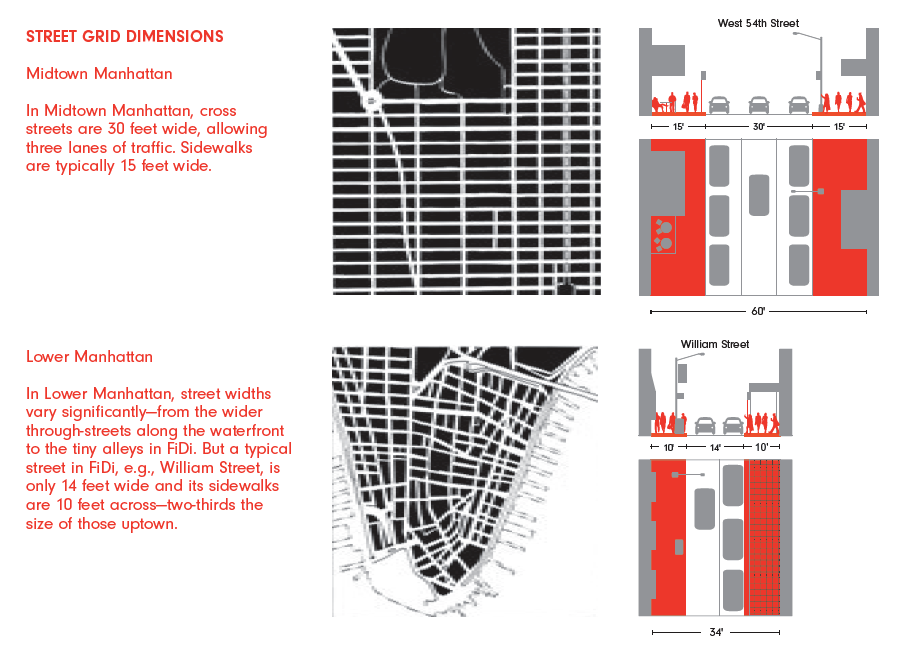
- Define the Challenges — The old, Colonial streets and sidewalks of Manhattan's Financial District have become far too crowded with modern-day obstacles, largely due to the ongoing conversion of skyscrapers to residential use and new construction of large residential buildings, coupled with the dramatic growth of downtown tourism. Piles of garbage often block sidewalks, creating health hazards and forcing pedestrians into already crowded streets. Construction scaffolding and street vendors block sidewalks everywhere. Loading zones sit adjacent to primary schools' streets, and congestion slows down emergency vehicles. Pedestrians and cyclists jostle with cars for space on streets and sidewalks — to which a recent spate of fatalities and accidents attests.
- FiDi streets are one-third as wide, with sidewalks half as wide, as east-west cross streets in the gridded portion of Manhattan above Houston Street. As far back as 1966, the City Planning Commission recognized that a new approach to managing these streets would be needed to accommodate the returning residential population — but it was never implemented.
- Define Possible and Specific Solutions which include, but are not limited to:
- Geographic reach of the shared streets pilot is a full district from Broadway to Water and Fulton to the Battery and mostly corresponds to the purple in the Slow Street District map below — and the area that was used in the NYC DOT's August 2016 Shared Streets: Lower Manhattan.
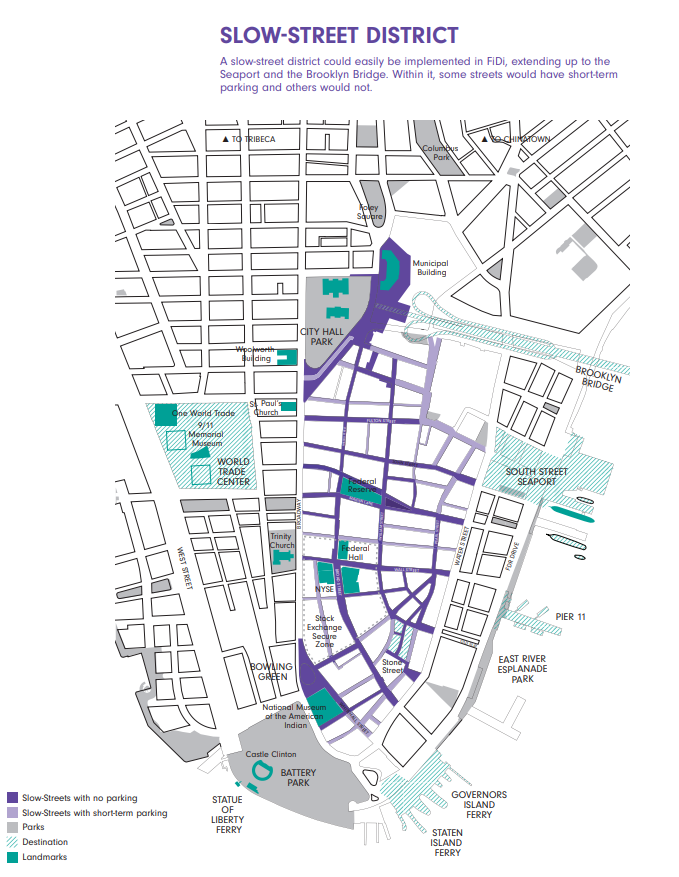
Source: Burohappold, Cities Practice - Create a Special District in this zone so that specific new rules can be applied to the area, to solve waste management and parked car issues
- Get garbage off the sidewalks through an innovative approach to pick-up schedules — interagency coordination is required with NYC Department of Sanitation (NYC DOS)
- Engage accessibility groups for best practices on access for all abilities
- Improve capacity to load and unload goods at curb — through reduced placard parking and coordination with Small Business Administration (SBA)
- Move vendors off sidewalks and into what today are parking places
- Build on Extensive, Existing City initiated Engineering and Urban Planning Studies — starting with a July 31, 2008 NYC DOT paper Street Management Framework for Lower Manhattan: The Downtown of the 21st Century. This formed the basis for September 2010 NYC DOT draft report Lower Manhattan Street Management — Shared Streets concluded that a shared street pilot zone is appropriate for implementation in Lower Manhattan. Within the pilot zone, it was determined that shared streets would enhance the pedestrian-oriented public realm and deliver potential economic and safety benefits. Don't reinvent the wheel when good studies are on hand.
- Funding — After the Lower Manhattan community, including both the local community board and FDNA, had urged its elected and government leaders for action for several years including in CB1's Budget Request Priorities, finally, in 2017, NYC Council Member Chin secured $500,000 in the NYC DOT budget to identify solutions to the area's mobility challenges.
- Continued oversight and a community feedback loop are essential to make sure that the NYC Department of Transportation's (NYC DOT) MW4LM Pilot Study will be comprehensive (vs. piecemeal) to address community concerns to ensure success and to make the public domain — the sidewalks and streets — safe and work for all. FDNA has urged that NYC DOT start this pilot study immediately to alleviate problems this summer and beyond — especially during the peak tourist season and the weather is nice and before the school year resumes Fall 2019.
- “Financial District Neighborhood Association (FDNA) has undertaken the Make Way for Lower Manhattan report in partnership with a team from BuroHappold Engineering, supported by Massengale & Co., WXY architecture + urban design, Publica, Appleseed, and Sam Schwartz Engineering. Funding for the report was provided by the J.M. Kaplan Fund in cooperation with Transit Center and Carmel Partners. ” ↩
- First, the amounts of heat we must supply are wastefully large, a result of decades of cheap energy and lack of interest. We must lower these loads through efficiency, including insulation, air sealing, heat recovery, and ever more efficient lighting and appliances. These techniques have been demonstrated extensively in the use of the Passive House and EnerPHit standards, and are the least expensive approach2. But further improvements become more expensive as the first, easiest steps are taken and the building becomes more efficient.
- We would like to convert fuel-burning equipment to electricity, but it makes no sense to do this until the grid is reliably carbon free. How is that coming along?
- Clean energy is coming, and fast. Lazard, a globally prominent financial analysis company, now rates on-shore wind and photovoltaic panels as the two technologies with the lowest overall cost of energy3. Cheaper than fracked gas in peaker plants, cheaper than oil, and competitive with fracked gas in expensive base-load plants. It makes financial sense, today in Arizona, to shut down a coal plant as soon as you have built a wind farm to supply the power. We can expect very rapid change, perhaps limited somewhat by issues such as NIMBY as well as limited land and work force availability.
- Current New York State plans are to have the grid be 70% carbon-free by 2030, and 100% clean by 2040. That must include NYC's power, but how? We don't have a lot of space for wind farms in the city, and despite City Council's well-intentioned efforts, wind machines on buildings produce lots of noise and little energy, since the wind regime here is relatively poor. Canadian hydropower via the new 1000 MW Champlain-Hudson Express transmission line4 will power city government5 by 2025, contributing up to 8 Terawatt-hours (TWh) to New York City's 52 TWh current annual load6. The bulk of NYC's improvement will come from wind farms in the Atlantic off the coast of the Rockaways and Coney Island. (Well off the coast — just barely visible from land.). NYSERDA will award contracts for 800 MW of off-shore wind this summer, at prices substantially below what they expected when preparing the Request For Proposal. And the Authority is now committed to 9000 MW of off-shore wind power by 2035, producing baseload power of about 24 TWh, almost one-half of our annual energy usage.
- In 2018, New York State's electricity was 60% carbon free (with 40% produced by fossil fuels using, normally, steam or combustion turbines), but for NYC, it's more like 35% carbon free, with a lot of that coming from the Indian Point nuclear power plant. That is scheduled to shut down by 2022, and will be replaced, at least in the short term, by gas combustion turbines. This will produce an increase in electricity-related GHG emissions7, which will, one hopes, be brought down by further deployment of carbon-free generation, over and above the Champlain Hudson-Express and off-shore wind mentioned above.
- The standard option: "same kind" replacement (putting in a new version of the same boiler, same size). This is awful, and will result in the same wasteful operation being carried on for another 30 years, or until carbon laws force the closure and disposal of a stranded asset.
- Do a careful analysis and put in the appropriate, almost certainly down-sized boiler with modern controls. This will save gas, perhaps enough to pay for the replacement over 10 to 15 years, but will still leave the boiler as a stranded asset by around 2040.
- For both of these options, the steam distribution system will be an albatross around the neck of the building in 2040, since it cannot be operated from a heat pump. Steam could be created ("raised") using pure resistance heating, the type used in toasters, space heaters, and old electrically heated houses. However, this would require twice the electricity, calling for vastly more carbon-free power and making it prohibitively expensive. The building's distribution system will be another component of the stranded asset.
- Third option: do a hydronic conversion, so the building is heated by hot water. Put in a high-efficiency gas boiler. Experience10 has shown that this will cut gas consumption by 30 to 50%, and it will leave the building with a distribution system that is "heat pump-ready," since the heat pump can raise the temperature of distribution water to adequate levels. Only the tired high-efficiency boiler will be a stranded asset.
- Fourth option: convert the building to all heat pump operation. Owners can either put individual air-to-air heat pumps, called "mini-split systems," into each apartment, putting the operation and expense entirely in the hands of the residents (Shut that window! Get out of the shower!) or larger heat pumps can fire a central distribution system, such as the hydronic systems just discussed. We will all end up with one or another of these in 2040 or 2050, but it's a very hard sell now in the city, since electricity is expensive and gas cheap. Upstate, the costs are reversed, and heat pumps are the standard heating systems going into new construction.
- “Urban Green Council, All About NYC's Historic Building Emissions Law, Urban Green Council, May 1, 2019 ” ↩
- “American Council for an Energy Efficient Economy, How Much Does Energy Efficiency Cost, Factsheet. ACEEE, March 17, 2016 ” ↩
- “Lazard's Levelized Cost of Energy ("LCOE") Analysis—Version 12.0, LAZARD, November 2018 ” ↩
- “Champlain Hudson Power Express CHPE Analysis of Economic, Environmental, And Reliability Impacts To The State Of New York ” ↩
- “NYC Mayor's Office, Green New Deal, April 22, 2019 Hydro-powered City government ” ↩
- “2018 Load & Capacity Data, A Report by the New York Independent System Operator, Inc.Gold Book, 2018 ” ↩
- “Urban Green Council, "Closing Indian Point,"What Does Closing Indian Point Mean For NYC Carbon Emissions?, October 17, 2018 ” ↩
- “December 17, 2018, Governor Cuomo Unveils Agenda for First 100 Days — 2019 Justice Agenda ” ↩
- “Piketty, Thomas, "Capital in the Twenty-First Century," Harvard University Press, 2014. ” ↩
- “Ian Shapiro, "Water and Energy Use in Steam-Heated Buldings," ASHRAE Journal article ” ↩
- Some of Yale's surveys produce slightly different data about these issues. For instance, their December 2018 report released with George Mason University says that 62% of Americans understand that global warming is anthropogenic, 34% say they hear about global warming in the media at least once a week, and 56% say they hear about it at least once a month. ↩
- WeWork's leaders are self-proclaimed environmentalists
- WeWork's clients include Gen X and Gen Y populations noted for their alignment with climate priorities
- New York City's own climate change mandates and public policies are among the most advanced in the country—which makes for a relatively advanced baseline upon which further market transformation could apply more harmoniously than elsewhere
- nearly 70% of New York City's global-warming-causing greenhouse gas emissions come from the energy consumption used in the operation of real estate
- development of curriculum for undergraduate and graduate studies in sustainable real estate development
- integration of sustainability into traditional course work for the MSRE, and
- coordinates and manages public programs for sustainability students and the community at large.
- Reduces utility and customer costs
- Improves quality of life and productivity
- Cuts carbon emissions and other pollutants
- Efficiency is not "metered" like other energy resources
- Efficiency is seen as the "low-hanging fruit" that will happen anyway
- Efficiency cannot readily be tied to specific utility cost reductions
WhoIs:
Reimund Schwarze is head of climate economics at the Helmholtz Centre for Environmental Research — UFZ in Leipzig and Professor of International Environmental Economics at the European University Viadrina in Frankfurt/Oder. Executive Board of the German Committee for Disaster Prevention (DKKV) and Scientific Advisory Group to UN-DRR
]]>Nowhere is this more apparent than in our massive missed opportunity to use the virus hiatus — which at its peak saw as much as 90 percent of traffic vanish — to begin something stirring and purposeful: outfitting the city's streets and roads to serve all New Yorkers, not just motorists, with speedy bus routes, protected bike lanes and broad sidewalks.
Buses are going to have to take on some of the transit ridership traditionally served by subways. The obvious mayoral move in March or April was to begin replicating in all five boroughs the fabulously successful 14th Street busway, which since last fall has boosted bus speeds and ridership by double-digit percentages simply by barring through-vehicles. Didn't happen. Whether the insufficiency was too few shovel-ready plans or missing mayoral resolve, City Hall hasn't begun a single successor busway, let alone the scores needed to move lots of New Yorkers.
Thanks @OneTrafford and @OfficialTfGM pic.twitter.com/RyLHTJdiOT
— Deborah (@UrmstonDeb) June 29, 2020
Bike-riding is our lone form of transport to have increased since lockdown began, and it's obvious why: subway worries, light traffic, and a hunger for fresh air. Yet the uptick in Citibikes and basement beaters barely scratches the surface of cycling's potential not only as healthful and affordable travel but also as a way to free up space on mass transit.
A mayor possessing even a passing familiarity with bicycling would have acted to install Citibike stations across the city and also generously subsidize bicycle sales and refurbishments to allow every agreeable New Yorker access to a bike, especially electric-assist models that lift drudgery and stigma from cycling. Such a mayor would also have committed to massively expanding safe cycling infrastructure along the lines sketched in the Regional Plan Association's new 425-mile Five-Borough Bikeway Plan linking New York City's gamut of "scenic greenways, wide boulevards, car-choked commercial streets and quieter back roads."
That too didn't happen here. But other cities and mayors haven't stood still. Early in lockdown, Oakland, CA began barring through-traffic from 70 miles of city roadways. Seattle, Denver, Pittsburgh and Boston followed suit. Here, two weeks would elapse before de Blasio even announced "a commitment" to his own open streets which, unsurprisingly, were piecemeal and under-utilized.
But it's in comparison to Paris that de Blasio's failings on transportation and streets are most starkly revealed. More than a decade ago Paris created the world's first sustained bike-share system, Vélib', and began converting the highway along the Seine to a sinuous walkway. The city official who spearheaded both programs noted in a 2017 New York Times interview that the Seine transformation "was disruptive at the time, but today Parisians and Paris lovers can't imagine this iconic landscape as a road anymore."
Mobility hierarchy as it should be #Paris pic.twitter.com/DySe50sFDU
— Urban Planning & Mobility (@urbanthoughts11) June 24, 2020
That official, Deputy Mayor Anne Hidalgo, ascended to Paris's mayoralty in April 2014, just months after Bill de Blasio's own New York swearing-in. On Sunday she handily won re-election on her pledge to put a bike lane on every Paris avenue as an element of what she calls the Ville du quart d'heure (the 15-minute city) in which shops, parks, schools and health centers are just a walk or bike ride away. (See map.)
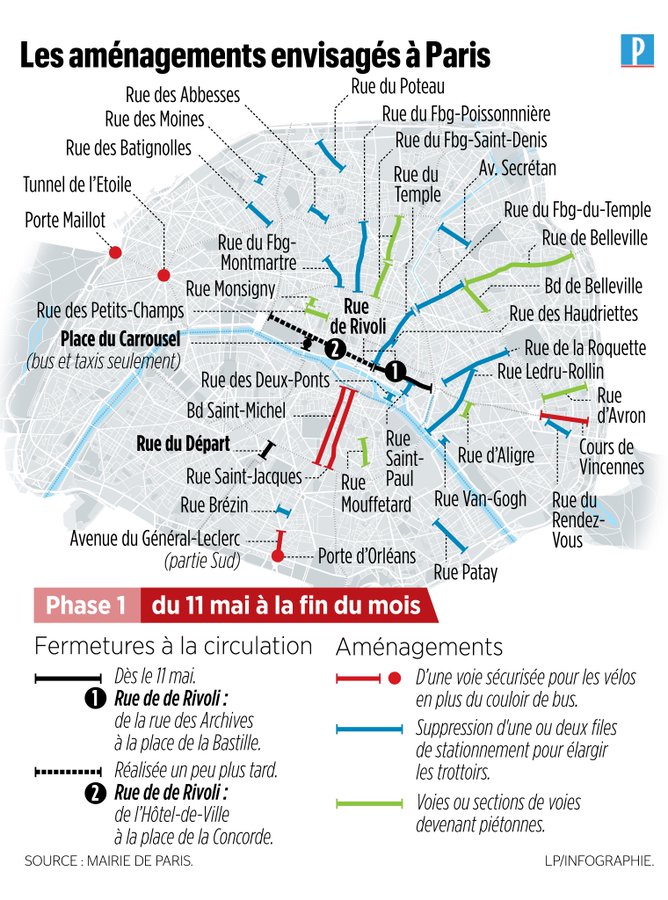
Contrasting Hidalgo's execution and vision to de Blasio's big shrug became somewhat of a cottage industry this year, culminating in Vice reporter Aaron Gordon's cri de coeur, "Be My Mayor, Anne Hidalgo Our current mayor can't handle this. Please save us." Just as telling was Hidalgo's 2017 Times interview, headlined "A Big-City Voice on Climate Change," which showcased the immense sweep, from granular to global, of her commitment to urban livability and global sustainability.
Alexa, can you show me why the streets of Paris are being transformed while New York's are staying the same? pic.twitter.com/OiE75QWNIt
— Peter Flax (@Pflax1) June 17, 2020
Mayor Hidalgo spoke then of both "Paris Respire" (literally, Paris breathes), the reclaiming of the city's streets "to give Parisians the opportunity, for the first time in living memory, to experience a healthier and more peaceful city, breathing a cleaner air"; and the Paris climate agreement, then scarcely a year old, whose enactment she credited to women campaigners and diplomats. What was her New York counterpart doing around the same time? Making a big show of divesting from fossil fuel companies, but declining to exercise his governing authority to combat New York's climate-damaging, cyclist-killing car culture.
By now, their differences are entrenched. Hidalgo the bold, proactive, urbanite Parisian; de Blasio the bunkered, bystanding Brooklynite. We'll give Streetsblog editor Gersh Kuntzman the final word on our guy:
De Blasio's choice of transportation [chauffeured SUV] insulates him from the experience of the vast majority of his commuting constituents. He never has to tell his boss he was late because the No. 6 train went out of service at Hunts Point Ave. He never gets doored by a driver on Smith St. He never has to tiptoe around bags of trash that overflow on sidewalks every night. He never waits 20 minutes for the M14 bus, only to have three arrive at the same time.
Gersh's assessment, in a Daily News op-ed, predated Covid by a full year.
Though a foot taller than height-challenged Mayor Beame, our current mayor has shrunk in stature to that of the earlier mayor. His disappearance from public life in a year and a half can't come too soon. But where is our own Anne Hidalgo, come to save us?
Policy-analyst and activist Charles Komanoff, a lifelong New Yorker, directs the Carbon Tax Center.
]]>
Many of us have been discouraged hearing environmental science experts state that individual actions count for very little in the fight. Our energy, they say, should be directed at influencing legislators to create policy. This is undoubtedly necessary. But how, after decades of inaction on climate issues by the very same legislators one is trying to influence, do you keep the momentum of policy agitation going? More importantly, how do you move an individual from climate apathy to caring about the common good? And how do you tap into the tremendous energy of the upcoming generation?
These questions and ideals are the guiding principles of It's Easy Being Green (IEBG). We are a neighborhood group, operating in a slice of the Upper Westside of Manhattan focused on climate crisis education and personal action. By gathering up like minded and committed individuals and by coming together to form a cohesive group, we have created that missing sense of community. By having this close neighborhood network to call on, we can vent our frustrations then brainstorm about new initiatives and soldier on, where we once might have given up.
By using long standing community networks, we have been able tap into a preexisting and deep rooted desire to make a difference. We have seen firsthand how, through education and the sharing of personal experience, we can make a change in an individual's mindset and behavior and propel someone to take action for the bigger picture. As an example, the neighbor who resisted separating her food scraps for NYC's compost program because she worried the bins would attract rats, after giving it a try, is now signing and promoting petitions to expand the program to other boroughs. Personal action and education in the form of a city agency workshop in her building and neighbor to neighbor conversations made the difference.

Since its formation in March 2019, IEBG's members, primarily senior citizens, have provided the engine for a variety of activities. We write and disseminate monthly newsletters which inform readers of our activities, provide links to relevant articles and list opportunities for advocacy. Our personal action blasts describe easy to implement changes readers can make on behalf of the planet. For example, the blast entitled "Meat, What's the Beef?" alerted readers to the outsized contribution beef production makes to greenhouse gases and encouraged participation in Meatless Mondays.
IEBG partners with local politicians and environmental groups; hosts talks by civic leaders and members speak about our efforts at community board meetings. In addition, we work to influence local grocery stores to reduce reliance on single use plastics, leading one local retailer to offer a compostable container option for take out food and to establish a plastic bag free line ahead of the March 1st deadline. We have created materials and a consultancy on how to convince coop boards to sign on for the city's composting program and offer our help to any who are interested in getting started with the city's program in their building.
IEBG also took advantage of its proximity to Columbia University to tap the knowledge of students in their graduate Climate and Society program. When we learned that students in the program were studying climate science and learning ways to communicate concepts to the public, IEBG members were eager to be an audience. Up to that point, the students had had very little opportunity to interact with the public at large. Together the idea of hosting a series of Climate Cafes was born.
Held in a member's apartment with refreshments donated by the catering service of a local market, three graduate students from the program deftly explained the difference between weather and climate while we posed questions and offered suggestions. The intergenerational conversation was lively and went on for three and a half hours, well over the scheduled time. It was a win/win evening. We learned technical details about climate science and the students got to practice presentation skills. Plans to schedule the next climate cafe commenced the next day.
In another IEBG intergenerational effort, several members served as mentors to two undergraduate women at Barnard as they wrote and received a grant to bring speakers on sustainability in the food industry to campus. Sadly that event, as well as the second Climate Cafe, had to be postponed due to the disruption of the coronavirus.
IEBG is sponsored by Bloomingdale Aging in Place and by the 104th Street and 102nd & 103rd Street Block Associations.

WhoIs:
Sharon Waskow has over 30 years experience as an educator of elementary, secondary and adult learners. She holds a B.A. in English ,an M.S. in Reading and an MLS in school librarianship. She has taught teachers how to create project-based curriculum on climate. She currently co-leads It's Easy Being Green. You can reach her at It's Easy Being Green
Christine Campbell is a retired science educator. She holds a B.A. in Science, an M.A. in Health Administration and an M.A. in Education. She currently co-leads It's Easy Being Green with Sharon. You can reach her at It's Easy Being Green
]]>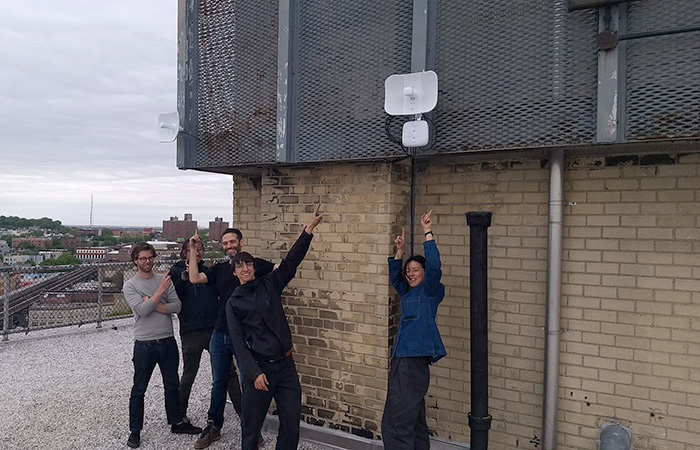
The genesis of the Saratoga Village "install" — as such an endeavor is called in the NYC Mesh community — began with a short email from BlocPower, a Brooklyn-based startup using remote sensing technology to improve heating and cooling efficiency in buildings. BlocPower, had recently entered into a partnership with the New York City Housing Authority (NYCHA) to pilot smart building technology in public housing. Many of the gadgets and gizmos planned for this undertaking, however, required low-cost or no-cost connectivity. Paying a cellular data plan for each of the dozens of devices was simply out of the question.
Enter NYC Mesh.
Within weeks, BlocPower and NYC Mesh entered a partnership promising not only to lay a digital foundation for smart building technology in aging public housing, but also to connect residents online and build community infrastructure serving the surrounding neighborhoods. In other words, a win-win-win.
Specifically, with the connectivity supplied by NYC Mesh, BlocPower installed 28 low-power sensors throughout the building that supplied integrated data on utility usage, heating and hot water systems, and the indoor environment. This allowed NYCHA to optimize systems and ultimately reduce energy use and costs. Additionally, the sensors provided predictive maintenance and diagnostics such that NYCHA staff could act before problems arose. Finally, in the course of the pilot, the sensors were also used to detect whether volatile compounds were present in the buildings air systems, ensuring the safety of residents.
While in the case of BlocPower, devices primarily optimized building efficiency, there are plenty of applications for this remote sensing technology, from collecting noise pollution and air quality data to monitoring rooftop solar installations.
The aim here, however, is not to give a shout-out for any particular future smart city or smart building "revolution" — there are countless marketing departments pumping out literature for that. Rather, the example of NYC Mesh and its committed volunteers at Saratoga Village demonstrate how grassroots (and perhaps not so grassroots) initiatives to promote digital equity and access can work hand-in-hand with environmental initiatives.
First, a little about NYC Mesh: Founded in 2014, the entirely volunteer-run organization is part of a growing, international community networking movement committed to improving digital access and creating a new internet infrastructure that puts people and communities first. It's built on the premise, as early internet activist Vint Cerf once noted, that "the internet is for everyone — but it won't be unless we make it so."
NYC Mesh operates with much of the same WiFi technology that you may have at home — a small router or antenna wirelessly communicating with a series of devices such as a laptop or cell phone. In the case of NYC Mesh, these small antennae ("nodes") are located on rooftops across the city where they connect apartment dwellers online through hardwired home routers and broadcast open WiFi networks for use by pedestrians or others passing by. (You can find the entirely open — NYC Mesh Community WiFi — network along streets across Brooklyn and Lower Manhattan.) These rooftop nodes interconnect to form a wireless "mesh" across the city. Internet traffic at each node hops from antenna to antenna back to an "internet exchange point," a fancy term for a location where various networks, say Google, Netflix, and NYC Mesh, all connect together — forming, to put it very simply, the internet.
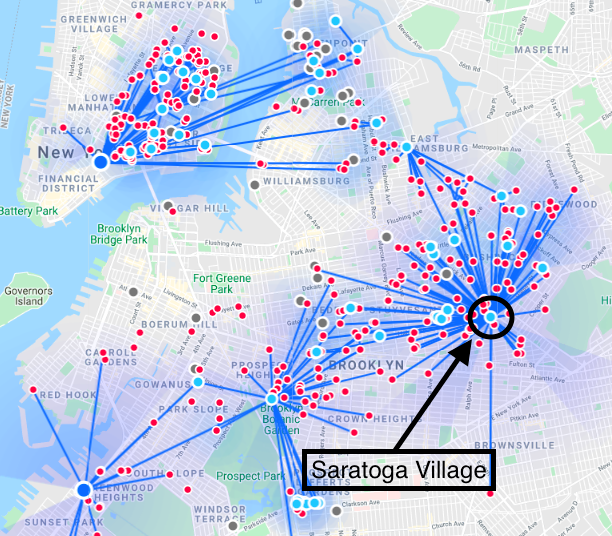
Community networks offer more than a grassroots means to combat the digital divide — an effort that itself is sorely needed in a city like New York where 1.5 million residents lack a home or mobile connection online. They also construct a community-owned and, ultimately, community-accountable digital layer in neighborhoods that can advance 21st-century environmental solutions and justice. When communities own their connectivity and the underlying infrastructure, they are empowered to support the development of local green businesses like BlocPower; they have the means to collect environmental data to inform stakeholders, policy, or even hold landlords accountable; and they can improve transparency and access to information.
The New York City Mayor's Office recently embarked on an effort to measure air quality in the South Bronx, an area with well above average levels of fine particulate matter outdoors. The pilot will attach sensors to city vehicles to generate precise, street-level data. With community networks, neighborhood organizations, building owners, activists, and others can exercise self-determination and take on these initiatives themselves — no more waiting on city leadership, better budget forecasts, or a sympathetic internet service provider.
NYC Mesh and likeminded networks in urban landscapes and rural communities are already deploying infrastructure on rooftops (or whatever may be available) across the globe. With relative ease, these resources could be leveraged to weave together economic development, community self-determination, resiliency, and environmental justice and stewardship. This is a field ripe for collaboration and — at NYC Mesh at least — we are already getting to work.
WhoIs:
Scott Rasmussen focuses on telecommunications policy and strategy at the intersection of equity and access. Scott is currently a Board Member and organizer for NYC Mesh, an open, neutral, and resilient community network aiming to make a home or business internet connection accessible and affordable to all New Yorkers. NYC Mesh is the largest community network in North America. Scott arrived at NYC Mesh with five years of experience developing policy and legislation on Capitol Hill, where he specialized in telecommunications. In his current position, Scott supports telecommunications planning and deployment in New York State. Scott can be found online at @rscooter369
]]>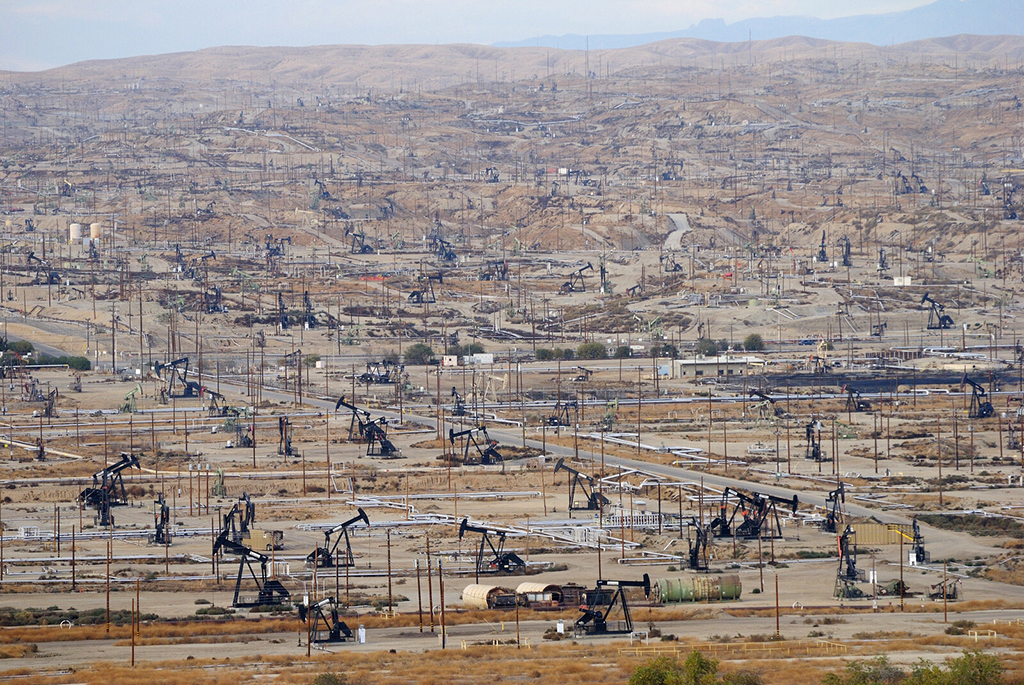
Don't get me wrong — I'm proud of my home state. I've lived in California for most of my life, and I can attest to the huge strides we've made in cleaning up our air and water. I'm proud of the progress we've made decarbonizing our transportation, and now our buildings too. I'm proud of our sanctuary cities, and a host of progressive reforms that leave us all safer and stronger. But driving my electric car through the oilfields of Fresno, Bakersfield, Santa Barbara, and LA, I see another California in stark relief: we are a petro-state. With oil derricks extending to the horizon, Bakersfield's Kern County is in fact the #1 oil producing county in America. For Los Angelenos (especially lower-income Angelenos), the oil derricks are literally in their backyards. For anyone who spends time in southern California, Dirty Secret #1 is really an open secret.
As Executive Director of Fossil Free California, my day job is attending to a less open secret: the fact that America's two biggest public pension funds, both in California, invest billions of our teachers' and public employees' retirement dollars in the fossil fuel industry. CalPERS (the Public Employee Retirement System) and CalSTRS (the State Teachers' Retirement System) have over $15B invested in companies holding carbon reserves. If you count the pipelines, refineries, and additional services that make burning those carbon reserves possible, the number shoots up to over $22B.
At a time when the IPCC has made it clear that averting total global catastrophe will require adhering to a strict carbon budget, the fact that America's two biggest funds are continuing to invest in carbon — like there's no tomorrow — is simply appalling.
Luckily (for the planet), these funds' determination to invest in ecocidal madness has not netted them much in the way of returns. Which brings us to Dirty Secret #3: Fossil Fuels are losing California (and the rest of the world) a lot of money. And if we don't get our collective act together, they're about to lose us a lot more.
I know that's a hard fact to believe — so please don't take it from me. Go to Morningstar and look up Exxon, or Chevron, or Shell, and compare any of them with the S&P 500. You can also look up XLE (an oil and gas ETF); you'll find the same thing.
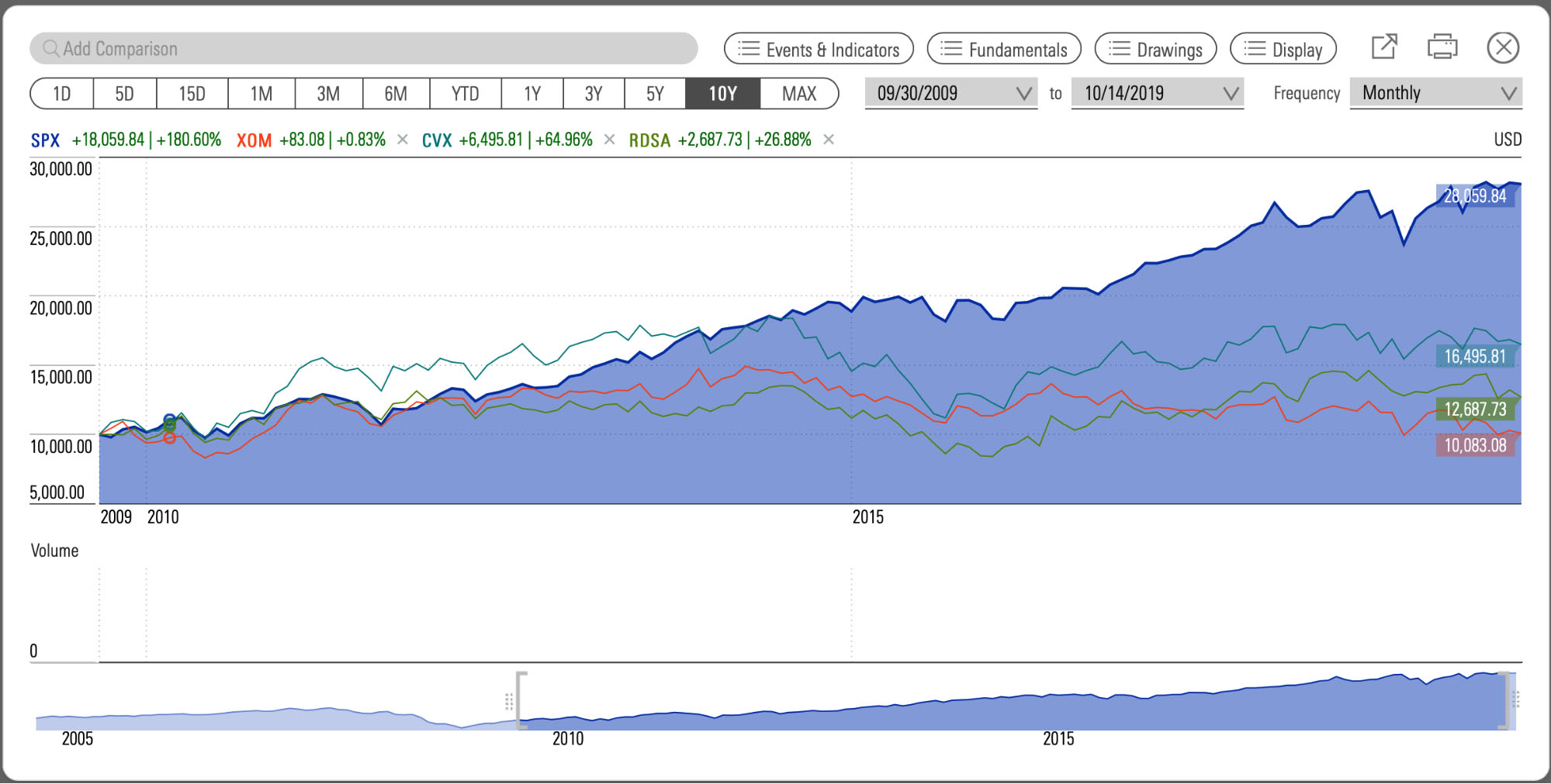
If you'd invested $10,000 ten years ago, Exxon would have returned a profit of $83, while the S&P would have made you over $18,000. The oil sector is doing so badly, that Exxon was recently dropped from the top ten in the S&P 500 for the first time ever. Sure, Big Oil is still big — but it's shrinking. And it's not your Grandma's blue chip stock anymore. (Remember Kodak?)
There is some poetic justice in saying that the fossil fuel industry is going the way of the dinosaurs. The problem is, even if we can get them to fail fast enough to save the planet, they may still take the economy down with them when they go.
It turns out, investing isn't the only way California's about to lose big on Big Oil. Thousands of the state's oil derricks have been sitting idle for decades, because it's not profitable anymore to run them. It might not ever be profitable to run them (pretty much no one sees prices rising above $100/barrel any time soon) — but the fossil fuel companies keep those wells idle, instead of shutting them down, because that way they can still be counted as an asset.
Once the company finally decides to shut down a well, or is forced to shut it down, that asset suddenly becomes a liability. Something called Asset Retirement Obligations, or ARO's, require companies to clean up each one of those wells, and restore the land back to how it was before the drilling started. And that can get very pricey, very fast. But the oil industry is doing nothing to prepare for its own retirement — which some analysts suggest could happen a lot sooner than many of us think.
So, what's a wily, unscrupulous industry to do, when faced with imminent decline? Why, foist the problem off onto someone else, naturally! Which is what's happening, right now, here in the Great State of California. One immediate example: Occidental Petroleum spun off its California operations back in 2014, with a new (undercapitalized, underinsured) corporate entity called California Resources Corporation (CRC). This new company — which currently owns 20% of all the idle on-shore wells in California — is now facing imminent bankruptcy. And who will be left paying for all that cleanup? The taxpayers of the Great State of California.
And who is invested in CRC? Yes, folks, California's two mega pension funds. Which will be left with bubkiss once all those ARO's are paid off.
Recent legislation has tried to shore up this looming disaster, but the Western States Petroleum Association got their hands on the legislation and watered it down to be far from adequate. Which leads us to Dirty Secret #4: Big Oil still calls a lot of the shots in Sacramento.
While California is somewhat unique, with mega pension funds invested in fossil fuels AND a massive, dying oil industry, many other states also have some combination of these two toxic assets. So let ours be a cautionary tale. We know we need to stop funding this industry before it completely blows up our climate. The smart money is already leaving coal, oil and gas. The only questions are, will we get out fast enough to make a difference? And who will be left holding the bag?
WhoIs:
Vanessa Warheit is the Executive Director of Fossil Free California, a non-profit focused on moving money out of fossil fuels and promoting a just transition to a low-carbon economy.
]]>Here's what's proved crucial for FDNA to execute a successful urban change campaign:
And most importantly,
With the implementation of the MW4LM Pilot Study, NYC will be one step closer to meeting two 21st century goals: addressing the global climate crisis by reducing vehicular congestion, and returning the public domain to those who live, work and visit the fourth largest business district in our country. Cutting congestion means improving air quality and protecting the health of residents, workers and visitors.
Shared-street districts now successfully exist in many of Europe's historic capitals — including Dublin, Amsterdam, London, Istanbul, Paris and Barcelona. Typically, low speeds permit cars and people to access streets simultaneously, street parking is limited, and access for deliveries and cargo-loading is scheduled for specified times of day. The core of FiDi is a perfect place to start here in NYC.
Lower Manhattan has reinvented itself again and again over the last 400 years since it was New Amsterdam. For the newly born United States, Lower Manhattan was the indispensable deep-water Atlantic port; it then became the linchpin of America's transformation from an agrarian economy to a modern industrial colossus. Lower Manhattan then became the epicenter of American banking and then of global finance. A new transformation is filling the streets and sidewalks and buildings of the neighborhood right now: a 24/7 work-live community with a unique heritage, a diverse commercial district encompassing cutting-edge tech companies and world-leading marketing firms, and a burgeoning arts sector. All this is happening in FiDi as the City grapples with being on the front lines of a global climate emergency and citizen demands for a greener city. All other cities around the world are watching NY and we need to rise to the challenge and implement the funded MW4LM Pilot Study now.
Footnotes:
WhoIs:
Catherine McVay Hughes serves on the boards of the Battery Park City Authority, Lower Manhattan Development Corporation, The Trust for Governors Island, the South Street Seaport Museum and is a Manhattan Community Board 1 Chair emeritus. She is a member of the Advisory Board of the Earth Institute at Columbia University, as well as the President's Council of CERES. She volunteers on the WTC Scientific Technical Advisory Committee and the FiDi Neighborhood Association.
]]>The Extinction Rebellion is right! The Intergovernmental Panel on Climate Change (IPCC) 1.5°C report is right! Human civilization will be unalterably diminished or even wiped out by climate change, not this year, but if current practice continues, during this century. What is to be done?
The solution is blindingly obvious and known to all: stop using fossil fuels. Other steps may help, like constraining biological methane emissions or moving towards permaculture (agriculture that embeds carbon in the soil) or removing CO2 from the air, but those steps are add-ons. They will only help if we stop extracting and burning fossil fuels, and the IPCC's best estimate is that we must do that, globally, by 2045 to 2055 if we are to have a reasonable chance of holding the increase in global temperature to 1.5°C. (We used to talk about 2°C, but it has become clear that the near-term impact on low-lying real estate, like in Bangladesh, Brooklyn, and Mar-a-Lago, will be too much too soon in this more relaxed 2°C case.) I'll stop now, but you can look all this up on the IPCC's web site.
]]> In case you didn't notice, I just told you that an 80% cut in fossil fuel emissions by the year 2050 is an inadequate target. The IPCC 1.5°C scenario doesn't depend on "only" emitting 20% of 2005-level greenhouse gas (GHG) emissions in 2050, it depends on zero. (This isn't me talking, it's the world's climate scientists, chanting almost in unison.) However, 80 by 50 is a widely adopted, politically accepted target and if we actually set our sights on it for now, we will be doing much less harm than with lesser goals. The New York City Council, with strong support from many sectors among its constituents, adopted targets of 40% reductions by 2030 and 80% by 2050. The following chart shows the corresponding annual reductions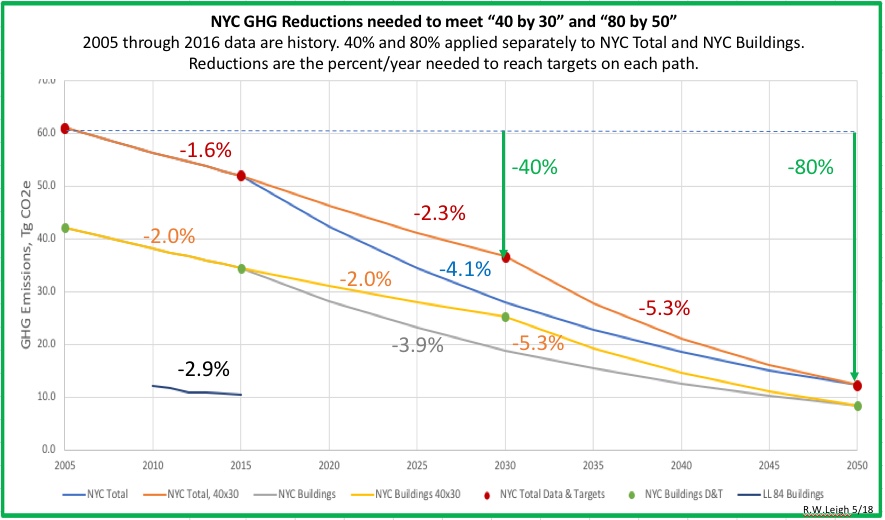
Feeling good about the actual reductions from 2005 to 2016? Don't. The reductions are largely due to moving the power sources on the electric grid from coal and oil to gas, and we can't do that again. I'll get back to the grid a little later. For now, the chart makes the scale of the challenge clear.
Realizing that good intentions don't always get you to your destination, the City Council passed several other laws to help make 40 by 30 and 80 by 50 happen. The most recent is Intro 1253-C of 2018, which was signed into law by the Mayor on Earth Day 2019. This law will place explicit limits on the quantity of greenhouse gases large (over 25,000 sf) buildings can emit, in pounds of CO2 per square foot. The limits were calculated to achieve 40 by 30. The legislation empowers City government to prepare new limits during the 2020s that will achieve 80 by 50. Analyses by Urban Green Council1 and others have maintained that perhaps one quarter of large buildings will have to take some measures to meet the 2024 limits, but that about 75% will have to take measures, some quite strenuous, to meet the 2030 limits. A glance at the chart above will convince you that almost all buildings will have to make further, major improvements to reach 80 by 50.
How can we possibly do this? Simple. Stop burning fossil fuels.
The catch: We burn fuels, mostly gas, for over 80% of our hot water and heat, as well as to generate electricity. How can we stop?
It would seem reasonable to switch our heat and hot water fuels to GHG-free electricity, but there are issues:
So, New York City has an electric system that is currently about 35% GHG emission free, which will suffer a near-term increase in GHGs when Indian Point goes off-line, but which will increasingly find its power supplied by fossil-fuel-free sources. New York State has asserted that it will be 100% free of fossil fuels by 20408, and that includes New York City. (Apply your search engine to "Norman Mailer-Jimmy Breslin.") If you're still with me here, the picture for developing a GHG-free electric grid looks pretty good.
Cost will be a problem. All the evidence is that wind power will get less expensive, so the issue will not be supply. The high price of electricity in New York City is due to the underground distribution system, which is far harder to maintain than are overhead wires. However, we have little choice in that matter. And as electrification increases, we will have to add to or rebuild large pieces of that system. Who will pay? This problem is not unique to New York or to electrification or even to climate change, so rather than open a whole new discussion, I'll offer one reference for future discussions.9
Since we have no choice with respect to fossil fuels, the electrification of New York City must continue. This will raise some interesting issues.
Steam boiler with steam distribution:
This technology heats the vast majority of New York City buildings, and also provides hot water in most cases. Boilers get old and, eventually, die and must be replaced. This can be staved off by good maintenance and heroic repairs. (Re-tubing, anyone?) For the 50,000 buildings covered by Intro 1253-C, we can expect over 1000 boilers a year needing to be replaced. What to do?
Co-generation
Co-generation, or "combined heat and power" (CHP) is an idea whose time came years ago, but never quite achieved the popularity it deserves. Using fossil fuels to generate electricity, whether in a turbine or a steam plant or a piston engine, thermodynamics limits the efficiency with which the energy of the fuels can be realized as electricity to 30 to 50%. The rest of the fuel's energy must be discarded as heat. This means paying for energy in the fuel that is now being thrown away, as well as paying for the radiator or cooling tower that does this job.
CHP overcomes this problem by capturing the reject heat and using it to make domestic hot water in a residence or for other uses in a commercial building, thereby lowering the amount of fuel gas that must be purchased, the associated emissions, and the associated cost. CHP is a win-win, a sure-fire way to lower a building's emissions (pun intended), useful in any multifamily building with over about 100 apartments, and will be very popular as the impact of Intro 1253 for 2030 becomes more clear and building owners search for straightforward, cost-effective ways to lower emissions.
This is awful.
Why is it awful? Because the useful life of CHP systems (properly maintained and operated) is at least twenty and up to forty years. Install one of these babies in 2025 to help get ready for 2030 and the building will still be burning gas in 2050. If there is any gas available. If not, it's the stranded asset problem.
When does the CHP system become a net source of emissions, rather than a net reduction? That depends on how many hours per year gas is still being burned by Con Edison's suppliers to keep the lights on. As a ballpark estimate, when New York City has fully GHG-free electricity half the year, the CHP system will be polluting more than it is saving — it will be a net polluter. If we are to be 100% GHG-free in 2040, that has to happen by the mid 2030s. My conclusion: if you really want to put in CHP, go ahead, but only after you have made sure that it will have paid for itself by 2035. That way, you can turn it off without feeling ripped off as gas becomes increasingly hard to come by. And your stranded asset won't be that stranded, since it did its job for fifteen years.
The issue is how to increase efficiency and lower emissions in a world where the electric grid is getting cleaner every day, and it turns out it's not as simple as we might have thought. This doesn't mean we can't do it, it just means it's a little complicated. We have to keep thinking on our feet as we forge ahead.
Footnotes
WhoIs:
Richard Leigh is a Visiting Professor at Pratt Institute, primarily teaching building science. Formerly, he was Director of Research at Urban Green Council, working on low carbon futures and strategies to attain them. He holds a PhD in Physics, a PE, and is a LEED AP.
]]>EndClimateSilence.org was conceived one enlightening day when I heard three different NPR stories about the effects of climate change, including a report about the Japanese mudslides that forced three million people from their homes, in which announcers never spoke the words "climate change" or "global warming." A Twitter thread I wrote about this surreal and disturbing experience quickly went viral, even inspiring a think piece in The New Republic which was then addressed, defensively, by the science editor at NPR. That day, I realized the moment for a real conversation about media climate silence had arrived.
In consultation with the climate advocacy community, and having convened a board of change-makers, scientists, and NGO strategists, I founded EndClimateSilence.org. We are a digital-activist group: we primarily mobilize on Twitter, the platform that enables us to have direct access to the very reporters, anchors, editors, and producers making the decisions about how to cover climate. We do not ask media outlets to do more stand-alone stories about climate change; rather we ask them to make the links to climate change explicit in the stories they're already reporting. To do this, we understand, is both easy and hard. It is easy to add one or two sentences to a story already being written; it is hard for every media figure who reports on science, extreme weather, migration, finance, real estate, energy, or global politics to recognize the ways their stories are connected to climate change and to make that connection explicit. But it is the news media's professional and moral responsibility to do this.
Media silence on climate change distorts our politics. According to Yale University1, only a bare majority of Americans in 2018 know that human begins are causing the climate change that threatens us. Only 22% hear about climate change in the media once a week. 77% of Americans hear about it once a month or less. It is impossible for citizens in a democracy to make fair decisions at the ballot about climate change when they are so woefully misinformed.
Media climate silence distorts our politics also in another more subtle but no less important way: it upholds the fossil fuel economy and the cultural assumptions that this economy produces. It is true that fossil fuels currently play central role in all our material practices and in our imaginations of the good life, but it is also true that fossil fuels are also dangerous pollutants whose effects can be expected to kill millions of people in the next decades and possibly billions in the next century, unless we stop using them. It is very hard to hold those two ideas in one's head at the same time, and all too easy to resolve one's cognitive dissonance by simply forgetting about the dangers of fossil fuels (which are really far off anyway, right? well, no). When the media suppresses the truth about the full scope of the climate crisis and the fact that climate change has already begun to destroy our world and endanger or even kill people, it enables and normalizes this commonplace climate denial. If our world is to survive in a habitable form, that normalization of climate denial must end.
We at EndClimateSilence.org will continue to push print and television media outlets to refuse fossil fuel sponsorship, end their conflicts of interest, and tell the truth about the climate crisis. We plan also to expand our focus from national news to local and regional markets, engaging volunteers to monitor those crucial platforms for climate silence. And finally, we plan to campaign vociferously and tenaciously to make climate change the most prominent issue in the 2020 election cycle. Our dream is to be able to disband our operations in the next five years, as the implementation of the Green New Deal is getting underway.
We know that this is the time for action — our only time for action. But we also know that another world is possible. Let's #EndClimateSilence and make that happen!
Footnotes
LinkBites
WhoIs:
Genevieve Guenther is affiliate faculty at the Tishman Environment and Design Center at The New School and the Founder and Director of EndClimateSilence.org.
]]>Development of the 32BJ Green Building Training Program
SEIU Local 32BJ is a building service workers union that represents building workers across the country with 150,000 union members nationwide and about 70,000 of those members in the NYC area. Local 32BJ represents a variety of workers, from security guards to cleaners to porters, handypersons and building operators (Superintendents and Resident Managers). In other words, the union represents the people who guard, clean, maintain and manage many of the apartment buildings across NYC, as well as other facilities such as offices, schools and airports.
The 32BJ Training Fund is a joint labor/management benefit program for union members, which is funded by employer contributions agreed upon in union contracts. The program has successfully supported the industry in a number of areas from general industry training to security training to safety training and more. One of the union's on-going training areas has been Green building training.
Green building training at 32BJ began back in 2005 with a series of introductory courses. Through a $2.8 million federal Department of Labor grant in 2010, the program expanded with a labor/management initiative called the Green Supers program. The goal of this initiative was to train 1,000 union members in energy efficient operations and maintenance (O&M) strategies. The grant project was completed in 2012 with over 1,500 union members trained. A graduation ceremony was held in 2012 with then-Secretary of the federal Department of Energy Steven Chu, who called building operators essential to cutting waste, saving money and making NYC a healthier place.
The program focused on opportunities to improve building operation through basic low cost/no cost operating and maintenance (O&M) strategies such as tuning boilers, insulating pipes, air sealing, etc. We documented successes from the training, such as the operator that saved his building over $40,000 per year by regular tuning of his boiler and the operator who instituted air sealing of the apartment PTAC units as well as training for residents in their operation.
Our Green building Training program has continued this basic building operator efficiency training while adding new levels of training, including the Urban Green Council's Green Professional training (GPRO O&M). GPRO training offers a grounding in the concepts and strategies of Green laws, standards and rating systems, focusing mainly on the LEED rating system. We also added building analyst training. As members completed this series, they began pursuing LEED professional certification (GA and AP). We have also continued to develop Green training for commercial building operators, including GPRO Mechanical, Electrical and Plumbing certification and the Northwest Energy Efficiency Council (NEEC) Building Operator Certification training.
The Next Level of Training: Green Supers On-Site Training & Coaching
Recently, we secured funding from the NYSERDA to develop Green Supers On-Site Training and Coaching. This new initiative is an effort to take training to a new level by first evaluating the building to inventory training needs and opportunities as well as building performance, then consulting with building management on the training plan for the building staff, then doing the training and following it up with on-site coaching to assist staff in applying the concepts and strategies learned to their daily O&M practices. Lastly, we will evaluate post-training building performance and report back to management and staff on our findings about improvements that were made and opportunities for further development and training.
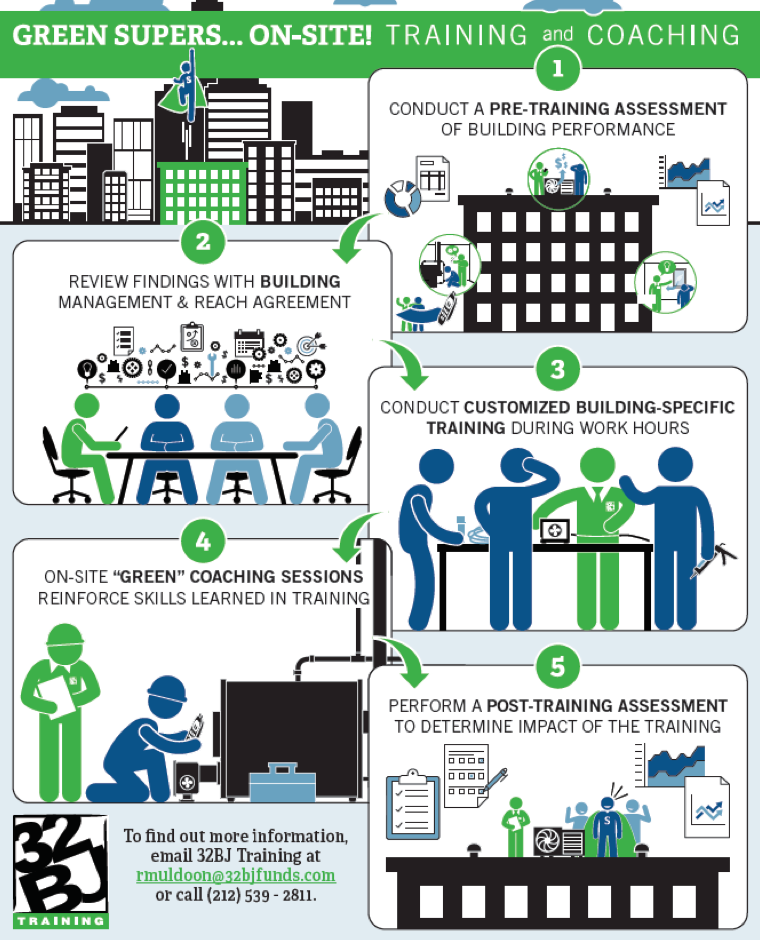
NYSERDA worked with the 32BJ Training Fund to pilot this training model back in 2017. We recruited the Mid-Bronx Desperados Community Housing Corporation (MBD) to try out the model with six building superintendents managing low rise apartment buildings. We discovered that when we delivered interactive training tailored to their building systems, staff responded and aggressively pursued many of the strategies. We also discovered opportunities to better coordinate boiler operations among these buildings and better involve the building superintendents in monitoring the equipment through logs and recordkeeping. MBD management was excited to learn about these opportunities and invited the 32BJ Training Fund to return this fall to train the staff for the rest of the MBD portfolio of about 30 more buildings.
We hope that our project establishes a new level of training that will be available to 32BJ employers well into the future and will evolve as we train different types of buildings across the city. We are still seeking more buildings for this training initiative and 32BJ employers are welcome to contact the 32BJ Training Fund at 1-212-539-2811 to learn more.
Lessons Learned: Empowering Building Workers
After almost 10 years of training building staff in strategies on energy efficiency and indoor environmental quality for multifamily buildings, we have learned some basic lessons about what our members need to help them be successful in efficient building operation. First, they need training in the concepts, strategies and technologies of efficient operation of building systems. We found that any time these can be delivered in a hands-on, interactive way, our 32BJ members are more engaged and more likely to apply what they learn in their buildings. Second, building staff also need the tools for energy efficient building operations. From easily affordable insulation for pipes to a $200 thermal imaging camera that attaches to a smart phone or a $1,500 combustion analyzer for boilers — all of these tools will quickly pay for themselves many times over when put in the hands of trained building staff. Third, building staff need to be plugged into the various incentive programs for retrofit and upgrading buildings.
From the NYC Retrofit accelerator program to the Con Edison incentive program and more, we work to educate our members about these programs so building operating staff not only bring their training back to their buildings but also real funding for upgrading lighting, heating systems and such. This can be operationally and financially critical as building systems are continually being replaced due to normal wear and tear, a key opportunity for a trained building operator to weigh in with the strategies and funding to upgrade to more efficient equipment. Finally, our members need the opportunity to earn industry recognized certifications so they can be recognized by their employers for the level of training they have achieved. Our courses offer a variety of Green building certifications including Building Performance Institute (BPI), GPRO and LEED, and more.
Training a New Level of Building Worker
In New York, nearly three-quarters of greenhouse gas emissions are produced by existing buildings. This means that building workers can be the vanguard of change in ushering in a new era of high performance buildings in NYC. Many building workers are hungry for the opportunity to play this role and help their buildings move to these new technologies and strategies. More importantly, it is a fool's errand to ignore the building workers when retrofitting a building. As building systems get 'smarter' and more automated, training is important to make sure newly installed systems are properly utilized with the proper controls that optimize efficiency rather than fluctuating with resident demands for heating, cooling or overall comfort. As building systems continue to develop, NYC needs updated and dynamic technical standards for building operators to guide them in the best practices for health & safety, energy efficiency, indoor environmental quality and how to usher in new technologies and strategies in support of high performance retrofits. These standards need to clearly lay out the basic tools required and to continuously incorporate new technologies and systems. And outreach for incentives should be targeted at the building operator and not just building owners and managers.
Finally, these standards must be the basis for an industry-recognized certification that ensures a building worker has achieved an understanding and demonstrated the ability to apply this understanding in running a building. Clearly, smart, high performing buildings demand workers who are provided with the training needed to reach their maximum performance levels.
WhoIs:
Robert Muldoon is the Manager for Green Building Training at the 32BJ Training Fund. He has earned various industry certifications, including LEED AP O+M, GPRO O&M and BPI MFBO & MFBA.
]]>In addition to its scale, other factors contribute to understanding WeWork's potential as a transformative agent. Consider the innovative nature of the company and its product line. The company is recognized in the real estate industry as something new in the office property market. This recognition is evidence that WeWork has the sophistication, vision, and experience to move the office property market. As well, there is reason to believe that WeWork has interest and incentives to advance sustainability in the real estate marketplace since
Were this only the case; but it is not. In fairness, the company has recently hired a director of sustainability. The director, Lindsay Baker, has indicated an unwillingness to describe programs and policies at this time because the company is "just launching our programs internally."
Let us hope that WeWork makes haste in the development of sustainability practices, and let us hope that these practices are neither limited to internal programs, nor slow to stimulate broad market transformation toward sustainability in the operations and management of class A office space. Let us hope that WeWork's innovative efforts would be driven by its mandate for corporate social responsibility as well as profit margins. Let us hope, as well, that the company will raise the bar in pursuing benefits that are financial and environmental, both internally and across the company's supply chain. As used in this context, the company's supply chain would include, but is not be limited to, the commercial property owners from which WeWork rents office space. Sustainability initiatives should also include the WeWork members who could benefit from the greater comfort and productivity that environmentally sustainable office space is said to provide.
A Path Forward
To start, and in keeping with this century's most urgent environmental priority, WeWork should integrate an energy efficiency and carbon performance requirement for the operation of the properties that the company considers leasing. However, unlike the typical practice of pursuing leases in buildings that have already achieved a green standard — such as the ENERGY STAR Label — WeWork should pursue site selection criteria based on landlords' demonstrated success at improving energy efficiency across their entire portfolios. This practice would be in contrast to the standard practice of site selection that is focused on identifying individual buildings that have already achieved standards of top performance.
By launching such a screening practice, WeWork would be putting its heft where market transformation is most needed. This new practice would stimulate investment in low capital cost improvements — which are higher in carbon reductions per dollar investment — through superior management practices in all buildings, rather than capital intensive upgrades of rarely replaced equipment in a select few buildings. This new practice would reward property companies that are stimulated to pursue and achieve ongoing improvement in energy and carbon performance across all properties, rather than pursue a focus on top tier properties only.
WeWork is well-positioned to adopt this practice. As demonstrated by cross-referencing the company's leasing history in NYC (as reported in multiple TRD articles) to energy performance disclosure data made available through NYC Local Law 84, WeWork pursues space in a broad range of types and ages of office buildings. It also appears that WeWork does not currently stipulate any demonstration of energy efficiency or carbon performance in its site selection practices.
For purposes of writing this article, I conducted a short, unpublished analysis, identifying locations mentioned in TRD articles and studied the energy performance disclosure data made available to the public through NYC LL 84. It captured data on roughly 20% of the locations in which WeWork space in NYC is available to its members. The analysis reveals that one third of the properties are in excess of 300,000 square feet, while WeWork also occupies space in buildings of less than 50,000 square feet. Among these properties, the average ENERGY STAR rating is 66. Across all analyzed properties, the ENERGY STAR ratings range from 18 (an indication of abysmal carbon performance) to 88 (an indication of nearly exception carbon performance). Also notable is the fact that the average age of a WeWork occupied building in this analysis is 89 (yes, 89) years. The highest ENERGY STAR rated building leased by WW WeWork is 87 years old and the lowest ENERGY STAR rated building is 103 years of age. Of course all of these buildings have received significant upgrades over the decades. Nevertheless, this data supports the findings of multiple previously published studies showing that an asset's age is a poor indicator of energy performance.
This apparent lack of linkage between asset age and energy/carbon performance makes the case for market transformative policy that would more effectively address the climate crisis. The vast majority of properties in any given market are less motivated. The vast majority of properties in any given market a not incentivized to become more energy efficient because they don't have larger, demanding, and potentially repeat-tenants with comprehensive environmental strategies. These properties are also under-incentivized for energy efficiency by current practices of corporate or government tenants or by public policies. By adopting site selection practices that stimulate improved performance across all assets, WeWork would incentivize a market for energy efficiency where there is currently 1) a dearth of stimulus, and 2) large untapped opportunities for inexpensive emissions reductions.
Beyond Energy Efficiency
An innovative and affirmative policy that focuses on carbon performance through energy efficiency is not the only innovative market-transformative path available to WeWork. In deregulated utility markets like New York's, for instance, WeWork could adopt a policy of purchasing green power. To the extent that NYC landlords already have executives in charge of utility purchasing contracts, these landlords are well-positioned to offer additional sustainability services. The landlords who do not have in-house expertise in utility purchasing or installation of on-site renewables will be stimulated to do so, or hire outside consultants. I reiterate here that NYC is one of the most matured sustainability markets for commercial buildings in the country. In responding to stimulus from WeWork, office property owners will find a wealth of supply chain members and advisors to help design, implement, and execute renewable-energy purchasing contracts and install on-site renewables.
WeWork can and should prioritize carbon emissions from building operations as the inaugural centerpiece of its sustainability policy. This effort would be the most effective and value-enhancing focus of a WeWork's sustainability program. The potential for such a private sector actor to stimulate cost-effective market transformation is unrivaled in New York, and presumably elsewhere. WeWork should do more than nibble around the edges of sustainability, which it has done by implementing such policies as refusing to reimburse corporate travelers for the meat-based meals. Given WeWork's purchase and planned renovation of the Lord and Taylor building, the company should create a landmark to energy efficiency and carbon performance. More broadly, WeWork should have a bigger appetite to be an effective market transformation agent through a multitude of touch points. As a matter of strategy, WeWork would do well to pursue subsequent foci that transform the market in other ways, such as non-toxicity, sustainable, or life-cycle-analyzed office furnishings and fit outs. But at its outset, WeWork should be focused and cognizant of our carbon priorities.
WhoIs:
Stuart Brodsky is a Clinical Assistant Professor at NYU School of Professional Studies Schack Institute of Real Estate. As Director of the Center for the Sustainable Built Environment, Professor Brodsky overseas, among other things, the
The efforts of New Yorkers — institutional and individual — are critical to achieving 80x50 here, at the urban scale. While the City has considerable options for regulating or incentivizing greenhouse gas emissions reductions from the real estate, transportation, waste and energy sectors, our municipal government will not be able to achieve sufficient reductions on its own. Across the City, we've seen landlords and tenants working together to improve the energy efficiency of their spaces. We've seen nonprofit groups pull together broad coalitions to help solve seemingly intractable challenges in achieving the scale of emissions reductions required to stave off the worst effects of climate change. We've seen rooftop solar networks sprout up in several New York City neighborhoods and we've seen households in all five boroughs begin putting their food waste out for City organics collection. The list goes on.
Last year, we established the NYC Climate Action Alliance to help connect New Yorkers engaged in the climate fight and to amplify their efforts. Our work is aimed squarely at helping New Yorkers who embrace the City's 80x50 goals adopt and scale up proven, cost-effective climate solutions in their homes, schools, workplaces and beyond by sharing best practices and lessons learned with their allies in reducing New York City's carbon footprint. We act as a neutral forum for convening stakeholders to discuss climate issues and encourage innovation from the corporate, non-profit, financial, legal, governmental, real estate, transportation, engineering, educational and environmental sectors in New York City. We provide legal and operational support to tackle climate challenges, and we engage in programming and messaging aimed at emboldening New Yorkers to reduce greenhouse gas emissions and encourage others to do the same.
Current NYC Climate Action Alliance projects include connecting law firms and other tenants of commercial office space to energy efficiency resources and bringing together a panel of environmental justice advocates, renewable energy professionals and representatives of the Mayor's Office to discuss decarbonization of the housing that serves low income residents.
We are launching a media campaign to celebrate the good work of New Yorkers who've taken on the fight against climate change and to encourage action by those who are looking for ways to decrease the City's carbon footprint by doing our part as individuals, families, and members of diverse and powerful NYC communities. Over the next year, we'll look to tackle significant structural legal impediments to the acceleration of decarbonization in New York City.
To be clear, our work only amplifies the efforts of countless New Yorkers who have seen and continue to see the need to act in the face of a changing climate. New Yorkers have always been leaders. We start fashion trends, set the bar on social justice issues and shape the world economy. Our approach to climate change is no different. New York communities, businesses, NGOs and individuals continue to lead the charge to reduce the City's greenhouse gas emissions by partnering with other New Yorkers to make climate-smart actions easier and more cost-effective for those around us.
Together, as New Yorkers, we are emerging as powerful citizen and civic climate leaders. By demonstrating that the country's largest and most dynamic hub of creativity and commerce can reduce its greenhouse gas emissions 80% in less than half a century and maintain its commitments under international climate accords, we are showing the world a path to do the same. In achieving our goal of a carbon neutral, climate resilient and economically vibrant New York City, we are proving that culture, economy and climate leadership go hand in hand. We may not have the guidance, or even the backing, of our current federal government, but we have the optimism, grit and determination that New Yorkers bring to all important challenges. Moreover, we have a network of climate leaders, a deep well of knowledge and lessons learned, and a strong desire to support one another in reaching our collective goal. As New Yorkers, we see the wisdom and power of working together to take on a challenge that is bigger than each of us but not bigger than all of us.
WhoIs:
Jeffrey Gracer is the President and Amy Turner is the Executive Director of the NYC Climate Action Alliance, an organization they co-founded, with others, to catalyze a broad, inclusive and non-partisan civic movement to inspire all New Yorkers to adopt and scale up proven climate solutions in their homes and workplaces and to demonstrate support for NYC's 80x50 goal.
Mr. Gracer is a principal at the environmental law firm Sive, Paget & Riesel P.C. in New York City. Jeff serves on the U.S. board of the Climate Group and was the founder of the Environmental Program at the Vance Center for International Justice at the New York City Bar Association, which focuses on providing pro bono advice on environmental issues around the world.
Prior to assuming the role of NYCCAA Executive Director, Ms. Turner practiced environmental, corporate and nonprofit law in New York City for a decade, including at Davis Polk & Wardwell LLP, Milbank, Tweed, Hadley & McCloy LLP and in solo practice. Amy is co-chair of the Environmental Law Committee of the New York City Bar Association and serves as secretary of the board of directors of the Brooklyn Greenway Initiative.
]]>According to research by the Knight Foundation, Americans are finding it more difficult to be well informed and determine accuracy in the news today. They think that the media has a critical role to play in informing the public but don't know if that role is being fulfilled. National TV news and local and national newspapers are Americans' most trusted sources about current events. Overall, two-thirds of adults in the U.S. still rely on the TV for news, although it varies by age — people under 50 prefer to get their news online, including from social media. Given the number of Americans using mass media to obtain information and form opinions, the Fourth Estate has a significant role to play in telling accurate, compelling and motivating stories about climate change. Without factual, frequent and timely media coverage of this issue, solutions cannot permeate public discourse and have a chance to effect meaningful change that ultimately leads to dramatic reductions in greenhouse gas emissions.
The majority of journalists pride themselves on upholding professional norms such as fairness, accuracy and objectivity. In the past, the inherent complexities of reporting on climate change left many credible news outlets struggling with how to tell the story. Climate change requires at least a basic understanding of climate science, economics, politics and technology to accurately cover. That, coupled with a decline in specialized journalists that covered the environment in the early 2000's left many news outlets without a specific reporter to cover the issue.
Additionally, the common journalistic practice of telling two sides of a story, combined with sophisticated efforts from the fossil fuel industry to present disinformation, led many journalists to frame climate change as a debate about whether or not it was occurring, which further sowed doubt and misunderstanding. Finally, in an increasingly 24/7 news cycle where media outlets thrive on breaking news, climate change was not deemed urgent enough to warrant airtime. In the past, these combined factors resulted in climate change coverage that was (with some exceptions) inaccurate, spotty and irrelevant to the issues the general public cared about.
Ultimately, and as 21st century weather events make clear, people must understand how these climate disruptions impact their everyday lives. Social science confirms this. Americans need to know how climate change is impacting them locally, right now, as well as the things they lose out on when politicians are beholden to the fossil fuel industry and what they can gain from cleaner, cheaper forms of energy that create economic growth and jobs.
Climate Nexus — a non-profit communications organization — aims to shift this conversation, working with journalists and organizations across the public, private and non-profit sectors to tell science-based stories about the impacts and opportunities associated with climate change. Our goal is to raise awareness for the issue itself, not a particular client or brand. We serve as a resource for the media and the broader community of organizations working on climate issues such as policy, health, energy, extreme weather, food and others.
Here's what Climate Nexus does to meet these goals. We conduct research and polling, form narratives and messaging, manage media relations, develop original content and strengthen and develop networks, all with the goal of changing the conversation on climate change and clean energy from one of argument to a constructive search for solutions.
Our most public-facing products include our daily Hot News roundup of the best climate and clean energy coverage, and our weekly Clean Energy News, which summarizes the major moments happening the sector. We also run Climate Signals beta site, a science information project that catalogues and maps the impacts of climate change, and Nexus Media, an editorially independent newswire. We work across all issues related to climate change, including climate science, the energy transition, policy, food and others.
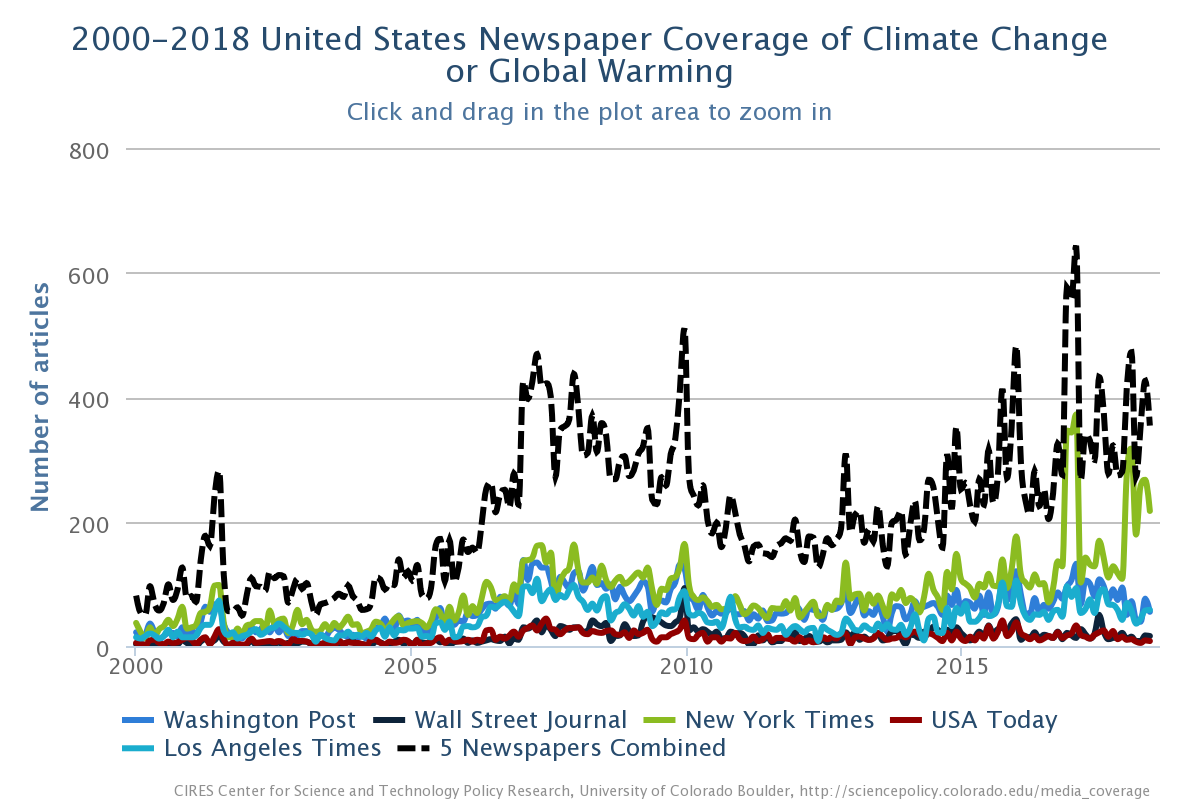
With the help of many sectors, including scientists, economists, business people, the medical community, policymakers and filmmakers, we have been successful in shifting the conversation. Credible journalists no longer cover climate change as a debate and newspaper coverage of climate change has increased since 2000. Climate change is more regularly integrated into mainstream reporting, and prominent news outlets like the New York Times have increased their team specifically reporting on climate change. Yet there is still much work to be done — in the U.S., there has been no clear increase in television coverage of climate change since 2000. Today, the Trump presidency has created an effect dubbed "Trump Dump", where media attention that would have focused on other climate-related events is now focused on Trump's actions and leaves other important climate stories untold.
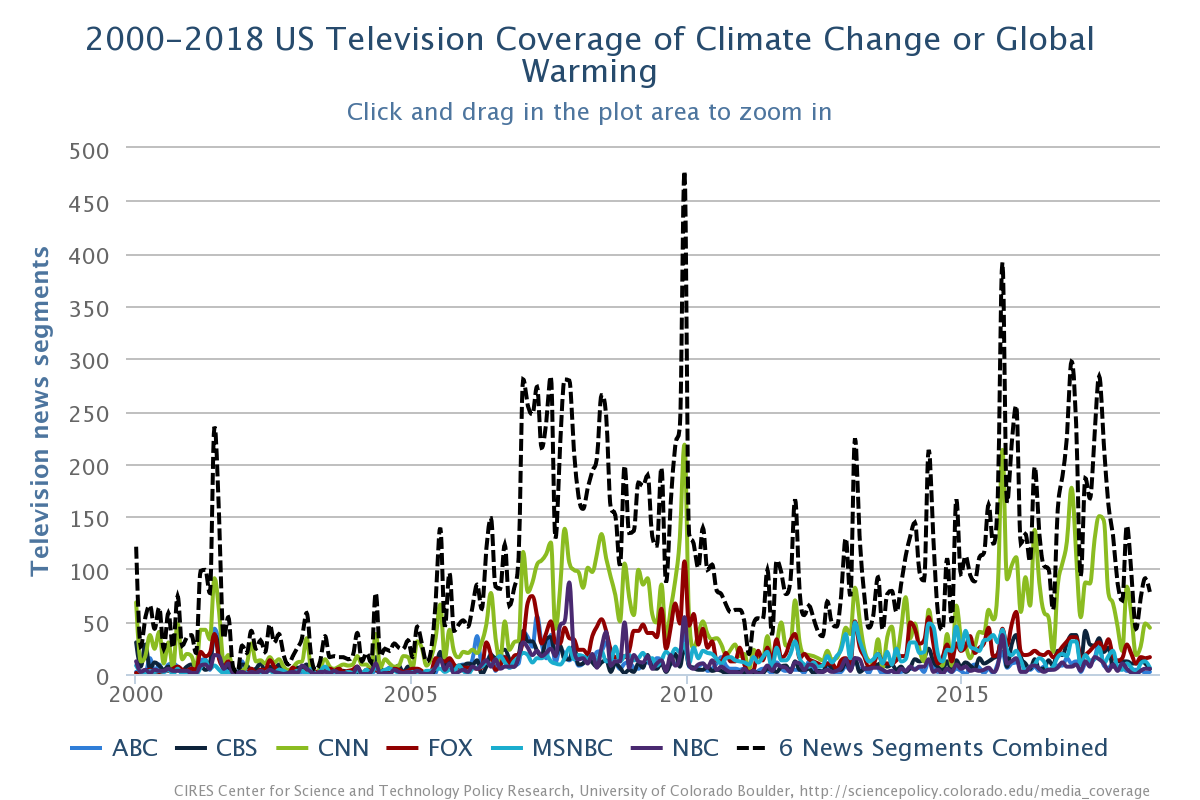
As with any message, a simple one that is repeated often is what resonates. This is especially true for climate change, which is proving to be such a "wicked" problem to solve. Good climate coverage that links everyday experiences to climate change, presents robust solutions and provides an audience with a visceral experience that leaves a lasting impact is needed now more than ever. This, in turn, can establish greater awareness and recognition of both the threat and the solutions, ultimately generating the public will and political and market action necessary to change the course we're on. The transition to a new media environment continues, and Climate Nexus aims to leverage these to help people recognize the immediacy of the climate threat and the salience of the solution.
WhoIs:
Courtney St. John is the co-director of the Energy Transition team at Climate Nexus, a non-profit strategic communications firm focused on climate and energy issues. Courtney has extensive experience working on climate change issues, including posts in academia and for the U.S. Navy's Task Force Climate Change.
]]>When you add everything up, efficiency hits the trifecta of awesomeness:
I know what you are thinking — sounds like the tooth fairy. But the good news is that efficiency is entirely realistic as long as policymakers and regulators treat efficiency as a real resource.
Traditionally, efficiency has been treated by states like a public benefit subsidy rather than as a resource. Somewhat arbitrary — but impactful — efficiency goals were set by policymakers in the form of Energy Efficiency Portfolio Standards ("EEPS") and similar policies that drove the development of efficiency "programs" measured by way of benefit-cost analyses. In other words, policymakers told utilities to spend a set amount of money as long as certain goals were met in a cost-effective manner.
While this traditional approach has enabled many states to reap the benefits of efficiency, it has limited the potential of efficiency as an economic energy resource on par with utility procurement of natural gas, coal, and other traditional sources of energy production. In other words, we could be doing a lot more if we treated efficiency as a real energy resource rather than just a policy goal.
So what would a policy that treats efficiency as a resource look like? The key is redirecting a portion of the billions of dollars that are being spent on new poles, wires, and expensive energy toward insulation, air sealing, and smart appliances that improve quality of life by improving building occupant health and comfort, reducing energy and carbon usage, and are cheaper than current energy outlays. Oh, and this kind of energy policy would create a ton of good, local jobs as well.
Currently, efficiency spending is largely divorced from capital investments associated with energy system planning and load forecasting, and when it is included, it is often heavily discounted. This leaves utilities relying on traditional capital investments and energy procurement, whether they purchase fossil fueled power or green energy, to meet the needs of the electric grid.
So what are the barriers to treating efficiency as a resource? Typically, there are three primary challenges:
Efficiency Not Metered
The first challenge can be overcome by advanced analytics that more granularly isolate the impacts of efficiency upgrades by taking into account all of the data available. Con Edison, in its Brooklyn Queens Demand Management ("BQDM"), for example, leveraged predictive analytics and other advanced data strategies to treat and invest in efficiency as a Non-Wires Alternative ("NWA"), going past traditional "measurement and verification". Efficiency, in fact, is expected to make up ~60% of the total NWA resources procured through 2026.
New approaches to energy savings calculations via metered data (sometimes called "M&V 2.0") and organizations like the Investor Confidence Project are enabling utility-grade savings that can be compared apples-to-apples with traditional utility spending. My company, Sealed is doing its part with predictive analytics that demonstrate sufficient accuracy to receive a residential energy savings insurance policy, showing that the private market can absorb performance risk with investment-grade energy savings predictions.
Efficiency Will Happen Anyway
The second challenge is more existential. Some argue that efficiency is low-hanging fruit and, therefore, does not need any additional utility investment. In other words, since efficiency is already going to happen — why invest it in like a resource?
While some efficiency activity is low-hanging fruit — and a lot of it is already occurring — neither the grid nor the planet knows or cares if energy savings would have happened "anyway" and, importantly, neither can afford to wait. Policymakers and regulators need to get comfortable with the idea that ratepayers will spend less than what is being spent on supply and infrastructure in the status quo, but more than they "should" in a perfect command and control system.
While rate design is an imperfect science, it is clear that if a customer installs insulation, leading to a permanent peak load reduction, such a peak load reduction is an "externality" benefit, which helps all ratepayers, not just that customer. Keep this in mind: efficiency is a permanent load reduction, and therefore in many ways even more valuable than more sophisticated technologies such as energy storage.
What this means in practice is that a true "negawatt" market enables all achievable efficiency to be compensated based on the value of peak capacity reductions, avoided distribution spending, the social cost of carbon, as determined by state policy, and any other "externality" benefits that are defined by state policy. Simply put, it means paying a fair value for the benefits created.
Efficiency Not Tied to Specific Cost Reductions
The third challenge is the most difficult, but it is a familiar problem faced by all utility regulators. As a distributed energy resource ("DER"), efficiency is, well… distributed. While efficiency from an individual building usually cannot tied to specific cost reductions, efficiency can operate on a massive scale, with the ability to fundamentally change the trajectory of peak capacity and infrastructure needs in any given service territory.
Unfortunately, utility capital planning is necessarily based on projections for peak energy usage and costs, including energy and transmission equipment. And like most projections, those made for capital planning purposes are often wrong, sometimes spectacularly so. None of this is a reason to fundamentally change the utility planning process — it is a natural challenge of a regulated monopoly business model. But there is no reason to continue the double standard that efficiency (and other DERs) experience when it comes to calculating future expenditures.
It is always better to be more accurate in making projections for capital planning — smart meters and similar technologies help with this — but we mustn't throw out the proverbial baby with the bathwater. The only difference between traditional utility spending and efficiency investments is that the worst-case byproduct of efficiency is lower energy bills, local jobs, and a cleaner planet.
It should come as no surprise that the data shows efficiency has a huge impact. Here in New York, for example, electricity demand projections for 2016 were reduced by 13% between 2008 and 2016, with efficiency identified as a key driver. And efficiency, when combined with solar and other clean behind the meter resources, is expected to reduce peak load increases by an order of magnitude, from 0.73% per year to 0.07% per year, according to the NY ISO. Efficiency represents the bulk of this impact, more than double that of solar and other behind-the-meter resources combined.
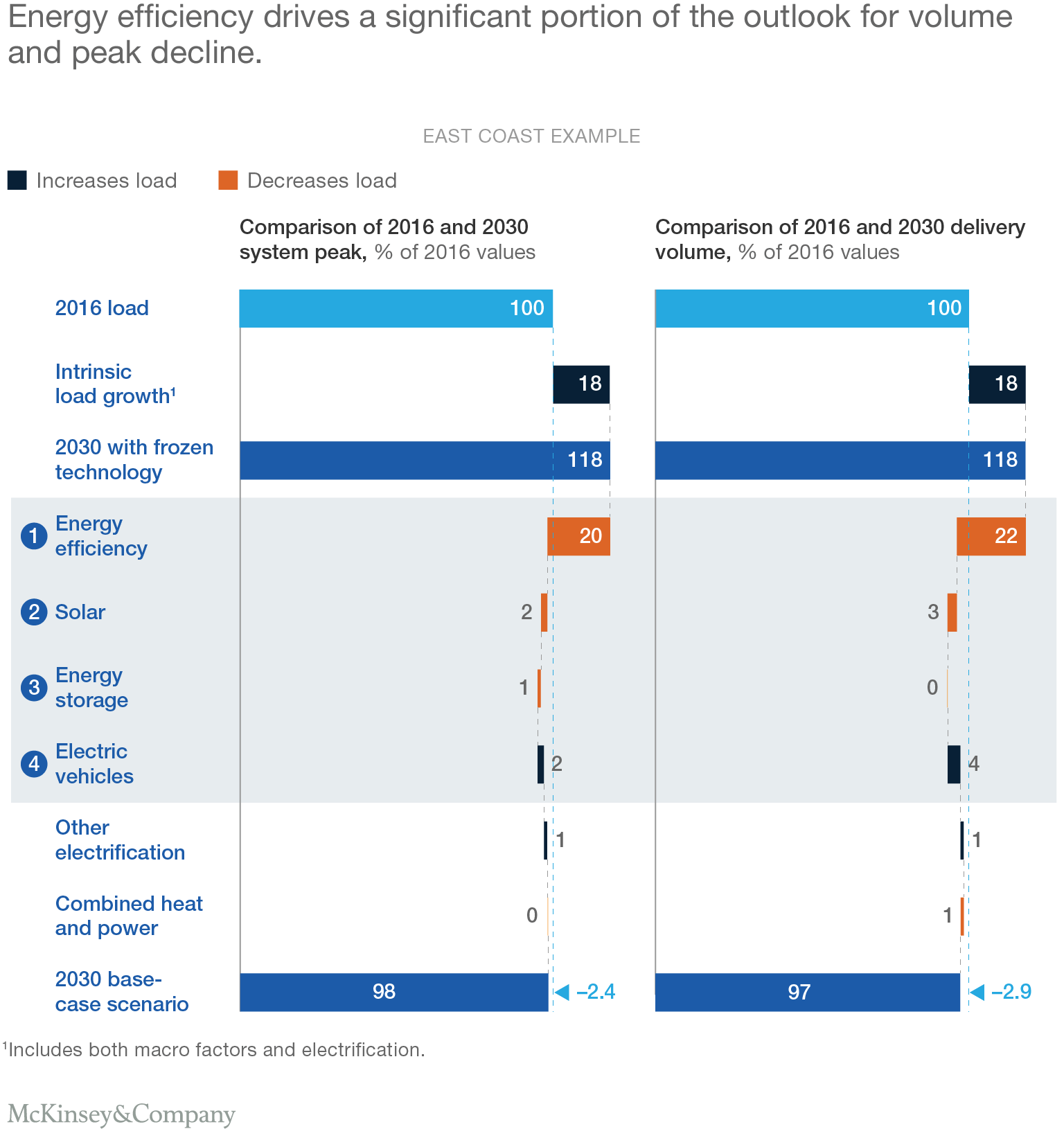
In California, the impact is even more dramatic, with efficiency and other DER avoiding $2.6 billion in transmission costs. And McKinsey estimates that efficiency will drive the vast majority of load reductions between now and 2030 (an order of magnitude more than solar), essentially offsetting all of the intrinsic growth (including electrification) and then some.
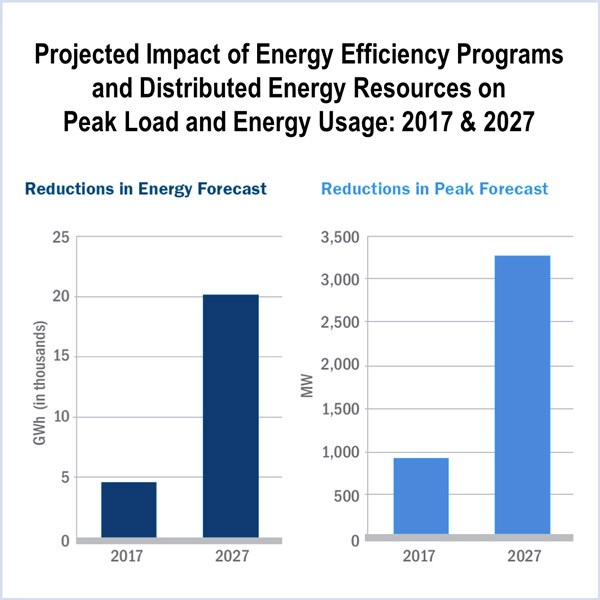
The benefits of efficiency will be realized only if efficiency is treated as the resource that it is. Policy reforms like New York's Reforming the Energy Vision ("REV") hold the potential to fulfill efficiency's potential, but only if pre-existing biases and old ways of thinking can be overcome. Efficiency can be simple, cheap, and plentiful, but only if is treated as a valuable resource.
The good news here in New York is that this vision may soon be a reality. Governor Cuomo will be announcing a significant efficiency policy commitment for Earth Day 2018. Based on the most recent New York Public Service Commission ("PSC") order, this commitment is likely to include a mechanism to value efficiency as a resource. A commitment to treat efficiency as a resource would be game changing, with the potential to dramatically reduce customer bills and the electric power supply's carbon impact. Stay tuned.
WhoIs:
Andy Frank is the Founder and CEO of Sealed, an energy and financial technology company that finances home upgrades with energy savings, enabling customers to affordably lower their environmental impact. Andy served on the Energy Efficiency Procurement & Markets ("EEPM") committee of the New York Reforming the Energy Vision ("REV") Clean Energy Advisory Council ("CEAC") that provided recommendations on efficiency policy to New York policymakers. Andy has a B.S. in Environmental Science & Public Policy from Harvard University.
]]>The social cost of carbon is a key environmental concept that assigns a monetary value to the economic damages caused by each new ton of greenhouse gases emitted into the atmosphere. This concept, which was supported by President Obama as a way to reduce greenhouse gas emissions, is now being undermined by the Trump administration as part of its overall strategy to eliminate as many restrictions as possible on fossil fuel extraction and consumption.
]]> In 2009, the Obama administration established an Interagency Working Group on the Social Cost of Carbon, comprised of officials from several federal government agencies, to establish uniform estimates of the social cost of carbon that were finalized in 2010. The Obama Administration's EPA website page, The Social Cost of Carbon: Estimating the Benefits of Reducing Greenhouse Gas Emissions, which the Trump administration archived,* explains that this concept is "meant to be a comprehensive estimate of climate change damages and includes changes in net agricultural productivity, human health, property damages form increased flood risk, and changes in energy system costs, such as reduced costs for heating and increased costs for air conditioning."As Michael Greenstone and Cass R. Sunstein relate in their December 2016 New York Times Op-Ed, Donald Trump Should Know: This Is What Climate Change Costs Us, the social cost of carbon was incorporated in cost-benefit analyses of regulations to limit greenhouse gas emissions, such as "energy-efficiency rules for refrigerators and washing machines, fuel-economy rules for cars and trucks, and the Clean Power Plan, which requires reductions in greenhouse gas emissions from existing power plants." Greenstone and Sunstein describe the social cost of carbon "as the linchpin of national climate policy" that became a requirement in 2008 when "a federal court of appeals ruled that the government essentially had to specify a social cost of carbon: It was not permitted to ignore harm from climate change, the court said, when setting regulatory policy."
The Interagency Working Group set the social cost of carbon at $21 per ton in 2010 and $36 per ton in 2015 with a projected increase to $69 per ton by 2050. As a FAQ prepared by the National Resource Defense Council (NRDC), the Environmental Defense Fund (EDF), and the Institute for Policy Integrity at NYU's School of Law explains, these estimates are based on Integrated Assessment Models (IAMs) that link together a global climate model and a global economic model, but IAMs do not include all damages from climate change: "The models used by the Interagency Working group omit several types of climate impacts; these omissions are often due to a lack of monetary damage estimates for many climate impacts to integrate into these underlying models. Some of the omitted damages are the effects of climate change on fisheries; the effects of increased pest, disease, and fire pressures on agriculture and forests; and the effects of rising sea levels and resource scarcity due to migration."
In his 2014 article, Omitted Damages: What's Missing from the Social Cost of Carbon, Peter Howard provides a detailed analysis of damages that should be included in the social cost of carbon. Moreover, with the acceleration of climate change, the accurate monetization of damages will become increasingly challenging. As Brad Plumer points out in his February 23, 2018 New York Times article, What Land Will be Underwater in 20 Years? Figuring It Out Could Be Lucrative, insurance companies, in particular, are developing new methods of data collection and analysis for predicting financial risks from climate change, such as rising sea levels.
One hundred and fifty proposed and final regulations incorporated the social cost of carbon during the Obama administration, which also highlighted the increasing costs of climate change by publicizing scientific reports on climate change impacts and the benefits from reducing greenhouse gas emissions.
The 2014 National Climate Assessment report describes how climate change is now affecting all regions of the U.S. and all sectors of the U.S. economy: agriculture, transportation, and more. Similarly, the 2015 E.P.A. report, Climate Change in the United States: Benefits of Global Action, which is based on data collected by the E.P.A.'s Climate Change Impacts and Risk Analysis (CIRA) project projected the costs of climate change impacts in over 20 sectors including health, infrastructure, water resources, agriculture and forestry, and ecosystems. As Coral Davenport reported in, E.P.A. Warns of High Cost of Climate Change, the agency concluded that initiatives to limit global greenhouse gas emissions to 2 degrees Celsius could result in a variety of savings, including an estimated overall "$200 billion in savings to the American economy by 2100" and a "40 percent to 59 percent reduction in probability of extreme drought, which would otherwise cost American farmers $2.6 billion to $3.1 billion."
In a September 8, 2016 videotaped interview with New York Times reporters Coral Davenport and Mark Landler, Obama on Climate Change: The Trends are 'Terrifying', President Obama described the "terrifying" trends built into climate change and his initiatives to communicate these trends to the American public. As he stated: "What we know is that if the current projections, the current trend lines on a warming planet continue, it is certainly going to be enormously disruptive worldwide."
Over the past year, these trends have become increasingly terrifying — not only because of recent reports on the acceleration of climate change and its impacts, such as the June 2017 National Climate Assessment Report and the October 2017 report issued by the U.S. General Accounting Office, but also because we now have a president who denies the science of climate change and is promoting fossil fuels over renewable forms of energy.
The Trump administration's intensive efforts to undermine the validity of the social cost of carbon began during the transition period, even before he became President. In December 2016, Trump's transition team sent a 74-point questionnaire to Obama administration Department of Energy (DOE) managers requesting the names of employees involved in developing policies on climate change, including "a list of all Department of Energy employees or contractors who have attended any Interagency Working Group meetings" as well as information about when these meetings were held and e-mails related to the meetings. Soon afterwards, in March 2017, the Trump administration issued an executive order to disband the Interagency Working Group on the Social Cost of Carbon.
Federal agencies are still required by law to use the social cost of carbon in cost-benefit analyses; however, these agencies must now consider the domestic rather than the global impacts of climate change, and the social cost of carbon has been reduced from $36. to only $1 per ton.
Seven Senators are challenging Trump administration policies on the social cost of carbon. In December 2017, Senators Sheldon Whitehouse (D-RI), Michael Bennet (D-CO), Jeff Merkley (D-OR), Ben Cardin (D-MD), Elizabeth Warren (D-MA), Kamala Harris (D-CA), and Dianne Feinstein (D-CA) wrote a letter to the Government Accountability Office (GAO) requesting a review of the Trump administration's reduction of the social cost of carbon to $1 per ton and how it is considering the repeal of government regulations that incorporate this concept, including the Obama Administration's Clean Power Plan that focuses on power plants — the main source of greenhouse emissions in the U.S. Incorporating a $36. per metric ton social cost of carbon in its cost-benefit analysis, the Obama administration concluded that the plan would result in up to $29 billion in benefits by 2030 compared to $8.4 billion in costs.
Several states are charting an independent path from the federal government. In his August 14, 2017 article, States Are Using Social Cost of Carbon in Energy Decisions, Despite Trump's Opposition, Peter Fairley describes how regulators in Minnesota, Colorado, Maine, and Nevada have used the social cost of carbon in evaluating proposals for new power plants. In 2014, for example, the Minnesota Public Utility Commission selected "the 100 megawatt solar project, proposed by Edina, MN-based Geronimo Energy, even though it cost 'half a percent' more to build and run than the gas-fired competition. The state's Public Utility Commission (PUC) cited several countervailing factors favoring Geronimo's project, including the social cost of carbon analysis." In this same year, Minnesota became the first state where its PUC used the social cost of carbon "to compensate rooftop solar panel owners who feed low-carbon power in the grid." Fairley concludes that the social cost of carbon may have more of an impact than cap and trade in reducing greenhouse gas emissions "because social cost of carbon estimates are typically higher than carbon market prices. While states are using a variety of values for a social cost of carbon, most are above $40 per ton — about three times higher than recent carbon prices on the California market."
As I describe in my 2017 article, Renewable Energy Initiatives in New York City, Council Member Costa Constantinides, the chair of the Committee on Environmental Protection, has introduced two bills for renewable energy that incorporate the social cost of carbon in determining cost-effectiveness. Intro 0609-2015A mandates identifying buildings appropriate for geothermal systems and requires taking into account the social cost of carbon in determining the cost-effectiveness of installing a geothermal system. The cost is initially set at $128 per metric ton with increases on an annual basis. The City Council passed this bill, which was signed by Mayor de Blasio in January 2016. Similarly, Intro 0426-2018 requires a feasibility study of the costs of installing solar water heating and thermal energy systems on city-owned buildings, and it mandates the installation of these systems when it is cost effective. This bill was reintroduced in 2018 during the current City Council session. The social cost of carbon in both bills increases over time with the acceleration of climate change and the projected costs of its future impacts.
These efforts illustrate how the social cost of carbon provides an important financial metric for facilitating renewable energy when a cost-benefit analysis and/or competitive bidding process is required, This concept will acquire a new importance as a result of the tariffs imposed by the Trump Administration on solar panels, which may increase the cost of utility-scale solar power projects by 10 percent.
However, whenever possible, either by state legislatures or PUC's, utilities should be mandated to transmit electricity from renewable sources. In New York State, the Public Service Commission's Clean Energy Standard ruling in 2016 requires all utilities in the State to distribute 50% of their electricity from renewable sources by 2030 and utilities that do not meet this mandate will be fined. Environmental organizations, such as the Sierra Club, are advocating for the PSC to increase this percentage at regular intervals until we reach 100% electricity from renewable sources.
Endnote:
[*] The Trump administration has archived Obama administration E.P.A. website pages which now appear with this explanation: "This is not the current EPA website. To navigate the current EPA website, please go to www.epa.gov. This website is historical material reflecting the EPA website as it existed on January 19, 2017. This website is no longer updated and links to external websites and some internal pages may not work." When I looked up the Trump administration's website, I was directed to a new epa.gov website with this statement: "We've made some changes to EPA.gov. If the information you are looking for is not here, you may be able to find it on the EPA Web Archive or the January 19, 2017 Web Snapshot."WhoIs:
Lisa DiCaprio is the Associate Director of Curriculum and a Clinical Associate Professor of Social Sciences in the Division of Applied Undergraduate Studies in NYU's School of Professional Studies. She is the Conservation Chair of the Sierra Club NYC Group and a member of the Energy Committee of the Sierra Club's Atlantic Chapter. Lisa advocates for environmental legislation in the New York City Council and has published articles on a wide variety of sustainability topics. Her most recent article, High-rise Passive House in NYC, appears in the Fall 2017 issue of the Sierra Atlantic, the publication of the Sierra Club's Atlantic Chapter.
]]>However in Germany, as well as in the rest of the European Union (EU), states' authorities are derived from their federal governments, rather than directly and independently from their Constitutions. In addition, the EU dictates many standards and rules related to climate and energy that the federal governments on down must follow, leaving even fewer tools for subnational governments at their disposal. With that legal context, it was eye-opening to see how German states, with their resources and intellectual capacity, play a significant leadership role. For example, Baden-Wurttemberg as the co-founder with California of the Under2 Coalition, which has become especially important in the subnational arena. Yet the same restrictions on German cities and states' decision-making authority on climate and energy would be disastrous for U.S. cities and states in these days of retrenchment from Washington; as such, the flexibility and independence built into the U.S. system is a real advantage.
A big upside of centralized policy-making is that the German government provides significant funding to local and state governments to carry out EU and national policies at the local level. Implementation appears to be more uniform. For example, multi-modal transportation like bike sharing and lanes are well-subsidized, as is public transportation, which was consistently high performing and well-planned to reach myriad urban neighborhoods. In addition, the German government supports robust research and development at the university and private levels. German federal funding even extends to local climate and sustainability NGOs and think tanks, whose budgets are subsidized by the national government rather than relying as heavily as their U.S. counterparts on foundations and other types of fundraising. More surprising was that the funding is considered almost as of right even for organizations who oppose certain federal policies whether through their publications or public protests. No one I spoke with claimed to feel any interference from the federal level to curb their opposition activities.
As I described initiatives and policies underway in New York City and State, however, many of my German hosts and colleagues were surprised at how much discretion we have, and at how decentralized the policymaking can be here. They were also surprised at the independence of our private sector, and how the drive for profit leads to the growth of solar and wind in New York and red states such as Iowa and Texas, regardless of climate skepticism from politicians. As their system is so centralized, they assumed ours is much the same, which led them to believe that the pronouncements coming from our federal government meant that all states and cities had no choice or flexibility to create their own policies on climate and energy.
For example, New York's policy levers to meet 80x50 greenhouse gas emissions targets, such as REV and OneNYC, were seen as wholly original and one-off, unlikely to be generated with our counterparts in Germany at the same level of local authority and capacity to carry out policies if they were not in line with federal and EU policies. Another example German officials raised was local building energy codes — in their case they are set by the EU, rather than at the local level, and so cannot be set at the local level to promote local goals (although these codes are generally tough in any case).
In addition, my hosts and counterparts were surprised that in the U.S. the private sector by and large decides where to spend their own capital with little interference from the federal government. The German government and private sector seem to be more intertwined when it came to how to invest and plan on the industrial side. For example, past robust government subsidies for R&D are now being re-evaluated as Germans believe that much of their technology was stolen for the benefit of other governments with less stringent intellectual property regimes. Solar panels were cited more than once.
In addition, my German counterparts were largely unfamiliar with the dynamics of onshore and offshore wind developments in the U.S., including how even Texas has come to develop its wind resources to be such a significant part of its electricity mix, regardless of red and blue politics. They were surprised that the independence and strength of our private sector meant that if there was profit to be made, even green energy could move forward regardless of Washington rhetoric, so long as tax and other incentives were in place. Little news reaches them through their media about U.S. local and state climate and energy policy, and thus they had the impression that Washington pulling out of the Paris climate agreement prohibited states and local entities as well as the private sector from following their own course.
As in New York, nuclear power and distribution of clean energy are big issues in Germany and in many of the same ways. For example, Germany is phasing out its nuclear power plants as we are phasing out Indian Point, yet low-carbon energy sources are not yet in place at the same scale. In fact, unlike in the U.S., German energy generation still relies on the coal industry, with about 37% of its gross power production from coal in 2017. For all the strong support of the Paris climate goals, the reality is that the Merkel government has already acknowledged that it likely will not be able to meet its greenhouse gas reduction goals on time.
Embed from Getty ImagesOne strategy for their federal government is to sell coal to Eastern Europe and the Ukraine, while buying nuclear energy from France — a strategy that may lower their national emissions but does not necessarily help with worldwide goals. The Energiewende, the comprehensive and impressive federal plan to transform the national energy system to all renewables, however, is a high priority for the Merkel administration, with significant resources devoted to innovation and implementation of its goals.
Some of their obstacles are familiar to New Yorkers: the bulk of energy generation is in the less populated and more rural north, while the loads are in the south, in the heavy manufacturing areas of Bavaria. Like New York, German transmission capacity from north to south is not fully adequate for future demand and the development of green energy, and they also have their own NIMBY issues of opposition to building more lines. And while we do not hear much of their climate skeptics, they do exist and are vocal during elections, though not at the same scale as in the U.S.
Overall, I found a great deal of interest and appreciation of New York State and City climate and energy initiatives. We share with our German colleagues a common determination and urgency in moving forward, a belief that success is possible and will boost the economy, and a hunger for information, technology and innovative strategies from any source to meet the Paris climate goals. We should continue sharing.
WhoIs:
Nilda Mesa is the Director of the Urban Sustainability and Equity Planning Program with Columbia University's Urban Design Lab in the Earth Institute, as well as an adjunct professor with the School of International and Public Affairs. She served as NYC Director of the Mayor's Office of Sustainability under Mayor Bill de Blasio, where she directed climate, energy, and other initiatives including OneNYC, the city's long-term sustainability plan. Previously she served in the White House Council of Environmental Quality, the U.S. Air Force, the U.S. Environmental Protection Agency, and the California Attorney General's office. She is a graduate of Harvard Law School.
]]>